


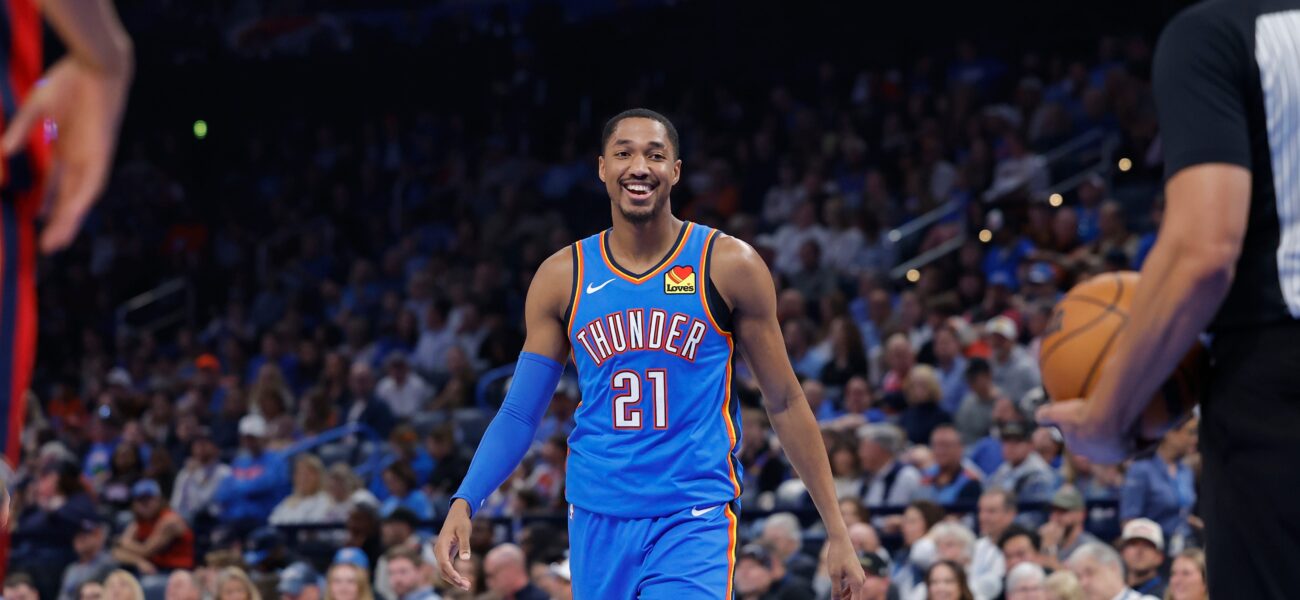
The Cold Equation of Rings: OKC’s Championship Cost, Paid in Human Capital
POLICY WIRE — Oklahoma City, USA — The confetti barely settled. The echoes of a championship parade, that delirious, city-wide bellow, still lingered in the Oklahoma air. But then, almost quietly,...

POLICY WIRE — Oklahoma City, USA — The confetti barely settled. The echoes of a championship parade, that delirious, city-wide bellow, still lingered in the Oklahoma air. But then, almost quietly, like a cleaning crew tidying up after a raucous party, the true costs begin to emerge. And for Aaron Wiggins, a young man who poured five seasons of sweat into a jersey—culminating in an NBA title, no less—that cost came in the form of an exit visa, traded away for two nebulous future second-round picks. Such is the brutal, unsentimental machinery of victory in professional sports. He was good. They won. But now, he’s gone. It’s simple, really. Brutally simple.
It wasn’t a sudden fall from grace. More a gradual, creeping obsolescence for the 27-year-old. Wiggins, a once unheralded 55th overall pick in 2021, became the poster child for the Thunder’s shrewd developmental system. From two-way contract to certified championship contributor—he even averaged 8.5 points and 3.2 rebounds over his five-year stint—his trajectory was a coach’s dream. An inspiration, they’d say. A credit to hard work. But every inspiring story, in the grand calculus of the NBA, seems to carry a silent expiry date. By the time the playoffs concluded, Wiggins was largely on the outside of OKC’s rotation looking in. His utility, at least in their hyper-competitive framework, had waned.
His parting words, delivered via social media, read like a heartfelt obituary for a career segment. “Thank you for believing in me from day one and always pushing me to be the best player that I can be,” he wrote, a sentiment tinged with a faint, almost imperceptible wistfulness. He mentioned the “ring that we won together is something that can never be taken away from us.” True enough. But a ring doesn’t buy you a permanent roster spot. Not anymore. Not in this league. Especially when ownership has to count the pennies. This move? It saved the team a significant chunk in luxury tax penalties, a tidy sum that would’ve otherwise flowed out the door.
But how much is a championship contributor worth, precisely? For the Thunder, the answer is evidently less than the sum of those tax savings and whatever hazy potential lies in two future second-round selections. Because money, you see, matters. It always does. “Aaron’s contributions to our championship were extraordinary,” a high-ranking Thunder official, speaking anonymously due to internal policy against commenting on individual trades, reluctantly conceded. “But sustained organizational health often requires difficult strategic adjustments. We’re always building for the next decade, not just the next season.” The pragmatism is almost chilling.
And it’s a chilling echo of countless other industries, where skilled workers, once instrumental, find themselves surplus to requirements. From migrant engineers building the glistening towers of Dubai—whose visas and livelihoods often hang by the thread of continuous employment—to these highly visible athletes on global stages, the transactional nature of high-stakes labor often follows the same brutal economics of talent. For them, loyalty, while preached from pulpits, rarely features on a balance sheet. The international flavor of basketball might bring a world of fans, but the economic principles guiding player movement are depressingly universal.
Data from Forbes revealed in 2024 that the average NBA team value crossed the $3 billion mark—a nearly 140% increase over the previous five years—underscoring the immense financial stakes at play. Yet, even amidst such valuations, cost-cutting becomes a priority. Because it’s all about maximizing profit — and minimizing overheads. This wasn’t a case of underperformance; it was a pure fiscal decision, trading a known quantity for abstract future assets and immediate tax relief. That’s capitalism, streamlined — and unforgiving.
What This Means
This trade, like many of its kind, strips bare the often-romanticized notion of sports loyalty. It reminds us that professional franchises, despite their hometown marketing, are ultimately ruthless businesses operating with a bottom-line mentality. Winning a championship? A fantastic achievement, certainly, a narrative triumph. But even that comes with an invoice, often paid by the players who were instrumental in earning it. For Oklahoma City, their fiscal discipline ensures future flexibility, potentially setting them up for another dynastic run. But what does it say about the human element? It tells us that an athlete’s peak contribution might just be a finite commodity, to be optimized and then, without much ceremony, jettisoned when more cost-effective options arise. And because this isn’t an isolated incident—it’s standard operating procedure across professional sports—it offers a stark lesson: talent can be celebrated, but it can also be commodified and discarded. Loyalty is an optional extra, rarely an immutable policy. Fans, they’ll grieve for a bit, then shift their affections. The show, as ever, must go on.