


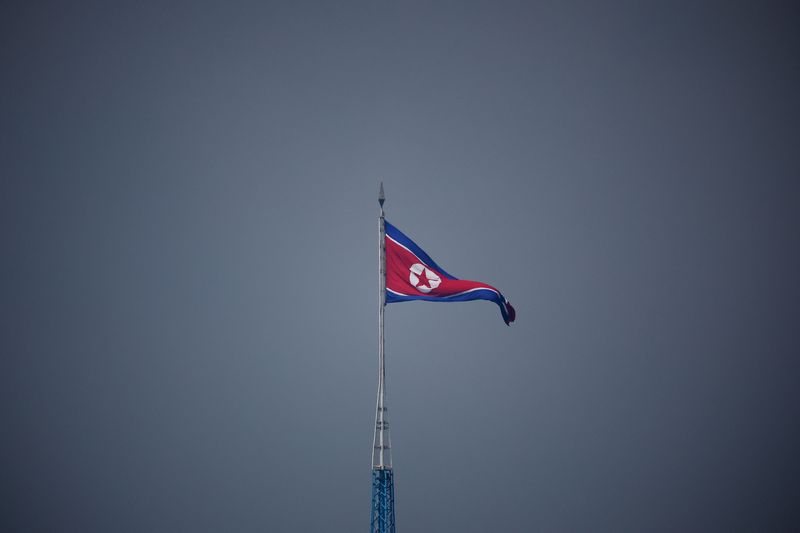
Pyongyang Rattles Regional Order: Tokyo’s Imperial Ghost Looms Large, State Media Warns
POLICY WIRE — Pyongyang, Democratic People’s Republic of Korea — In a pronouncement that hardly registered a seismic tremor on the global Richter scale of provocation, but nevertheless holds...

POLICY WIRE — Pyongyang, Democratic People’s Republic of Korea — In a pronouncement that hardly registered a seismic tremor on the global Richter scale of provocation, but nevertheless holds potent implications for regional stability, North Korea’s state media has once more cast Tokyo in the unflattering light of an unrepentant aggressor. They weren’t mincing words—or so we’re told. The dispatch wasn’t focused on the latest missile test or another tit-for-tat over maritime boundaries, but rather on the more ethereal, yet politically charged, concept of historical narrative. It’s an old tune, sure, but sung with renewed vigor — and a particular target.
Instead of new weapons programs or a thinly veiled threat against South Korean-U.S. exercises, the Kim regime’s propagandists decided it was a good time to exhume historical grievances. You know, just another Tuesday in Northeast Asia. The gist? That [QUOTE_PLACEHOLDER] That specific turn of phrase—echoing through the carefully controlled channels of official DPRK output—isn’t just historical revisionism; it’s a pointed strategic jab at Japan’s contemporary security posture and its burgeoning defense budget. It’s an assertion that despite decades passing, some habits simply don’t die.
This isn’t an isolated incident, not really. Pyongyang’s messaging apparatus consistently leans on these narratives, using the specter of past atrocities to cast suspicion on any modern Japanese rearmament efforts. And Japan’s recent trajectory gives them *some* grist for that mill. Tokyo has been inching away from its post-war pacifist constitution, notably hiking its defense spending to a projected 2% of GDP by 2027 — an ambition largely driven by perceived threats from China and, ironically, North Korea itself. It’s a tricky tightrope, for sure. When you look at the raw numbers, the Stockholm International Peace Research Institute (SIPRI) reported that Japan’s military expenditure in 2023 reached an estimated $50.2 billion, ranking among the world’s highest, signaling a very real shift from its long-held defense-only doctrine. This is something any savvy observer can’t help but notice.
But to attribute modern defensive restructuring to a reawakening of imperialist ambition? That’s quite the leap. Pyongyang’s narrative conveniently ignores the DPRK’s own decades of ballistic missile development and nuclear brinkmanship as primary motivators for Japan’s defense pivot. It’s a classic case of projection—or, at the very least, a cynical manipulation of historical trauma to score geopolitical points. They’re good at it; they’ve been practicing for generations.
The rhetoric—stale yet stinging—aims to sow discord between Japan and its regional partners, especially South Korea, who share a similarly complex history with Tokyo. But it’s also directed outwards, a coded message to powers like the United States: Beware of your allies; they might just be wolf in sheep’s clothing. It’s a calculated attempt to undermine the burgeoning trilateral security cooperation between Washington, Seoul, and Tokyo, a bulwark against what many perceive as a rising authoritarian tide in Asia. It won’t work overnight, obviously. But these persistent whispers can wear at relationships over time. A kind of drip, drip, drip.
And because North Korea doesn’t exist in a vacuum, its messaging often mirrors, or at least resonates with, broader anti-imperialist sentiments across Asia, and sometimes, even in parts of the Muslim world. Historically, Pakistan, for example, a nation deeply concerned with its own regional rivalries and historical narratives, has viewed global power dynamics through a lens sensitive to colonial legacies and potential external aggressions. Though their geopolitical interests differ wildly from Pyongyang’s, the language of resisting ‘imperial’ influence can find distant, if faint, echoes in diplomatic discourse originating from places like Islamabad—especially when it involves criticism of former colonial powers or nations perceived as overly dominant. They might not explicitly agree with Kim’s crew, but the underlying sentiment sometimes aligns in unexpected ways.
📄 POLICY WIRE WHITEPAPER PUBLISHED: PAKISTAN'S NATIONAL SECURITY POLICY PRIORITIES
👉 READ BY CLICKING HEREIt’s worth remembering that for Pyongyang, their external communication isn’t just about truth, it’s about control—control over their domestic populace and control over their international image. But even within that controlled narrative, we occasionally glean what they *want* us to believe about the wider world, and their place within it. They want to be seen as the stalwart defender, standing up to old monsters that others are too weak or foolish to recognize. And frankly, some audiences are predisposed to believe that, even if they don’t buy the whole package.
What This Means
This latest volley from North Korea’s state media is more than just a historical rehashing; it’s a political utility. It provides a convenient smokescreen for their own escalating militarism, deflecting criticism by painting Japan as the perennial bogeyman. It also works internally, buttressing the regime’s legitimacy by portraying external threats as existential—a narrative that demands national unity and obedience. Economically, instability in Northeast Asia never bodes well for global trade, even if the direct impact of such rhetoric is hard to quantify. But the ripple effects on investor confidence and regional supply chains, especially for tech and manufacturing powerhouses like Japan and South Korea, are something to watch closely.
But the irony, and there’s always irony, is that this kind of accusatory finger-pointing by Pyongyang actually solidifies the very alliances it seeks to fracture. When North Korea shouts about historic aggression, it pushes nations like South Korea and Japan closer together, compelling them to coordinate defense strategies against a shared, immediate threat. It forces their hand, really. So while the rhetoric is harsh, its ultimate practical effect might be quite the opposite of its intended goal—another notch in the belt for regional integration. You can almost see Washington’s strategists shrugging, ‘Well, that makes *our* job easier.’
This particular attack on Japan also reminds us that for totalitarian regimes, history isn’t something to be accurately remembered; it’s a flexible tool, molded and remolded to serve present political objectives. And they’ll keep doing it as long as they believe it works. It’s their brutal logic, a cynical calculus. That doesn’t change anytime soon.
📖 GET YOUR FREE COPY NOW OF POLICY WIRE DIGITAL MAGAZINE JULY 2026 EDITION
👉 READ & DOWNLOAD FREE MAGAZINE