


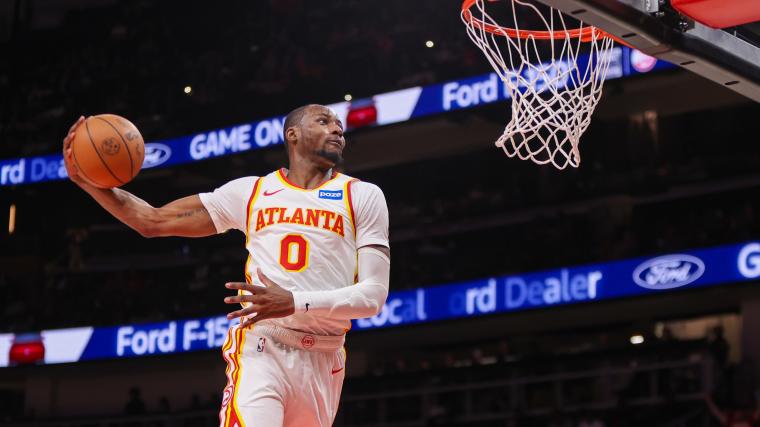
Lakers’ Post-LeBron Gamble: Is Kuminga Their Answer, or Just Another Roll of the Dice?
POLICY WIRE — LOS ANGELES, USA — It isn’t always the departure of a king that causes the most immediate uproar. Often, it’s the sheer, unadulterated scramble among his former retainers...

POLICY WIRE — LOS ANGELES, USA — It isn’t always the departure of a king that causes the most immediate uproar. Often, it’s the sheer, unadulterated scramble among his former retainers that truly captures the imagination, or simply—the spectacle of it all. In this specific theater of the absurd, we’re not talking about palace intrigue in Westminster or Islamabad’s volatile corridors, but the frantic, very public rebuild playing out in the NBA’s perpetually spotlighted realm: the Los Angeles Lakers. LeBron James, that undeniable titan, has packed his bags. And in the vacuum he left, Hollywood’s basketball machine isn’t just looking for pieces; it’s practically ransacking the league’s clearance aisle and auction houses, hoping to snag a forgotten gem. Jonathan Kuminga is their latest fascination, a talent puzzle they seem hell-bent on solving.
Because let’s be honest, the Lakers have been on a bit of a spree. They’ve traded for Walker Kessler, inked Quentin Grimes, Sandro Mamukelashvili, Collin Sexton, — and Kevon Looney. A whirlwind, isn’t it? One might call it an aggressive re-staffing of the palace guard, desperately trying to project strength even as the true powerbroker sails off into the sunset. Now, murmurs from the backrooms indicate a specific kind of flirtation: a two-year, $20 million proposal dangled before the still-developing Kuminga. This isn’t just about talent; it’s about strategy, about market confidence—the kind of fiscal maneuverings that mirror broader economic shifts far beyond a basketball court.
Broderick Turner of the Los Angeles Times broke the story, reporting the Lakers are ‘looking at’ this deal for the former Warrior and Hawk. But it’s not so simple. For a pact like that to materialize, the Lakers don’t just wave a magic wand; they’ll need to shed some salary baggage or engineer a byzantine sign-and-trade with the Atlanta Hawks. It’s a bit like negotiating an international arms deal where every nation involved needs to save face, or at least gain an edge. The Hawks, having already waved off Kuminga’s $24.3 million option for 2026-27, probably wouldn’t mind shipping him off rather than watching him walk for nothing. They’ve got plenty of other young wings littering the roster. Don’t think they’re exactly broken up about it, which, again, speaks volumes about Kuminga’s fit there.
“We’re building a team designed for tomorrow, not just today,” Lakers General Manager Rob Pelinka told Policy Wire, his tone a practiced blend of conviction and weary optimism. “This isn’t about one player; it’s about a philosophical shift. We’re identifying talent, yes, but more importantly, potential. Jonathan’s athleticism and raw skill are intriguing, and we believe in our infrastructure to develop him into something special.” Indeed, it’s a gamble on untapped capacity, a political party bringing in an outsider candidate with an unpolished but enthusiastic base.
Last season, Kuminga showed flickers of that promise. In 16 games with the Hawks, he chalked up averages of 12.3 points, 5.3 rebounds, — and 2.1 assists. But his shooting — 47% from the field and a rather pedestrian 34% from beyond the arc — still hints at inconsistency. Per the official NBA statistics for that season, he’s still very much a work in progress. That said, his frame screams ‘elite defender,’ even if his actual output on that end has mostly been a whispered suggestion. And the Lakers, bless their hearts, currently possess about as much perimeter defense as a leaky bucket. So, naturally, the dream is Kuminga finally becomes that defensive stalwart everyone knows he could be. Hope springs eternal, doesn’t it?
But the real juice here? ESPN’s Anthony Slater recently revealed Kuminga had already had a digital rendezvous with Lakers heavyweights Rob Pelinka and new head coach J.J. Redick. And for what, you ask? To convince him he could thrive alongside one Luka Doncic. Interesting fit. Not sure if it’s ‘perfect spot’ material or simply another frantic roll of the dice in an increasingly unstable situation. “Our vision for Jonathan isn’t about fitting into a preconceived mold; it’s about unlocking his inherent gifts within a winning environment,” Redick explained, exuding the confidence of a coach eager to implement his own blueprint. “We see a player with a unique blend of size — and speed, someone who can disrupt on defense and elevate our pace. It’s going to be a process, but we’re ready for that commitment.” It’s all very diplomatic. He wouldn’t say, ‘we’re desperate for anybody who can guard a broomstick.’
Sometimes, these sports narratives mirror grander geopolitics. Imagine the complex, nuanced dances playing out across the Strait of Hormuz or the diplomatic maneuvering in Central Asia. Each move, each potential acquisition, carries layers of meaning, unspoken risks, and the distant echo of past miscalculations. Betting on a young player’s latent defensive gifts is hardly analogous to nation-building, of course, but the principles of calculated risk, resource allocation, and projecting future strength in an uncertain world? They resonate. Even in a region as tumultuous as South Asia, investment in unproven, yet potentially explosive, local talent represents a similar economic gamble on future stability and prosperity, facing unpredictable headwinds and requiring sustained commitment. Or it’s just Tinseltown making another audacious, star-chasing blunder. We’ve seen enough of those. Either way, it makes for compelling copy.
What This Means
The Lakers’ pursuit of Jonathan Kuminga represents a high-stakes recalibration in the post-LeBron era, moving from a championship-or-bust model to a developmental one with significant inherent risk. Economically, a $20 million, two-year deal for a player still finding his stride is a bet on future appreciation rather than immediate, guaranteed returns. It signals a shift from expensive veteran acquisitions to a ‘buy low, sell high’ strategy, hoping Kuminga’s untapped potential skyrockets under a new system. Politically, this roster overhaul projects both uncertainty — and aggressive repositioning. It demonstrates the Lakers’ willingness to completely dismantle a failed older guard to make way for a younger, athletic, but largely unproven core. If Kuminga flourishes, it validates their scouting and coaching decisions; if he falters, it’s another costly mistake that further complicates their path back to relevance. It’s less about a clean, democratic transition of power and more about an ambitious, perhaps messy, internal coup in the executive suites. The question isn’t just if Kuminga fits; it’s whether the entire institution can finally find stable ground after such a seismic shift.