

Presidential Touch Fails USMNT: World Cup Exit Spurs Political Kickback
POLICY WIRE — Seattle, USA — The stench of defeat hung heavy in the Seattle air, a thick, metallic tang far more bitter than usual. It wasn’t just a 4-1 shellacking by Belgium that sent the...

POLICY WIRE — Seattle, USA — The stench of defeat hung heavy in the Seattle air, a thick, metallic tang far more bitter than usual. It wasn’t just a 4-1 shellacking by Belgium that sent the United States men’s national team packing from the World Cup. Oh no. This particular drubbing, played out on a global stage for all the world to see, came after a highly publicized presidential intervention that — let’s just say it didn’t exactly move the needle for Uncle Sam’s squad.
President Donald Trump, in what many observers characterized as a brazen move, lobbied FIFA boss Gianni Infantino to reverse a red card for star striker Folarin Balogun. The player, sidelined after an altercation in the Bosnia-Herzegovina match, found his ban magically suspended. A global outcry ensued, obviously. Nobody likes to see the rules bent, even for a Head of State.
And what was the President’s take on this diplomatic gamble gone wrong? Before the Belgium game, he mused aloud: If they beat us, they can be really proud. The other way, if they beat us, we’ll say – I’ll say it was rigged, just like the election was rigged in 2020, but I won’t get into that.
A prescient thought, maybe, if delivered with less bombast.
California Democratic Sen. Alex Padilla didn’t mince words after the final whistle, quickly branding the whole messy affair a textbook example of “the Trump effect.” He put out a clip of himself online, scorecard in hand, saying of Trump: He’s like the reverse Midas touch — everything he touches turns to… you know what.
Not exactly a glowing review from the opposition bench.
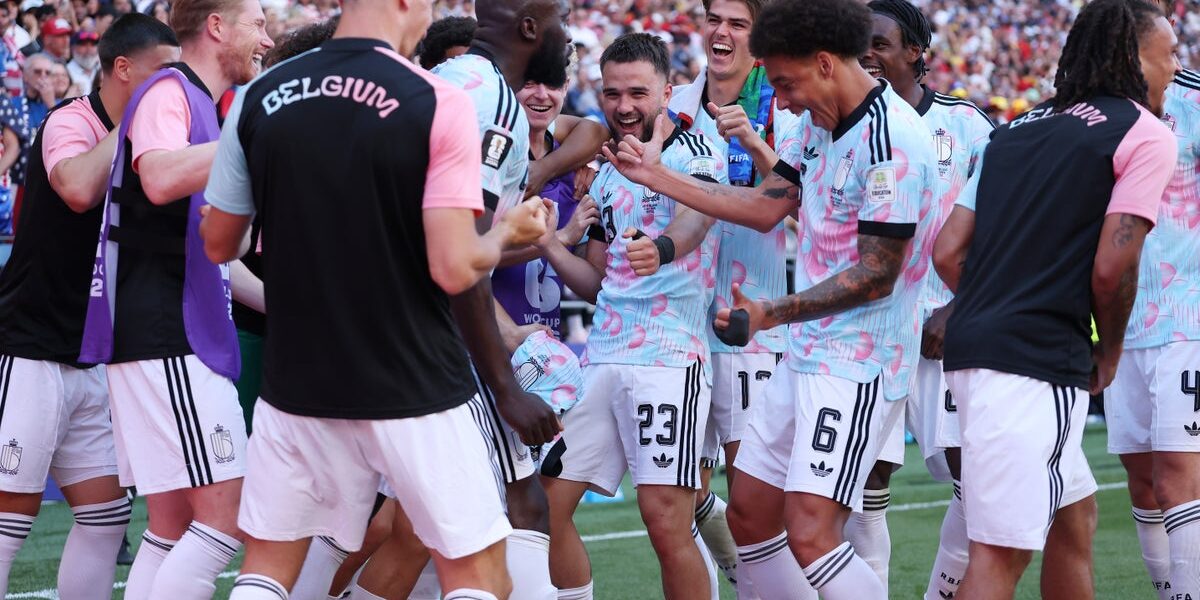
But the political theatre wasn’t confined to Washington’s Beltway. On the pitch, after cementing their dominance, Belgian players appeared to mimic Trump’s distinctive celebratory dance moves. Their official Instagram account later twisted the knife with a photo of striker Romelu Lukaku celebrating, captioned simply: “Overturn this.” The geopolitical message couldn’t have been clearer: some things, even for a president, aren’t for renegotiation. That’s a concept much of the world, especially emerging economies closely observing the delicate balance of global power, understands intuitively.
The U.S., you see, wasn’t just hosting this tournament; it was trying to cement its reputation, to use the beautiful game as a soft power play. But when presidential decrees seem to overrule the referee’s whistle, it starts to look less like diplomacy and more like an attempt to bully. It doesn’t sit well in places like Pakistan, where communities live with the lingering effects of interventions – both subtle and overt – and see international rules as, well, rules. It really muddies the waters for developing nations hoping for a fair shake on the world stage.
Because, for them, institutional credibility matters more than ever. They’re watching how global bodies like FIFA handle external pressure, judging whether the system bends for the powerful, or holds firm for fair play. And when they see what happened here, with an alleged strong-arming that fell flat, it only reinforces perceptions about who truly wields influence.
📄 POLICY WIRE WHITEPAPER PUBLISHED: PAKISTAN'S NATIONAL SECURITY POLICY PRIORITIES
👉 READ BY CLICKING HEREThe mockery didn’t stop at the field. Online, the ‘Republicans Against Trump’ account joked about the President slapping Belgium with 6,000 percent tariffs as retribution. Podcaster Spencer Hakiman, with dark humor, quipped: “JUST IN: Trump says Belgium is 2 weeks away from developing a nuclear bomb.” Lawyer Adam Cohen pointed out that the President had also presided over a New York Knicks NBA Finals loss, attending the game only for his team to go down. Everything. Trump. Touches. Dies – so went the collective digital gallows humor. It’s hard to imagine that’s the message the administration wanted to project internationally.
Even before kick-off, commentators sensed the potential for humiliation. Brian Krassenstein said it just showed how “everything he touches is delegitimate crap,” foreshadowing that anything the USMNT achieved would now be “questioned.” Geopolitics expert Cyrus Janssen rightly dubbed it a “lose-lose situation,” stating: We beat Belgium and the victory will be tainted as we needed our President to cheat to help us win. If we lose than even our President cheating couldn’t help us win.
State governors Gavin Newsom — and Kathy Hochul tried, somewhat awkwardly, to pivot the narrative to team effort. Newsom lauded the thrills, the joy, and the belief these last few weeks.
Hochul chimed in that the team left it all on the field tonight and showed the world what we’re made of.
— To which, one pundit caustically rejoined: We must have watched different games.
Ouch. Meanwhile, the man himself, en route to a NATO summit (a forum where robust diplomacy is usually, shall we say, encouraged), has remained mum on the World Cup debacle, presumably busy with more pressing concerns, or perhaps, simply deleting Truth Social drafts. This kind of presidential non-committal speaks volumes without uttering a word. FIFA, by the way, estimated the 2022 World Cup final alone was watched by 1.5 billion people worldwide; every move here was seen.
What This Means
This incident transcends mere sports news; it’s a telling symptom of the increasing — and often clumsy — intersection of high-level politics and international institutions, especially those built on principles of fair play. The political capital spent to (unsuccessfully) reverse a single red card speaks volumes about perceived impunity. For nations looking to the United States for leadership, such blatant attempts to circumvent established rules undermine soft power efforts and foster distrust. Economically, while a single match won’t break the bank, the ripple effect on brand USA and its perceived reliability as an honest broker in global forums can be considerable. It chips away at the narrative that America respects universal standards, rather than demanding exceptions. It reinforces caricatures, honestly, of the U.S. using its influence to dictate outcomes, an image particularly unhelpful in sensitive regions across South Asia and the Muslim world where political skepticism toward the West already runs high. This misstep isn’t just about a football game; it’s a minor — but painfully visible — diplomatic own goal.