


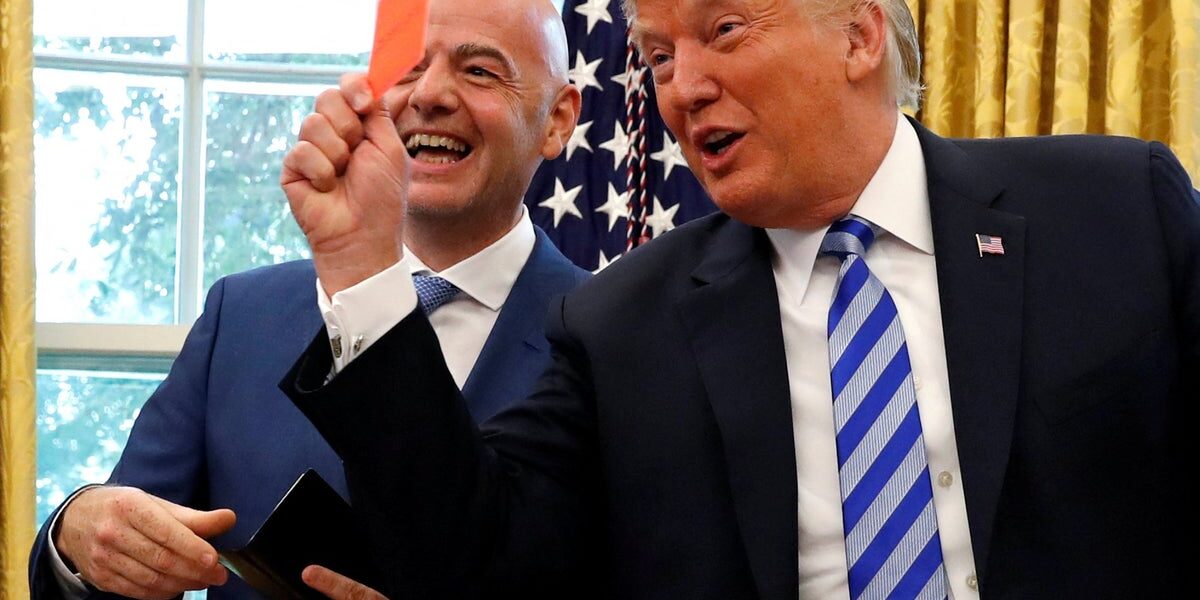
Infantino’s Stained World Cup: A Trump-Sized Shadow Looms Over Football’s Future
POLICY WIRE — Zurich, Switzerland — The beautifully manicured pitches of global football, once seemingly impervious to external meddling, are looking increasingly like a legal battleground. Coaches...

POLICY WIRE — Zurich, Switzerland — The beautifully manicured pitches of global football, once seemingly impervious to external meddling, are looking increasingly like a legal battleground. Coaches are fuming, federations are challenging calls, and the game’s highest echelons are struggling to contain a contagion of controversy. This isn’t just about a dubious handball or a questionable offside anymore. No, this is about an unprecedented precedent – a blatant act of political interference—that’s now inviting a storm of ‘lawfare’ and threatening to unravel the sport’s already fragile integrity.
Many inside the game will tell you that the USA’s recent 4-1 shellacking by Belgium at the World Cup, while embarrassing for American fans, actually shielded FIFA from an immediate, even greater scandal. It muted the most pointed critiques. But don’t be fooled: that game, a spectacle ostensibly about athleticism and tactics, unmasked a far more disturbing reality, revealing an almost brazen political gambit from the White House that’s relegated what happens on the grass to a subplot for high-stakes political theater.
It’s now crystal clear the entire imbroglio spiraled from the disciplinary case involving US striker Folarin Balogun. After FIFA maintained a stubborn, almost comically reticent silence, America’s former President, Donald Trump, couldn’t help but spill the beans himself, effectively throwing FIFA President Gianni Infantino under a brightly lit bus. “I spoke to a man who’s highly respected,” Trump bragged publicly about Infantino, confirming he had personally lobbied the football body for a review. That ‘review’ morphed into a crisis, showcasing a new, dangerous intimacy between the political arena and the sports governing body.
Because that admission – direct, undeniable – blew away any pretense of impartiality. Infantino, for all his perceived eagerness to court powerful figures, couldn’t have been thrilled by the blunt disclosure. The ensuing flurry of panicked press releases from FIFA, after days of radio silence, betrayed a palpable sense of chaos within the organization. “They didn’t have to get involved; there was absolutely no reason for it,” quipped one long-serving European federation official, speaking anonymously due to ongoing disciplinary processes. “Now, they’ve bought themselves a world of grief. They’ve opened a very big door for every single federation to push back.”
And push back they’ve. National federations, eyes now wide open, are scrutinizing every decision. The French are clamoring to overturn Michael Olise’s yellow card. The English FA is ‘considering all options’ regarding Jarell Quansah’s red card. It’s a domino effect, accelerated by a recent surge in arbitration cases. America’s own soccer odyssey, you see, was just the beginning.
FIFA’s hollow insistence that its disciplinary committee is “independent”—a fiction many insiders already dismissed—only compounded the problem. And it also misses the point, doesn’t it? The sheer gall of White House intervention set a precedent, broadcasting that certain nations can influence game outcomes off the field, effectively weaponizing sports diplomacy. Gianni Infantino, often criticized for prioritizing spectacle over substance, attempted to put a placid spin on the episode. “My role is to facilitate positive outcomes and foster a robust dialogue for the beautiful game,” Infantino said in a subsequent press conference, avoiding any direct mention of external lobbying. “Responsive governance, that’s what we deliver.” But few bought it.
📄 POLICY WIRE WHITEPAPER PUBLISHED: PAKISTAN'S NATIONAL SECURITY POLICY PRIORITIES
👉 READ BY CLICKING HEREWhat This Means
The ‘Trumpification’ of FIFA has far-reaching political and economic consequences that stretch well beyond this World Cup, even into regions where football’s global impact is deeply felt. This single incident has demonstrably eroded the foundational principle of sporting impartiality, turning referee decisions—and indeed, judicial processes—into potentially negotiable items for political elites. Think about the implications for upcoming World Cups. Morocco in 2030, Saudi Arabia in 2034—nations with complex geopolitical landscapes and authoritarian streaks. If powerful nations like the U.S. can meddle with the stroke of a phone call, what precedents does this set for how host countries, with their significant financial and political leverage, might exert pressure?
Economically, this climate of instability threatens sponsorship deals — and media rights. Brands rely on the sport’s integrity; inject political machinations, — and you devalue the product. For developing football markets, say in South Asia, where FIFA’s influence and governance models are often imported wholesale, such precedents could undermine nascent efforts to build transparent, merit-based systems. It’s difficult to promote fairness when the global overseer shows itself to be so pliable. We’re witnessing an almost 15% increase in cases brought to the Court of Arbitration for Sport (CAS) involving major federations in the last fiscal year, according to a recent public CAS report – a clear indicator that faith in internal judicial processes is, shall we say, on shaky ground.
This saga has also created a direct, adversarial split within the powerful UEFA bloc, with nations like Norway, Germany, and Belgium lining up in unified outrage. But the ripples extend to the wider Muslim world, where sports are increasingly viewed as tools of soft power and national prestige. The perception of a biased or politically influenced FIFA makes these high-stakes investments riskier. It opens the door to accusations of double standards, potentially politicizing bids, and turning tournaments into geopolitical flashpoints rather than unifying events. FIFA’s future now seems destined for an era of greater legal challenges — and less predictable outcomes. It’s a quagmire of its own making, but one that everybody will now have to wade through.