
Caracas’ Earthquake: Where Class Walls Crumble, And The State’s Grip Tightens
POLICY WIRE — CARABALLEDA, Venezuela — The Caribbean Sea always made a fine backdrop. For years, sleek yachts bobbed in marinas, practically kissing the public housing blocks lining...

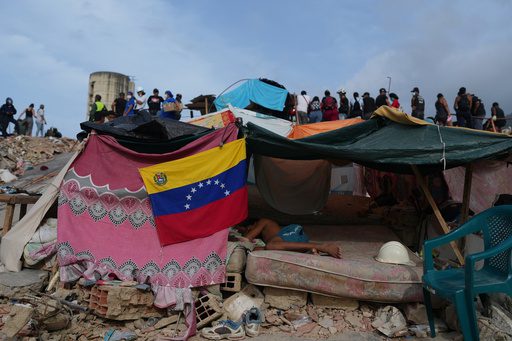
POLICY WIRE — CARABALLEDA, Venezuela — The Caribbean Sea always made a fine backdrop. For years, sleek yachts bobbed in marinas, practically kissing the public housing blocks lining Caraballeda’s curved shore. Rich, poor—they once shared a view, sometimes even a street, a peculiar blend of socialist aspiration and capitalist excess. But when the ground decided to chew up concrete on June 24, something far more sinister than a crumbling landscape emerged: a stark, unblinking portrait of a state that built housing to control, now floundering as its carefully constructed facades — physical and political — fell apart.
It wasn’t a choice, this sudden, involuntary egalitarianism. Just seismic fate. The quakes didn’t care about deeds, about family wealth, or even about the socialist promises etched into the foundations of countless homes. Yachts listing in ruined harbors, alongside pulverized state-subsidized apartments — a grim, leveling act. Roughly 17,000 souls now count themselves among the homeless, survivors in a country already brought to its knees by decades of economic mismanagement. And here they’re, utterly dependent, again, on a government notoriously adept at using housing as a lever, not merely as a right.
Venezuela’s relationship with housing has always been… complicated. Since the mid-20th century, oil money built everything from grand complexes to makeshift “ranchos” – the informal settlements locals built, often expanding skyward. The country became one big housing project. Even after the economy face-planted back in 2013, most folks still had a roof. They got one through direct government handouts, or deep-discounted sales from desperate migrants, or by just occupying abandoned properties. But there’s always a catch, isn’t there? Especially with the state.
Many of those living in housing built by the ruling party, first under Chávez, then by Nicolás Maduro’s administration and currently — in acting capacity — helmed by President Delcy Rodríguez, don’t actually hold the property deeds. That’s a huge deal. Carlos Ortega, who lost most of his family in Caraballeda’s collapsed towers, remembers the “immense joy” when his relatives were assigned homes years ago, a supposed fresh start after a previous mudslide. “They’d lost everything once, then got this home. Now? They’ve lost it all again, some even their lives.” It’s brutal. Just brutal.
His nephew, living on a ninth floor, was lucky enough to be at work, but he’s still missing. Meanwhile, searchers dug through debris near luxury yacht clubs, where cookie-wielding well-wishers offered respite. A chilling tableau, really. Rescuers, sweating — and grim, wading through wreckage that housed both generals’ wives and struggling families. They don’t often mention that kind of detail on the nightly news, do they?
Because that’s the point of these programs, isn’t it? As Ronal Rodríguez, a sharp researcher at Colombia’s Universidad del Rosario, notes, even before Chávez, governments tried to integrate different socioeconomic classes, to blur the lines. But under Chávez’s “Grand Housing Mission,” — and Maduro’s continuation, it morphed. It became less about social good, more about political dependency. “What Chavismo attempts is to keep people tethered,” Rodríguez stated flatly. “They say, ‘If you cross us, if your loyalty wanes, we can take that roof right back.’” The state becomes landlord, overlord, and executioner, all rolled into one.
📄 POLICY WIRE WHITEPAPER PUBLISHED: PAKISTAN'S NATIONAL SECURITY POLICY PRIORITIES
👉 READ BY CLICKING HEREBut the earth didn’t care about loyalty pledges. And now, the survivors, many vocal about the dismal government response, find themselves even more vulnerable. Delcy Rodríguez, the acting president, released a terse statement from Miraflores Palace. “Our resilient Venezuelan people will rise again, as one. The socialist revolution stands shoulder-to-shoulder with every affected family. We won’t abandon them,” she declared, offering precious little in the way of concrete plans or timelines for long-term recovery. It’s the usual rhetoric — all unity, no action. The death toll climbed past 3,500, a chilling number for a region used to hardship but not such swift, broad devastation.
The scale of the wreckage? It’s immense. In Catia La Mar, a city nearby, at least 10,000 structures — a good third of the total — got smashed or damaged. That’s according to satellite imagery pored over by Microsoft’s AI for Good Lab. And this catastrophe serves as a grim warning for other nations with shoddy infrastructure — and seismic risks. Consider places like Pakistan’s densely populated, earthquake-prone areas or Iran’s historic cities. Governments there, like Caracas, often grapple with housing crises, often politicize development, and too often neglect robust, independent building codes. When disaster strikes, the pre-existing cracks in governance become gaping canyons of human suffering.
Folks like Benito Mantilla, 68, are proof. He’s sleeping in a pharmacy parking lot in Catia La Mar, his private home a write-off. His wife left for the Dominican Republic; he’s sticking it out, trying to fix his car repair shop. “It’s what we do here. We just… endure,” he murmured, staring at his meager tent. Caryudedi González, 44, who’d bought her own place at 21, watches half of it slide down a ravine. “Everywhere else, owning a home? It’s a pipe dream. Here, we fight so hard for our own little bit. It just… vanishes.”
What This Means
This isn’t just a natural disaster; it’s a political tremor for Venezuela’s leadership. The immediate aftermath highlights the regime’s consistent shortcomings in managing anything beyond self-preservation. Its response has been lackluster, bordering on negligent. The long-term implications are particularly grim. The forced homelessness of tens of thousands — people who largely depend on the state for housing, even for basic shelter — hands President Rodríguez and her administration an unprecedented level of leverage. It’s not just about rebuilding homes; it’s about rebuilding loyalty, forcing desperate populations back into the orbit of a state that sees provision as a tool for control. This crisis deepens the dependency model that Chavismo perfected. Economically, it adds another crushing burden to an already bankrupt state, promising prolonged hardship and further migration. And because independent media coverage remains stifled, the full truth of the human cost, and the state’s accountability, will likely remain obscured. They say a disaster doesn’t discriminate. But in Venezuela, recovery absolutely does. The tremors have merely exposed an even deeper, more disturbing foundation.