


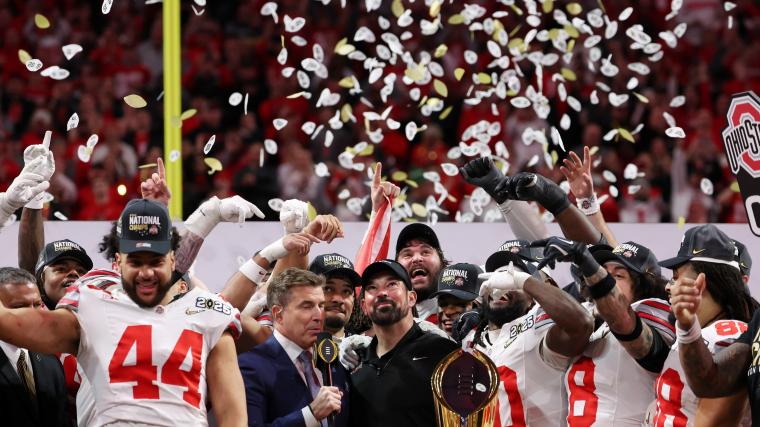
Gridiron’s Fickle Fortune: Ohio State’s Grand Design Faces Prophecies of Disarray
POLICY WIRE — Columbus, Ohio — The titans of modern American sport—college football programs built with quasi-professional fervor and budgets rivalling small nations—are forever dancing on a...

POLICY WIRE — Columbus, Ohio — The titans of modern American sport—college football programs built with quasi-professional fervor and budgets rivalling small nations—are forever dancing on a precipice. For the Ohio State Buckeyes, an institution that regards anything less than absolute gridiron supremacy as a fundamental betrayal, the upcoming 2026 season already presents a familiar, gut-wrenching forecast: immense talent, yes, but a frustrating scarcity of ultimate glory.
It’s not often you hear prophecies of defeat whispered about a team assembled with the precision of a Silicon Valley startup chasing market dominance. And make no mistake, the Buckeyes’ 2026 roster is stacked—absolutely dripping with what NFL scouts euphemistically call ‘pro-ready’ talent. Julian Sayin under center, Jeremiah Smith torching secondaries—these aren’t just college players; they’re blue-chip assets. Yet, the chattering class, particularly CBS Sports analyst Brad Crawford, paints a different picture, one where Ohio State somehow falters against an Ascendant Texas, spearheaded by one Arch Manning, then inexplicably collapses against Indiana later in the autumn. Two losses? That’s not just a hiccup; it’s a strategic withdrawal in a season where every skirmish matters.
This isn’t merely about W’s and L’s on a Saturday afternoon; it’s a grander narrative of institutional pride, alumni remittances, and the psychological health of an entire state. Head coach Ryan Day, whose mandate is etched in stone – win the Big Ten, beat Michigan, hoist a national trophy – finds himself in the unenviable position of managing expectations for a roster that, on paper, should sweep all before it. “We’ve got the talent, sure. But this game isn’t played on paper,” Day recently mused, the strain evident in his controlled cadence. “It’s played on Saturdays, under immense scrutiny, against other young men who are just as hungry. Anyone who thinks it’s a foregone conclusion just hasn’t been in the trenches.”
Because the new, expanded 18-team Big Ten is less a conference and more a regional military pact, every perceived weakness becomes magnified. A projected 10-2 regular season, while enviable for most programs, means missing out on an automatic conference-champion bid. It’s the equivalent of a multinational corporation hitting 98% of its targets, then being told the market’s moving on without them. The Big Ten title game? Predicted to be a crushing defeat against Oregon, forcing Columbus to beg for an at-large playoff berth—a humbling ask for a program accustomed to reigning supreme.
And these forecasts don’t just affect fan sentiment. They ripple through the financial architecture of collegiate sports. “Our program is a global brand,” stated Ohio State Athletic Director, Gene Smith, during a rare unguarded moment. “The ripple effect of a winning season—or one perceived as faltering—touches everything from alumni giving to legislative support for our broader academic initiatives. It’s not just about football; it’s an economic engine for the entire region. The stakes couldn’t be higher.”
📄 POLICY WIRE WHITEPAPER PUBLISHED: PAKISTAN'S NATIONAL SECURITY POLICY PRIORITIES
👉 READ BY CLICKING HERESuch narratives, where the expectations of a privileged few dictate the emotional rhythm of the many, aren’t unique to American college sports. Consider the fervour, almost political, that surrounds cricket matches between India and Pakistan—where the outcome isn’t just a sporting result, but a perceived validation, or challenge, to national identity and, at times, broader geopolitical standing. These are, in their own ways, high-stakes narratives, imbued with collective desire and despair, much like the autumn Saturdays in the Midwest. The flow of global capital into elite sports, often bypassing traditional geographical lines through complex NIL deals and donor networks, hints at how universal this hunger for athletic prestige has become, transforming localized rivalries into spectacles of international finance and soft power.
Crawford’s model ultimately sees Ohio State heading to the playoffs, but as a wounded warrior rather than a triumphant emperor. That 2023 saw the National Collegiate Athletic Association (NCAA) pull in over $1.28 billion in operating revenue, much of it cycling through these elite programs, means that any perceived misstep on the field carries a very real, very heavy financial implication for the entire apparatus.
What This Means
The predictions for Ohio State’s 2026 season offer more than just a glimpse into potential gridiron disappointment; they highlight the precarious nature of elite athletic empires. On a political level, a struggling Ohio State team can directly impact the morale of a state, potentially influencing everything from local political narratives to the mood music for re-election campaigns of state-level officials keen to align themselves with public sentiment. Economic implications are stark: donor fatigue from a frustrated fanbase could hit the university’s wider endowments and research initiatives. The ‘brand value’ of Ohio State, a major economic driver for Columbus and beyond, hinges on sustained success, especially in its most visible athletic program.
But the forecasts also underscore a deeper truth about hubris — and prediction markets. In an age of algorithms and endless data points, the human element—a slip, an inexplicable lapse, a moment of individual brilliance or collective failure—remains stubbornly irreducible. These predictions, therefore, become a form of public pressure, testing the very psyche of the team, the coaching staff, and the administration. It’s a cruel game, this pursuit of perfection in a fundamentally imperfect world. For Day, it’s not just about winning; it’s about defying a meticulously calculated destiny, one loss at a time. It’s a high-stakes bet that even the most mercenary of talent acquisitions can’t guarantee. And for the Buckeye faithful, it’s the annual dance with expectation and dread, only this time, the prophets are sounding an alarm even before the season begins. Will the power of Texas prove to be the Buckeyes’ undoing?
📖 GET YOUR FREE COPY NOW OF POLICY WIRE DIGITAL MAGAZINE JULY 2026 EDITION
👉 READ & DOWNLOAD FREE MAGAZINE