

Cosmic Feathers: Distant Giants Defy Expectation, Lighter Than Air
POLICY WIRE — Washington D.C., USA — It’s a universe brimming with unfathomable gravity, black holes devouring light, and stars that crush matter into something dense beyond human...

POLICY WIRE — Washington D.C., USA — It’s a universe brimming with unfathomable gravity, black holes devouring light, and stars that crush matter into something dense beyond human comprehension. So, when astronomers toss around terms like [QUOTE_PLACEHOLDER]shaving foam[QUOTE_PLACEHOLDER] in connection with celestial bodies the size of Jupiter, one can only assume they’re having a bit of fun. Or, perhaps, they’ve stumbled upon something so profoundly odd it warps our understanding of cosmic construction.
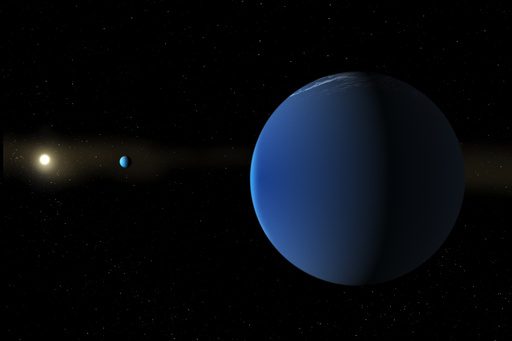
It turns out, they’ve done precisely the latter. Out there, roughly 1,110 light-years from Earth – a distance that, let’s be real, puts a rather inconvenient damper on any immediate space tourism plans – a duo of truly gargantuan planets are currently making a mockery of our preconceptions. They’re called ‘super-puffs’, — and this recently discovered pair? They’re the biggest ones yet identified that could quite literally float if you stuck them in an improbably immense swimming pool. You heard that right; these behemoths are less dense than cotton candy. Pretty wild, isn’t it?
University of Oxford’s George Dransfield, a lead on this particular cosmic caper, stated that these planets are the lightest known for their substantial girth. Dransfield and her cohort rolled out their discoveries Wednesday in Monthly Notices of the Royal Astronomical Society. They didn’t specify how much an actual super-puff costs to mail. And because the universe, as always, is less interested in aesthetic appeal and more in quantum mechanics, Dransfield posits that these wispy giants likely aren’t even the fetching pink associated with their confectionery analogue. Nope. We’re probably talking white or blue here, depending on whether their atmospheres are cluttered with cloud formations. Hydrogen and helium? That’s the educated guess for what these airy spheres are mostly made of, but we’ll need NASA’s Webb Space Telescope to offer up the hard proof. You know, once it’s gotten around to it.
Discovered over the last ten years by NASA’s Tess satellite, these extraordinary puffy-puffs are doing their orbital dance around a star chilling in the southern constellation Volans, also known as the flying fish. Scientists utilized ground-based telescopes to figure out the planets’ densities, pulling that data from over a thousand light-years away. For perspective, a single light-year is almost 6 trillion miles. Jupiter, our own local big boy, is a solid 35 times denser than these two intergalactic featherweights. That’s a significant difference, — and frankly, a bit unsettling if you like your planets solid.
Super-puffs are generally considered quite rare in the vastness of space. Only a smidgen, actually. NASA’s grand tally of planets beyond our solar system currently sits at nearly 6,300 confirmed. Of those, Dransfield notes, fewer than 40 are super-puffs. It’s like finding a needle in a hay… well, you get it. Their formation is a whole other puzzle, but the prevailing theory suggests they form in the gaseous disks around nascent stars where gas vastly outweighs dust, shedding mass over cosmic eons. But this pair? They’ve taken the shedding to an extreme, stripped down to almost nothing while still maintaining their gargantuan size.
But what does this all mean for us? For a world grappling with issues slightly more pressing than the density of exoplanets?
What This Means
This revelation, while purely scientific, holds a subtle, perhaps ironic, mirror to our human endeavors. Here we’re, perfecting satellite technology and astronomical instruments, pushing the very boundaries of the observable universe to categorize planets that, in essence, barely exist. They’re like cosmic whispers. Meanwhile, on Earth, the weight of tangible, undeniable problems presses down hard. From the energy crises rattling regions like South Asia’s evolving geopolitical chessboard to the constant struggle for resource allocation in Pakistan, nations are often left grappling with existential densities far greater than any super-puff.
One can’t help but wonder about the human impulse that drives us to catalog every speck of stardust, every bizarre orbital anomaly, even as cities here struggle with clean water, political instability, and burgeoning populations. It isn’t a critique of science, not truly. It’s more of an observation of human focus. We invest immense brainpower and resources to comprehend the utterly distant, sometimes to the seeming neglect of the immediately critical. It shows our boundless curiosity, yes. But it also, in a way, underscores how detached we can sometimes become from our terrestrial challenges. The cosmos remains aloof, impartial, presenting us with its endless marvels whether we’re ready for them or not. We stare up at the heavens, hoping for answers, perhaps missing the ones closer to home.
And it doesn’t quite change the price of bread in Lahore, does it? But perhaps, understanding the incomprehensible lightness of distant worlds offers a moment of profound perspective, a humbling reminder of our small place, and the sheer audacity of life itself. After all, if planets can be made of shaving foam, what other impossibilities might be lurking just around the cosmic corner? It’s enough to keep a journalist, — and humanity, perpetually pondering.