

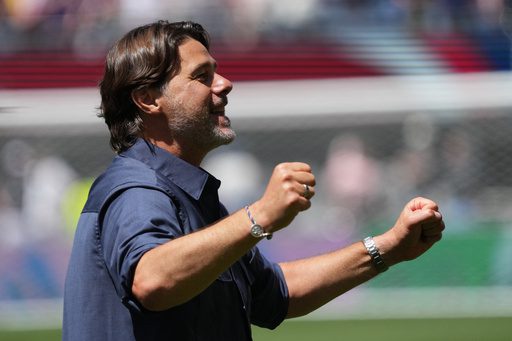
Pochettino’s Orange County Odyssey: Unpacking US Soccer’s Complacency Crisis
POLICY WIRE — Dana Point, USA — It seems fitting that Mauricio Pochettino, a man who doesn’t understand waiting, finds himself observing surfers—idle human driftwood on an Orange County beach....

POLICY WIRE — Dana Point, USA — It seems fitting that Mauricio Pochettino, a man who doesn’t understand waiting, finds himself observing surfers—idle human driftwood on an Orange County beach. They’re just “waiting for the perfect wave, and it never arrives.” He wasn’t born to wait, you see. He makes his own waves. That fierce impatience propelled him from Argentina’s rough-and-tumble leagues to Europe’s top clubs, first as a player, then as a manager—a relentless striver in soccer’s cutthroat echelons.
So, nearly two years ago, when this veteran coach took the helm of the United States national team, he wasn’t expecting to discover a hidden, placid bay where ambition gently ebbed and flowed. No, he came looking for a torrent, a shared desperation for success ahead of a home World Cup. But what he found instead—perched with a panoramic Pacific view from his World Cup office—was a profound cultural chasm. It wasn’t just a challenging job; it was an unexpected deep dive into the very fabric of American soccer’s soul.
“We were so naive when we signed our contract,” Pochettino said Tuesday night, during a media huddle in that same clifftop office. “I think what we find after we sign, we misjudged the situation. It was worse than we really believed.” It’s a candid admission, one that paints a stark picture. Here’s a man used to the immediate, visceral hunger of footballing nations like England, France, and Spain, colliding with an athletic powerhouse—the US—that, for all its resources, sometimes just… cruises.
He hadn’t coached a national team before, mind you. But while he understood the limited player contact, the sheer scope of the required cultural overhaul for a program with what he considered only [QUOTE_PLACEHOLDER] on the international stage genuinely caught him flat-footed. This wasn’t just about tactics or player selection; it was about shifting an entire mindset.
And what exactly was this deeply entrenched issue? Complacency, according to Pochettino. The kind that permeates a system, dulling the competitive edge. The team, remember, had been bounced from the 2024 Copa America group stage—at home, no less—a fate that led to the prior coach’s dismissal. “When we arrived here, we received a big punch, and we were knocked out for a while,” he recalls, that dry wit shining through. “Because we were so excited about that. It’s so close, the World Cup. Everyone is going to want to be involved and want to come to the national team, and it was the opposite.”
But Pochettino, to his credit, doesn’t wallow. He adapted. He turned that jolt into resolve, working meticulously to sculpt a new culture. He pinpointed key players, selling them on an all-consuming project that’s now showing glimpses of real fruit. This World Cup campaign began with back-to-back victories over Paraguay — and Australia, by a combined 6-1 score. That’s a first, historically; the U.S. had never started 2-0 in its World Cup history, a data point illustrating just how challenging consistent global performance has been for them.
His tactics have proven sharp. Their theoretical path forward in the tournament, frankly, looks manageable—which suggests this team might just make their most impressive World Cup finish since 1930’s semifinals. But getting here wasn’t simple. It took the guts to push past setbacks, like two CONCACAF Nations League losses in March 2025. It meant persevering when the Gold Cup fizzled without talisman Christian Pulisic in the summer of 2025. And it especially meant finding new ways to motivate a group that, perhaps, hadn’t yet felt that fierce international fire.
📄 POLICY WIRE WHITEPAPER PUBLISHED: PAKISTAN'S NATIONAL SECURITY POLICY PRIORITIES
👉 READ BY CLICKING HEREThe turning point, many say, arrived in the fall of 2025. There was a notoriously scrappy friendly with Australia where Pochettino, mid-game, challenged his players to simply be more competitive. Then, a team talk last November delivered a rallying cry that now literally adorns his office wall: “Why not us?” His players’ shocked expressions tell a story. “’Why not us?’ It was like a motto for us to say, ‘We can. If we believe we can, we can do. If we work hard, we can do. If we change our mindset, we can do.’” He’s not just talking about winning games; he’s talking about an existential shift in perception.
This Argentinian’s stint in America has, subtly, reshaped him too. He’s navigating the vast culinary expanse between Chick-Fil-A — and Whole Foods. And he’s somehow found an appreciation for both Lainey Wilson — and Teddy Swims. His future with the USMNT, post-World Cup, is an open question, though links to European club jobs persist. “It’s difficult to describe or know your future,” he muses, yet adds a telling detail: “But when you are here, I think it’s difficult now to see yourself living in another place, because for sure, we will miss it if one day we don’t stay here in this country.” The waves of California, it seems, have their own quiet pull.
What This Means
Pochettino’s struggle to instill a relentless hunger in US soccer is far more than a sporting anecdote; it’s a striking political-economic parable. Here you have a nation with immense financial power and a vast, sophisticated sports infrastructure, yet struggling to fully embrace the global footballing ethos of ruthless meritocracy and unwavering, singular focus. Compare this with countries where football is often a primary avenue for national identity and global recognition, sometimes even transcending significant political and economic challenges. Take Pakistan, for instance, a Muslim-majority nation grappling with its own economic and migratory dilemmas.
While cricket remains dominant, the sporadic interest in football there, even with limited resources, demonstrates an inherent passion. When Pakistan has managed even minor successes in the sport (often on the fringes of major competitions, true), it offers a significant — if ephemeral — boost to national morale and international standing, showcasing a shared cultural identity that’s not beholden to massive commercial machinery. Pochettino’s cultural clash underscores a unique challenge for the US: building that same intrinsic drive when the sport isn’t necessarily paramount in a landscape crowded with NFL, NBA, and MLB. For emerging football nations in South Asia or the wider Muslim world, the pathway to sustained success is arduous, typically devoid of the US’s financial cushions, demanding a different kind of resilience and political will to nurture talent from the ground up, hoping to emulate the global impact witnessed by, say, Tokyo’s strategic investment in the sport. This isn’t just about winning games; it’s about understanding what truly moves a nation to collective sporting glory, with or without surfers patiently awaiting a perfect break.