


NBA’s High-Stakes Commodities Market: The Human Element Amidst Contractual Jousting
POLICY WIRE — New York, United States — It isn’t the political maneuvering in Washington or the precarious global energy markets holding our attention today. Instead, it’s the peculiar...

POLICY WIRE — New York, United States — It isn’t the political maneuvering in Washington or the precarious global energy markets holding our attention today. Instead, it’s the peculiar alchemy of high-stakes capitalism meeting human athleticism, played out on polished hardwood courts across America. You see, the NBA isn’t just a league; it’s a living, breathing commodity market, where bodies—often fragile ones—are bought, sold, and traded with a dispassionate calculation that’d make a commodities broker blush. This isn’t about mere sport; it’s about investment, risk, — and the pursuit of a fleeting competitive advantage.
At the center of this most recent drama stands a certain center, Robert Williams, once a Boston Celtics fan favorite, now a much-discussed asset in the frenzied summer trade talk. But the headline isn’t simply which teams want him—everybody always wants somebody—it’s the paradox of a ‘beloved’ figure being dissected for his market value, a staggering sum approaching a $48 million price tag attached to his name at one point, his physical longevity under severe scrutiny. And it’s here, in this collision of affection and brutal pragmatism, that the true nature of modern professional sports becomes glaringly apparent. [QUOTE_PLACEHOLDER]
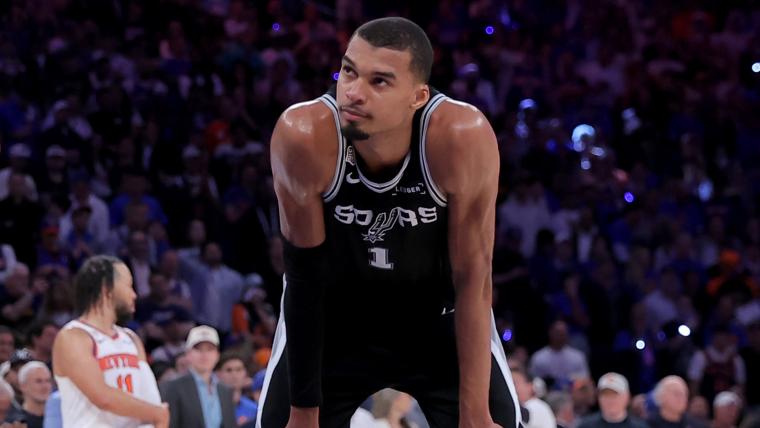
The chatter suggests two titans, the Los Angeles Lakers and the San Antonio Spurs, are both sizing up this particular piece of the basketball puzzle. Now, for the Spurs, you’d think they’ve already got their man, Victor Wembanyama, a player who seems to defy physics and basic biology with equal aplomb. He’s their future, the long-term investment. But here’s the rub: even dynasties need depth. Specifically, the Spurs’ second-unit low-post production leaves much to be desired. Remember Luke Kornet? He was unplayable for San Antonio at times in the postseason. Not that it was all on him; hardly. But you get the picture. Every machine needs its cogs, even the secondary ones.
Enter Williams, currently with the Portland Trail Blazers, a team that didn’t last long against the San Antonio Spurs in the first round of the playoffs. Still, for them, just making the postseason was a significant step forward for the franchise, says Eric Pincus of Bleacher Report. But Williams, who has struggled to stay healthy for most of the last few years, stepped into an important defensive role, living up to his status as a veteran with playoff experience. The assessment? His value isn’t about being an iron man. It’s about impact, however brief or intermittent it might be. This man could fetch a hefty salary, possibly above $10 million for one or two years, Pincus speculated. It’s not about guaranteed years, you see, it’s about concentrated bursts of capability.
Teams that could threaten to steal him from the Blazers include the San Antonio Spurs, the Los Angeles Lakers, the Atlanta Hawks, and the Chicago Bulls. While Chicago may not be postseason-ready, they’ve a glaring need for center depth — and defensive acumen. But what’s Williams, exactly? He isn’t the most polished sound big man option on the trade market, we’re told. That’s a polite way of saying he’s rough around the edges, technically speaking. But what he lacks in fundamentals, he makes up for in energy, vertical athleticism, upper-body strength, and rim protection. That’s a good trade-off, especially in a league obsessed with the spectacle of raw power. Last season, with the Blazers, Williams notably appeared in 59 contests—his most durable stretch in years—averaging 6.7 points, 7.0 rebounds, and 1.5 blocks per game, while shooting an impressive 70.8% from the field, according to data widely reported across sports media outlets, including The Sporting News. Numbers never lie, even when bodies occasionally do.
The Spurs could use Williams immediate two-way impact off the bench in 2026-27. The Lakers, ever in search of the next glittering piece for their superstar ensemble, could slot him right into their starting five. It all depends on Deandre Ayton and his $8.1 million player option, which hovers over their plans like a very expensive ghost. Need I say it? Both Western Conference franchises are in the thick of it for this former first-round pick.
What This Means
This micro-saga of Robert Williams isn’t just about a basketball player; it’s a compelling snapshot of modern economic policy in miniature, with global implications. Imagine an emerging nation—say, Pakistan, which is often navigating a treacherous path between external debt and internal development—trying to attract foreign investment. They don’t just need a good pitch; they need a stable, albeit sometimes imperfect, infrastructure to demonstrate reliable returns. Here, Williams’ injury history is akin to a market volatility concern. Nations, like teams, must weigh the potential upside of an asset’s unique strengths against the inherent risks, often measured in health reports or GDP forecasts, all while contending with larger, more established players—the Lakers and Spurs—who can often outbid or out-leverage their smaller counterparts. The globalized sports economy, fueled by endorsements, broadcasting rights, and talent acquisition, mirrors the larger currents of wealth disparity and capital flow. A rising star’s journey from a modest background to multi-millionaire status resonates across continents, even in areas like South Asia, where millions follow global sports, aspiring to a fraction of that prosperity or seeing parallels to their own nations’ struggles to nurture and retain talent against powerful external lures. It’s a subtle reminder of who truly holds the leverage in any market, and how a commodity, even a beloved one, eventually moves to where the capital and competitive ambitions converge. Talent, after all, is a global currency, and its migrations often tell us more about power dynamics than any quarterly earnings report.
And so, the grand charade continues. Money talks. The bodies listen. And we, the observers, marvel at the exquisite, brutal efficiency of it all. There’s always another trade to chase, another injury report to parse, another contract negotiation to fret over. Because that’s the game, isn’t it?