
Spain’s Socialist Left Cheers Pope Leo as Mideast Burns
POLICY WIRE — Madrid, Spain — It felt, for a fleeting moment, like a scene plucked from an alternative timeline. Spain, a nation whose historical entanglement with the Catholic Church was once...

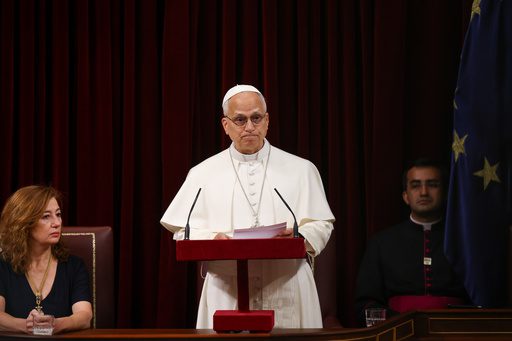
POLICY WIRE — Madrid, Spain — It felt, for a fleeting moment, like a scene plucked from an alternative timeline. Spain, a nation whose historical entanglement with the Catholic Church was once synonymous with authoritarianism and whose subsequent secularizing trends are, well, pretty stark—gave a Pope a seven-minute standing ovation. That’s right. A Pope. Not just any pontiff either, but American-born Leo XIV, addressing lawmakers in Las Cortes Generales for the very first time. An improbable confluence, you’d think, given the country’s deep secular roots, yet here we’re. It makes you wonder what, exactly, passes for an ideological divide these days.
Lawmakers didn’t just clap. They cheered. They chanted, “Viva el Papa!” You couldn’t script better optics if you tried, especially considering the socialist-led government that hosted him. Prime Minister Pedro Sánchez, an avowed atheist, has found, of all things, common ground with the current Holy See. It’s enough to make a seasoned politico choke on their morning coffee.
Leo’s message, delivered smack-bang in the middle of a weeklong visit that drew estimated crowds of 1.5 million people for Mass on Sunday in a downtown plaza alone, was, if you’re asking, nothing short of expansive. He spoke, primarily, of migrants. Of their dignity. Of their protection. It’s a hallmark of this papacy and the one before it, mind you, and a consistent thorn in the side of more conservative European policies. Spain, bucking the popular European — and U.S. trends, has been on record defending immigration, calling it good for the economy — and humane. Funny how that works, isn’t it? They’ve even been working on a legalization push for hundreds of thousands of immigrants who’re, let’s just say, unauthorized.
But the pontiff wasn’t content with merely humanitarian appeals. His speech landed precisely as Israel — and Iran engaged in an aggressive volley of fire. Leo didn’t equivocate. He repeated his demand for dialogue, “diplomatic courage” and “the obligation of states to resolve their disputes through the peaceful means offered by international law.” He doesn’t mince words when global stability, already hanging by a thread (hasn’t it always?), gets tugged on so violently.
And because no pontifical address to a secular parliament can be truly complete without a nod to the philosophical bedrock of international law, he dove into the 16th century Spanish intellectual tradition, the School of Salamanca. These theologians, he pointed out, understood that “reason could not be invoked to legitimize whatever force or self-interest that seemed convenient” and that there were “moral limits of power.” Which, coming from an institution that once legitimized—and sometimes even profited from—colonial conquest and the trans-Atlantic slave trade, carries a particular weight. You could almost feel the collective intake of breath when Leo acknowledged that [QUOTE_PLACEHOLDER] An interesting confession, considering its implicit self-indictment. But, you know, better late than never, some might quip.
For nations like Pakistan, navigating a delicate dance between Islamic jurisprudence, international law, and the realities of modern statecraft, Leo’s calls for “rigorous ethical oversight” of AI-driven weapons systems could resonate deeply. Decisions about life — and death, he declared, shouldn’t be farmed out to algorithms. He wants to keep them tethered to human moral responsibility. A thought, perhaps, that many in Islamabad’s military think tanks — and religious seminaries could certainly chew on.
This whole Spanish rendezvous couldn’t have happened at a more peculiar time for Sánchez. His Socialist Party is embroiled in corruption scandals, although none have directly fingered the PM himself. Still, the stench of probes lingers around his inner circle, his wife, even his brother. But Sánchez, in his wisdom (or perhaps desperation), has declared the pope’s voice “a moral compass in the fight against injustice.” An unshakeable alliance forged in a moment of mutual — albeit very different — political need. They’ve both even been critics of the Trump administration, so there’s that. Politics truly makes for strange bedfellows, doesn’t it?
What This Means
This seemingly unlikely alignment between a historically progressive, secular government and a contemporary Pope represents more than just polite diplomacy; it signals a seismic shift in political and moral influence within Europe. For the Vatican, Pope Leo’s reception in Madrid, following a robust attendance for his public appearances, legitimizes a softer, more globally conscious Catholic stance—one that prioritizes humanitarian issues over traditional doctrinal rigidity in the public square. It’s about rebranding, folks, plain and simple, moving from historical adversary to an ally on global challenges like migration and climate change. It’s an interesting maneuver, especially given Spain’s progressive stance on issues like same-sex marriage and abortion rights—issues the Catholic Church typically, well, frowns upon. But on shared concerns, the political utility of a papal blessing is immense. It provides a moral imprimatur for policies that Sánchez wants to champion, simultaneously shoring up his credibility with a public deeply jaded by scandal. And, crucially, it re-establishes the Catholic Church, at least Leo’s version of it, as a relevant, even progressive, voice in European policymaking. For a world struggling with geopolitical tensions, such as those that flared this week in the Middle East, a high-profile call for dialogue and peace, regardless of its ultimate efficacy, is a soundbite every news organization needs. And politicians love a good soundbite, too. It’s all very neat, isn’t it?