


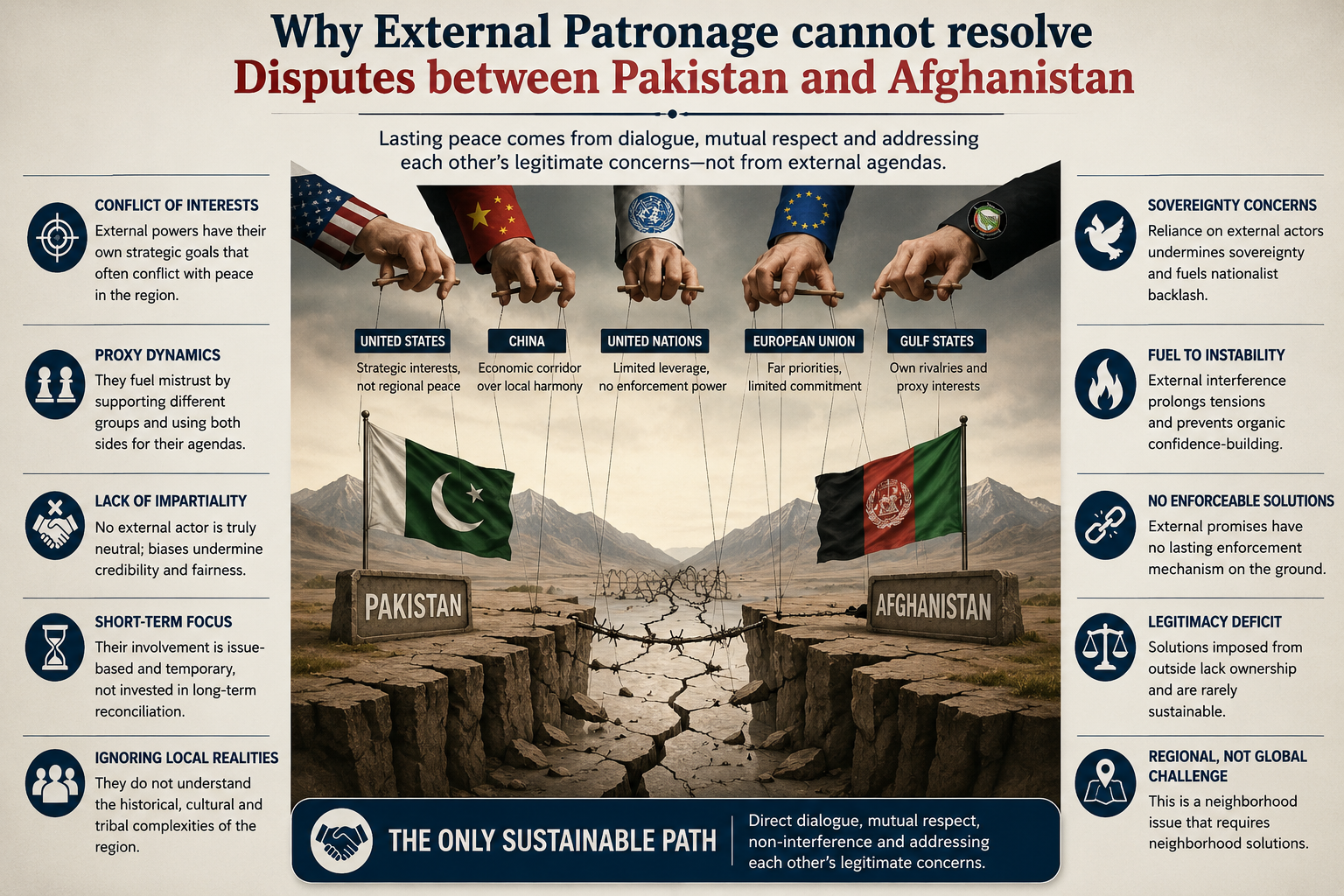
Why External Patronage cannot resolve Disputes between Pakistan and Afghanistan
Recent debates in Afghanistan’s media, arguing that the latest attacks by Pakistan across its borders show how unsuccessful the security pact between the Taliban and Russia in deterring Pakistan has...

Recent debates in Afghanistan’s media, arguing that the latest attacks by Pakistan across its borders show how unsuccessful the security pact between the Taliban and Russia in deterring Pakistan has been, fails to understand a deeper truth. The core problem between Pakistan and Afghanistan has never been Russia or any other foreign country. The problem has always been one of cross-border terrorism with the Tehreek-e-Taliban Pakistan (TTP) militants carrying out terrorist attacks from Afghan soil into Pakistan. As far as Pakistan is concerned, this recent instance proves the futility of diplomatic posturing on an issue that has not been sorted out yet.
The official stance of Pakistan on the issue has been consistent for several years now. The Pakistani government has continuously raised alarm about the presence of terrorists within Afghanistan, claiming that such organizations keep attacking Pakistani citizens, law enforcement agencies, and infrastructure. Pakistan insists that their claims are supported by intelligence data, captured terrorists, and other information shared through diplomatic channels. Pakistani leaders maintain that the TTP remains the greatest danger to national security, while many of their units continue to operate beyond the border.
Such information is usually neglected when discussing the issue solely from a military perspective without considering the background that lies ahead of military operations. The last attack took place at the time of new accusations of militant infrastructures existing in neighboring countries to attack Pakistan. Pakistan referred to the attack as a necessary measure against the militants while Taliban insisted on civilian deaths and the breach of sovereignty. Both stories have been central to this discussion, but neither one can be understood completely without appreciating the wider security contest that has framed the relationship ever since 2021.
First of all, the premise that signing a security deal with Russia will somehow change things for Pakistan is misguided at best. The rules of international politics do not rely on symbolism; rather, states make decisions based on interests, capabilities, and perceptions of danger. Russia’s involvement in Afghanistan has mainly revolved around security and stability issues in the region, terrorism, narcotic drugs, and security of Central Asia. It is not an anti-Pakistan military alliance, and there is no indication that Russia wants to clash with Pakistan over this issue.
Certainly, the assumption that Russia will serve as the security guarantor of Afghanistan contradicts modern geopolitical trends. Firstly, Russia is currently involved in the war in Ukraine. Moreover, there are other areas where Russia has to be careful and cautious with its strategic plans. Even when Russia has strong strategic relations with some country, it still shows reluctance regarding military support. Thus, thinking that Russia’s involvement in Afghanistan means protection against Pakistan is misleading.
What is more important, in international politics, deterrence does not rely on declarative acts or treaties. Deterrence is achieved thanks to the balance of power and clear communication of commitment. It is quite probable that Taliban leaders were happy that they were recognized by Russia; however, recognition does not always mean security guarantees. There are numerous countries that continue their contact with Kabul without supporting the Taliban or becoming the guardian of Afghanistan.
Further evidence of this can be found in the subdued reaction by international agencies to the recent strikes. While international bodies have condemned these attacks as causing civilian casualties and calling for restraint, there has been no notable attempt at organizing international pressure against Pakistan. This is certainly not to say that such an attack is somehow condoned. On the contrary, it highlights how the international community understands the fact that the Pakistan and Afghanistan situation cannot be addressed without solving the problem of cross-border terrorism.
This does not mean that civilian protection does not matter at all. Civilian casualties in any country are to be avoided at all costs, and any incident should receive a thorough investigation. Stability cannot be achieved through militarization alone. But then again, there cannot be peace when these countries continue to accuse each other of harboring terrorists.
The important lesson that one learns from the current crisis is, however, that Russia did not fail in Afghanistan. The lesson is that no matter who the partner, whether Moscow, Beijing, Washington, or others, the problem of domestic security cannot be offset by outside assistance. No matter what arrangement made with other capitals, the hard work of dealing with militants and building neighborly confidence is unavoidable.
There can be no shortcuts for either country to peace, which means no reliance on foreign help to secure its national interests. The way to achieve stability lies neither through geopolitics nor through any grand symbolic gestures but rather through the hard work of working together against militancy and creating mechanisms to ensure that one’s own soil isn’t used against oneself.
Author