


Belfast’s Double-Edged Blade: Unity Emerges Amidst Anti-Immigrant Anarchy
POLICY WIRE — BELFAST, Northern Ireland — On a recent Saturday in Belfast, amid the smoldering aftermath of homes set alight and police vehicles pelted with firebombs, something quite different...

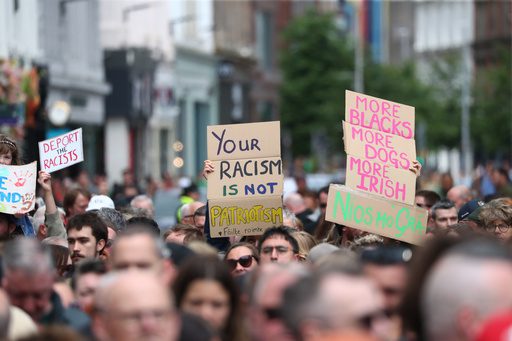
POLICY WIRE — BELFAST, Northern Ireland — On a recent Saturday in Belfast, amid the smoldering aftermath of homes set alight and police vehicles pelted with firebombs, something quite different unfolded. Couples fresh from their wedding vows emerged from City Hall, not to a carriage, but directly into a human current, a peaceful counter-demonstration that swelled into thousands. It’s a curious contrast, isn’t it—tying the knot, then linking arms against xenophobia just meters from where brickbats flew?
This surprising surge of civic resistance followed nights of visceral, ugly violence. Anti-immigrant agitators, riled by the arrest of a Sudanese asylum seeker in a brutal stabbing incident, turned pockets of Northern Ireland into chaotic, fiery battlegrounds. Masked men, not shy about their motives, specifically targeted homes they presumed housed immigrants. They torched a bus. They didn’t just throw things, they pelted police with bricks, bottles — and firebombs. A dozen officers got hurt, and more than two dozen folks found themselves homeless, displaced not by conflict but by calculated hate.
It was thuggery, officials said. And indeed it was. But that Saturday saw a different kind of defiance. Elaine Crory, a voice from the rally stage, captured the chilling simplicity of the unrest, stating: [QUOTE_PLACEHOLDER] Her words hang heavy, a concise diagnosis of how fragile peace can be, how quickly perceived otherness can become a pretext for destruction. But thousands turned out, carrying signs proclaiming “The problem is evil & violence not race” and “Protect people not prejudice.” People, it turns out, weren’t uniformly buying the narrative peddled by the provocateurs.
But how does one even begin to quantify the psychological toll of such swift societal rupture? Consider the human cost: The stabbing left one man partly blind. The subsequent riots left a physical — and emotional scar. One recent report indicated that in 2023, global forced displacement reached over 117 million individuals, according to the UNHCR. This staggering figure throws the local hostility into a wider, frankly global, context.
Cara Bell — and Matthew Richardson, the aforementioned newlyweds, spoke of a [QUOTE_PLACEHOLDER] joining the rally. “It’s important to note that things like today really show that this is not the general feeling of people in Belfast,” Bell reflected. “A week where you’ve seen the worst of humanity and the best of humanity in Belfast.” Her sentiment isn’t just a silver lining, it’s a stark reminder that beneath the froth of fanaticism, there’s often a broader, more decent undercurrent.
But let’s be frank: this isn’t just a Belfast problem. Officials and even the stabbing victim’s family had called for calm, but it seems those calls largely bounced off the thick skulls of certain figures. Far-right and anti-immigrant elements, clearly skilled at their nefarious craft, were busy whipping up protests not just in Belfast but across the U.K. We saw similar disorder rear its head in Glasgow, Scotland, where minorities were targeted and worshippers at a mosque found themselves in lockdown, terrified.
And because the ideological contagion respects no borders, that same Saturday, an anti-racism group rallied in Glasgow to reclaim its streets, squaring off against a smaller, but deeply disturbing, contingent of men making what appeared to be Nazi salutes and screaming anti-Muslim chants. [QUOTE_PLACEHOLDER] retorted the anti-racism group. It’s a phrase we’ve heard in different languages across various continents, hasn’t it? From the West’s growing nationalism to the unsettling rhetoric occasionally heard even in places like Pakistan and other parts of South Asia concerning Rohingya refugees or Afghan migrants—the undercurrents of xenophobia feel awfully similar, a global affliction manifesting locally.
What This Means
This eruption in Belfast, like its Glasgow echo, isn’t a mere localized fracas. It’s a raw nerve, exposed, a testament to how quickly grievances—real or imagined—can be weaponized by political actors. The initial crime, a serious one without doubt, provided a convenient match for a fire already laid by those exploiting economic anxieties and societal fissures. For Northern Ireland, with its own deeply etched history of sectarian division, this re-direction of anger towards asylum seekers represents a worrying new vector for discord. It demonstrates a troubling flexibility in who gets deemed the enemy, shifting from traditional political or religious lines to ethnicity and origin. The economic implications are considerable, too; instability frightens off investment, while a reputation for xenophobia discourages the very migration often needed to fill labor gaps. And who pays the long-term price for a city becoming inhospitable? Everyone does. This brand of virulent nationalism, with its explicit anti-Muslim undertones, casts a long shadow, linking struggles in places like Belfast to broader patterns of religious and ethnic discrimination experienced by Muslims globally, from Xinjiang to the recent citizenship debates in India affecting its Muslim population. It’s not just a local skirmish—it’s a node in a much larger, global network of hate, a dangerous signal that such sentiments are, sadly, far from eradicated.