


Rome’s Dual Echoes: Migration Tensions Strain Meloni’s Coalition
POLICY WIRE — ROME, ITALY — Giorgia Meloni, Italy’s right-wing premier, can’t catch a break. Not really. Just as the European Union unveils its freshly hammered-out — and, let’s face it, long...

POLICY WIRE — ROME, ITALY — Giorgia Meloni, Italy’s right-wing premier, can’t catch a break. Not really. Just as the European Union unveils its freshly hammered-out — and, let’s face it, long overdue — migration regulations, her own capital city, ancient Rome itself, becomes a sprawling stage for two wildly opposing acts. What started as a peculiar, seemingly fringe idea called Remigration and Reconquest
has now crash-landed smack dab into Italy’s political mainstream, courtesy of a surprisingly potent citizen initiative.
It’s a curious state of affairs. This petition, pushing for harsh anti-migrant policies, amassed the 50,000 signatures it needed to force a parliamentary debate, according to an Associated Press report. No specific date for that discussion has popped up yet, mind you. But just knowing it’s coming makes for awfully tense dinner table conversation in power circles across Rome. The initiative? It demands some rather extreme stuff. It wants sweeping measures targeting foreigners,
which means coercive returns,
incentives for people to leave Italy,
and policies critics say could extend to legal residents.
That last bit—it’s a kicker, ain’t it? [QUOTE_PLACEHOLDER]
Saturday brought the theatre. You had several thousand demonstrators
for the anti-migration march. They were singing the national anthem, a sea of Italian flags. But then, there it was. Not just a few, but on several occasions,
many folks in that crowd raised their arms in the old fascist salute, shouting Duce! Duce!
That’s not just a historical callback, it’s a gut punch, right? Benito Mussolini, the country’s former dictator. You just can’t escape those specters here.
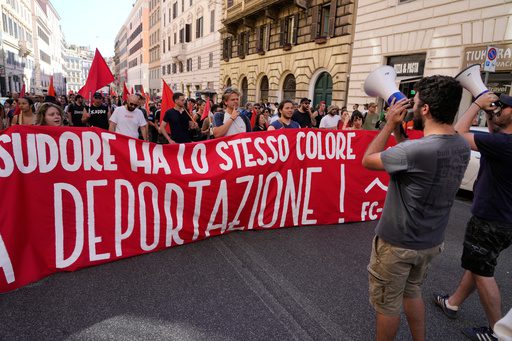
Then, across town, another scene. Tens of thousands
— that’s a whole lot of people — for the rival, pro-migration demonstration. Left-wing groups, trade unions, a mix of folks. And yes, some demonstrators waving Palestinian flags.
It hints at a broader global conversation about displacement and identity, you know, connecting with similar narratives heard from folks making perilous journeys across the Mediterranean from places like Pakistan or war-torn corners of the Middle East, hoping for safe harbor in Europe.
The cops, thankfully, did their job. Thousands of police
were on duty, ensuring the two boiling kettles didn’t spill over into each other. No reported violence, which, given the passions involved, felt like a small miracle.
But the real drama? It’s playing out in Meloni’s own government. Her coalition’s made of strange bedfellows. The anti-migration League party, they’re all in, backing discussion of the initiative. Her own Brothers of Italy party, plus the centrist partners, they’re walking a tightrope. They’ve been more cautious about endorsing a proposal linked to extremist circles,
according to reports. And why wouldn’t they be? Concerns over legal risks and internal divisions
are always in play, particularly when you’re navigating thorny issues of constitutional and international anti-discrimination principles.
📄 POLICY WIRE WHITEPAPER PUBLISHED: PAKISTAN'S NATIONAL SECURITY POLICY PRIORITIES
👉 READ BY CLICKING HEREBecause, — and this is where it gets really rich, Meloni’s government is also busy with a contradictory strategy. They’re pursuing a parallel policy of expanding legal migration,
signing off on plans to welcome hundreds of thousands of non-EU workers. Why? To address labor shortages in key economic sectors.
So, on one hand, Duce! Duce!
and send them back; on the other, ‘please come, we need you to pick our fruit and build our bridges.’ You couldn’t make this stuff up, could you?
The rallies hit just a day after the European Union’s fresh migration rules kicked in. This European Migration and Asylum Pact
— years in the making, brutal negotiations — was supposed to fix the previous system, which was widely considered a failure
and, tellingly, gave far-right parties a potent issue to win votes.
A full circle, isn’t it? The more things change, the more the core arguments stay the same.
What This Means
This whole Roman kerfuffle isn’t just local theater; it’s a harsh spotlight on the profound ideological fractures within Meloni’s government, and by extension, much of Europe. She’s got to perform a genuine political high-wire act—juggling the nativist fervor that helped get her elected with the cold, hard economic realities demanding immigrant labor. It’s an unsustainable tension, — and it’s bound to snap at some point. Economically, Italy desperately needs workers, especially as its population ages; the government’s dual approach here—talking tough while inviting in hundreds of thousands—smells of political expediency, and it could very well alienate both bases in the long run. Migration policy is an increasingly global hot button, you see. Domestically, expect this to feed ongoing battles between populist elements and more centrist factions within Meloni’s coalition, which could easily hobble other legislative efforts. On the European front, Italy’s internal wobbles only make the new, already-fragile EU pact even more susceptible to individual member states reneging or pushing their own nationalistic agendas. We’ve seen this script before, but its re-run in Rome feels particularly pointed, signaling persistent volatility for a continent still grappling with its identity.