


Rio Rancho’s Silent Sentinels: The Creeping Reach of Automated Enforcement
POLICY WIRE — Rio Rancho, New Mexico — It’s a truth universally acknowledged in modern American municipalities: budgets are tight, and road safety is — for many — an ever-present concern. Enter...

POLICY WIRE — Rio Rancho, New Mexico — It’s a truth universally acknowledged in modern American municipalities: budgets are tight, and road safety is — for many — an ever-present concern. Enter the mobile speed camera. This isn’t just about catching lead-foots anymore. This is about policy, pocketbooks, and a creeping embrace of technology that reframes how we think about public order itself.
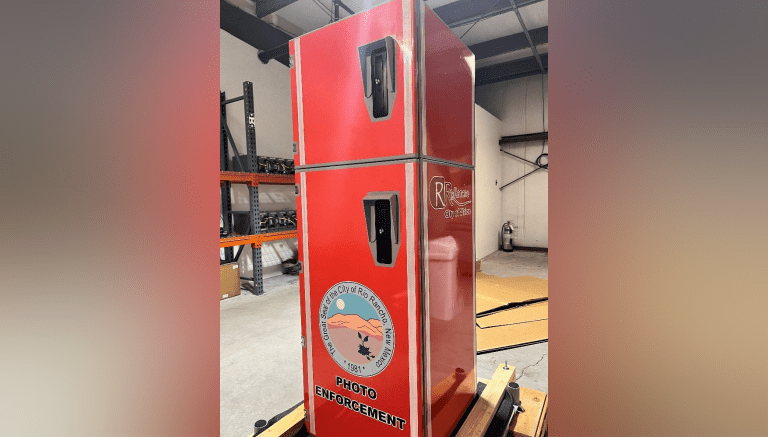
Down in Rio Rancho, New Mexico, the stakes are ratcheting up a notch. The decision? To unleash three additional mobile speed camera units onto the city’s Highway 528. This move, cloaked in the usual bureaucratic language of ‘data-driven safety improvement’ and ‘public feedback,’ effectively paints a starker, more monitored landscape for drivers. And you’ve gotta wonder, how much of this is about safety — and how much about that ever-elusive revenue stream?
The Rio Rancho Police Department, they’re not mincing words. They’re trying to crack down on speeding. That’s the official line. One unit’s heading to the NM-528/Pasilla Road intersection, then it’ll float between Iris — and Idalia Roads. The other two? They’ll drift along different sections, from Westside Boulevard down to 19th Avenue, and then over from Sara Road to Zenith Court. It’s a rotating roster of silent, unblinking oversight. A perpetual motion machine designed to ding drivers who don’t hit their marks. It’s certainly efficient. But at what cost to trust?
“We’ve seen the numbers, and they don’t lie,” asserted RRPD Chief Paul Rodriguez in a recent statement, reflecting the official position on the city’s rationale. “Our primary goal here isn’t about generating fines, it’s about preventing serious crashes and saving lives on our most congested roadways. These cameras are simply tools that allow us to enforce limits effectively, without requiring a constant physical police presence that strains our limited manpower.” That’s a common refrain, isn’t it?
But the numbers can be spun, too. Think about it: a fine of $100 for going 11 mph or more over the limit. When the camera clocks you, it snaps a photo, records video, grabs your license plate, — and logs the speed. Then, some law enforcement officer (presumably not an AI, for now) confirms it. Simple. Automated. Impersonal. This entire apparatus, from deployment to administration, is managed by a third-party vendor, Verra Mobility. They’ve cornered this market, they’re efficient, — and they’re certainly profitable. Just like the massive economic forces at play in other sectors, this system represents big business wrapped in civic duty.
“Look, nobody likes getting a ticket. I get that. But residents have been clamoring for solutions on 528 for years,” explained City Councilwoman Elena Ramirez during a community forum last week. “We’re balancing the need for public safety with fiscal responsibility. Every dollar generated by these citations is reinvested into local road improvements — and public safety initiatives. It’s not just about punishment; it’s about communal well-being — and supporting our infrastructure.” It sounds good. But don’t most people just call it a ‘speed trap’?
📄 POLICY WIRE WHITEPAPER PUBLISHED: PAKISTAN'S NATIONAL SECURITY POLICY PRIORITIES
👉 READ BY CLICKING HEREThis deployment isn’t an isolated incident. The City of Rio Rancho actually requested these units as part of a larger safety improvement plan spearheaded by the New Mexico Department of Transportation (NMDOT). NMDOT wasn’t just urging; they fully supported it, — and their Commission gave it the green light. A perfectly engineered bureaucratic process, from conception to implementation. Seamless, even.
And while New Mexico wrestles with its technological solutions to traffic woes, across the globe, burgeoning urban centers in the Muslim world — say, Lahore or Karachi — face even more acute traffic management challenges. They often grapple with the efficacy — and ethical considerations of similar surveillance technologies. Do these systems truly foster a culture of compliance and safety, or do they merely act as efficient revenue generators in disguise, breeding resentment among a populace already sensitive to state intrusion? The conversation isn’t so different there, you know. The balancing act between order — and individual freedom remains a sticky point, no matter the hemisphere.
Globally, automated enforcement is big business. It’s also debatable. A study from the National Highway Traffic Safety Administration (NHTSA) found that speeding contributed to 29% of all traffic fatalities in the U.S. in 2021, accounting for a staggering 12,330 deaths. But does that justify ubiquitous photographic enforcement, or does it call for more traditional, visible policing?
What This Means
This expansion isn’t just about Rio Rancho. It represents a subtle but significant shift in how American towns govern — and fund themselves. Politically, expect little immediate backlash beyond the usual grumbling; these things are often sold on public safety. The city administration gets to trumpet its proactive approach to reducing accidents. Economically? That $100 fine adds up. For Rio Rancho, these cameras represent a tidy, predictable revenue stream, supplementing traditional tax bases that are always stretched thin. It’s a fiscally conservative approach that offloads enforcement costs onto an automated system and pushes the burden directly onto the wallets of drivers. This isn’t about replacing police; it’s about monetizing behavior. It might make the roads incrementally safer — maybe — but it certainly makes the city coffers a bit healthier. And who doesn’t love a fatter budget? The challenge, as always, is whether the perceived increase in safety outweighs the erosion of a public trust increasingly wary of the ever-present digital eye.