

San Antonio’s Reckoning: Johnson’s ‘Undisciplined’ Truth as Empire State Looms
POLICY WIRE — New York, USA — Madison Square Garden isn’t just an arena; it’s a cathedral of pressure, a crucible where legacies are forged or, more often, crushed. And now, the San...

POLICY WIRE — New York, USA — Madison Square Garden isn’t just an arena; it’s a cathedral of pressure, a crucible where legacies are forged or, more often, crushed. And now, the San Antonio Spurs, young and promising, find themselves staring directly into that unforgiving spotlight, two games down against the battle-hardened New York Knicks in the 2026 NBA Finals. It’s not just about a basketball series anymore, not really. It’s about composure, about handling the weight of expectation when the stakes get ridiculously high. Some nights, a team just can’t get out of its own way.
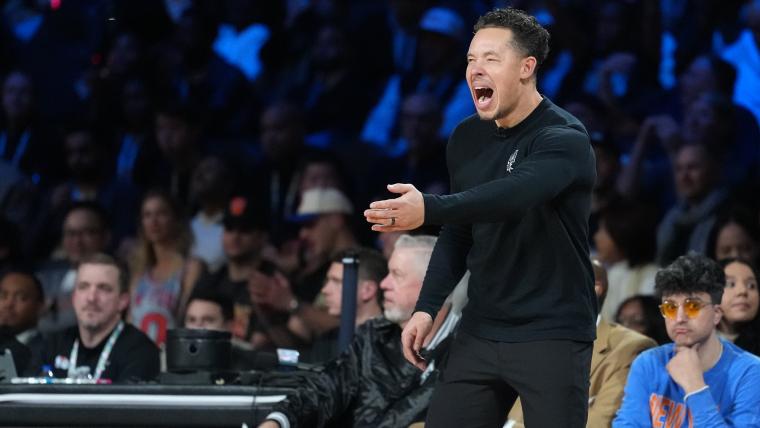
Spurs Head Coach Mitch Johnson, known for his calm demeanor, let a sliver of exasperation creep into his voice when he recently laid bare the team’s predicament. They’ve been here before—up by ten, feeling good. But then, it evaporates, like morning dew under a desert sun. His words were sharp, hitting home. The biggest thing is we’ve put in some good hard work at times and haven’t taken advantage of that hard work,
Johnson conceded. And that’s been partially, some undisciplined things on us, and partially also, [the Knicks] stepped up and made some plays.
The Big Apple’s Ascendance wasn’t just a catchy headline; it’s becoming a stark reality.
Undisciplined things. That’s a diplomatic way of saying turnovers at the worst possible moments, missed free throws, and lapses that a team of the Knicks’ caliber devours like fresh-baked bread. The numbers don’t lie. San Antonio has given away a staggering 32 possessions through live-ball turnovers in the first two contests—each one a wasted opportunity, each one a jab from the more experienced foe. They aren’t just mistakes; they’re momentum killers. You can’t hand points to an elite defensive team and expect to survive,
observed Marcus Sterling, a longtime Knicks analyst for the New York Post, his voice laced with the kind of casual confidence that comes from watching your team dominate.
The first two games of this series were, in essence, a masterclass in contrasting philosophies. The Spurs, brimming with raw talent — and explosive potential, snatched double-digit leads in both matchups. They showed flashes, blindingly bright, of the dynasty many predict they’ll become. But the Knicks? They simply refused to break. They’re grinders. They’re seasoned. They know how to bend without snapping, how to turn an opponent’s youthful exuberance into frustration, then defeat. They just do.
Now, with Game 3 looming, the arithmetic is grim. No team in the history of the NBA Playoffs has ever recovered from a 3-0 deficit to win a series. This isn’t just a fun fact; it’s a cold, hard statistic that hangs over every single dribble — and pass. History isn’t on their side. But, perhaps Johnson hopes, the sheer audacity of trying to buck a century of records might galvanize his crew. The coach, ever the pragmatist, knows the drill for digging out of a hole: You dig into the film, you argue, you beat yourself up, you give each other feedback, figure out how to help the guys for the next game.
It’s a grueling process, certainly. But what else are you gonna do?
Globally, these high-stakes clashes resonate far beyond America’s borders. You’d be surprised. From the packed cafes of Istanbul to the flickering screens in Lahore, the NBA’s drama plays out to an audience deeply invested in the hero’s journey, the underdog story. Even in cricket-mad Pakistan, where sports fandom is often equated with the national team’s fortunes, the saga of a young San Antonio squad challenging an established titan like New York finds purchase. People love a good fight, don’t they? And this series, despite the deficit, is delivering on that front. And the world watches.
📄 POLICY WIRE WHITEPAPER PUBLISHED: PAKISTAN'S NATIONAL SECURITY POLICY PRIORITIES
👉 READ BY CLICKING HEREClad in their understated black—a stark contrast to the Knicks’ vibrant orange—the Spurs arrived in Midtown embracing an underdog persona they hadn’t really earned all season. They’re hoping that Game 3 becomes their narrative reset button, a heist at the Garden. If they can just reel in those live-ball turnovers — and hit their free throws, the talent is absolutely there. The game changes quickly. It does.
What This Means
The battle for basketball supremacy between the Spurs and the Knicks isn’t just about athletic prowess; it’s a microcosm of deeper economic and socio-political dynamics. For New York City, a finals appearance and potential championship isn’t merely about bragging rights; it’s an economic injection. Local businesses, tourism, increased merchandising—the spillover effect of a winning team in America’s largest media market is substantial, generating tens of millions in ancillary revenue. It solidifies the city’s brand, acting as a global marketing tool that no conventional campaign could buy. The ‘political capital’ gained by a thriving sports franchise, for both the city — and the league, can’t be overstated. It fosters a collective pride, a shared narrative that momentarily transcends urban divides.
For the younger, smaller market Spurs, this series, win or lose, offers invaluable experience—a trial by fire that sculpts future leaders. Their undisciplined things
on court mirror broader struggles of growing organizations finding their footing against established power structures. The lesson here extends to any young institution: raw talent often isn’t enough; seasoned execution, mental toughness, and the ruthless elimination of errors are the true differentiators in high-stakes competition. It forces a self-reflection on what separates potential from realized power. In an economy increasingly driven by brand and perceived success, this public crucible sets the stage for San Antonio’s future marketability and talent attraction. And because these are the Finals, everybody’s watching.