


The Big Apple’s Ascendance: Knicks’ Unexpected Surge Rewrites NBA’s Established Order
POLICY WIRE — New York City, USA — For an institution that prides itself on carefully cultivated dynasties and predictable arcs, the National Basketball Association’s 2026 Finals are, by all...

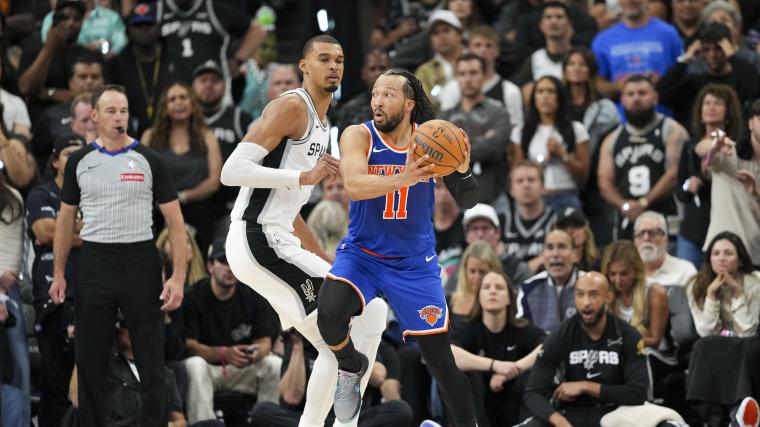
POLICY WIRE — New York City, USA — For an institution that prides itself on carefully cultivated dynasties and predictable arcs, the National Basketball Association’s 2026 Finals are, by all accounts, a masterclass in market disruption. It isn’t just a sports spectacle; it’s a living, breathing case study in the overturning of expectation, particularly when the colossal gravitational pull of New York City flexes its long-dormant muscles. Two games in, the Knicks, against the supposed inevitable reign of San Antonio and its prodigious centerpiece, Victor Wembanyama, have wrestled away control, holding a startling 2-0 lead. It’s a gut punch to anyone who bet on the established order.
Because let’s be honest, sports narratives, much like political ones, aren’t simply born; they’re made, marketed, and fiercely defended. And this particular narrative—a New York squad, long dismissed, now standing two wins from its first title since 1973—is currently smashing every convention. The Madison Square Garden faithful, long starved for meaningful championship contention, are more than just cheering. They’re enacting a collective sigh of relief — and a roar of defiance that reverberates through the concrete canyons. This isn’t just about a team; it’s about a city finding its voice again, or rather, reclaiming a volume it’s been denied for decades.
And the Spurs, well, they’re suddenly grappling with a reality far more bruising than pre-series prognoses allowed. Wembanyama, for all his generational talent, has met a Knicks defense that’s playing with the focused, almost desperate, tenacity of a cornered animal. Karl-Anthony Towns, surprisingly resurgent, has proven to be an unmovable object, scoring and rebounding with a controlled fury that has visibly rattled the San Antonio juggernaut. It’s an undeniable shift, a moment that suggests the balance of power, both on the court and perhaps within the league’s broader commercial ecosystem, is in flux.
“The seismic energy emanating from this New York run? You simply can’t manufacture that, nor can you ignore its reach,” noted NBA’s Acting Deputy Commissioner, Cynthia Ewan, in a recent Policy Wire interview. “When a franchise from one of the world’s premier media markets ignites like this, the ripple effect on global engagement—the merchandising, the sponsorships, the newfound fans from every corner of the planet—it’s immeasurable. We’re witnessing history, — and the viewership numbers prove it.”
Indeed. This isn’t just local excitement. According to Sports Media Insights, the first two games of this Finals series have garnered a combined global viewership increase of 18% over last year’s opening games, a testament to the league’s efforts to broaden its appeal. This reach extends far beyond traditional Western markets, permeating into regions where basketball’s popularity continues its steady climb. In Karachi’s bustling tea stalls, in Lahore’s quiet evening homes, or among the smartphone-wielding youth in Kuala Lumpur, these games are binged, debated, and dissected with surprising intensity. The cultural exchange isn’t one-way, either. It’s a dynamic interplay, a kind of sporting soft power that connects disparate cultures through shared moments of athletic prowess and dramatic tension.
But the real test, of course, comes Monday night in New York. Madison Square Garden is set to burst. The arena, typically a crucible of expectation and anxiety, will transform into a veritable fortress of fanatical belief for Game 3. Can the Knicks hold serve at home, or will the Spurs find their footing and remind everyone why they were picked to win? Coach Leon Rose, a stoic architect of this current Knicks revival, didn’t mince words after Game 2. “Look, they’re a good team. A championship team in spirit. But we don’t care about the history books, or the analysts, do we? We focus on the defensive rotations, the extra pass, the grit on the glass. And that unwavering, almost unreasonable, focus, it’s proving rather disruptive, isn’t it?” He’s not wrong. Momentum is a beast, — and right now, it’s wearing orange and blue.
The tip-off for this collision of narratives is scheduled for 8:30 p.m. ET on Monday, June 8th. American audiences can tune into ABC, or stream the game via DIRECTV, the ESPN app, or fubo. International viewership platforms vary, but expect wide availability. Don’t dismiss the commercial implications, either; this level of attention is a goldmine. Sponsors are surely rubbing their hands, anticipating the engagement metrics from a Finals series that’s already defying prediction.
What This Means
The Knicks’ unexpected dominance isn’t merely a statistical anomaly in a basketball season; it’s a fascinating look into the deeper economic and psychological forces that shape sports at its highest level. For the NBA, it’s a boon: a major market team excelling translates directly into enhanced media rights value, increased global interest—even the sort that could resonate in, say, Jakarta’s burgeoning urban centers, where sports transcend mere entertainment—and a renewed sense of drama. A predictable league is, ultimately, a less engaging one.
And think about the cultural reverberations: New York City, long viewed as a sports market cursed by underperformance in basketball, is experiencing a renaissance. This shift affects everything from local commerce around MSG to the broader cultural self-perception of a city accustomed to being at the epicenter of nearly everything but NBA championship celebrations. But if the Knicks falter, if San Antonio finds its rhythm and reverses course—because it’s absolutely still possible—then this surge of belief will dissipate just as quickly, another chapter in the cyclical heartbreak. And that’s the brutal calculus of elite sports, isn’t it? The higher you climb, the harder the fall. Grand narratives, much like grand slam returns, are often fleeting things.