
Shadow of the Dragon: Ancient China’s Feathered Menace Reconfigures Prehistoric Predation
POLICY WIRE — Beijing, China — For generations, our primal fears—and our children’s bedtime stories—have pictured dragons: terrifying, scaled beasts soaring on leathery wings, reigning over ancient,...

POLICY WIRE — Beijing, China — For generations, our primal fears—and our children’s bedtime stories—have pictured dragons: terrifying, scaled beasts soaring on leathery wings, reigning over ancient, unkempt lands. But it turns out, our imagination, dramatic as it’s, might’ve undershot reality, particularly where ancient China is concerned. A new discovery from the fossil-rich Liaoning province doesn’t just rewrite evolutionary textbooks; it conjures a creature stranger and arguably more fascinating than any mythological chimera, an aerial terror from a primeval world, flapping not on two wings, but four. And it changes everything about how we thought a predator, not too distant from the notorious velociraptor, operated.
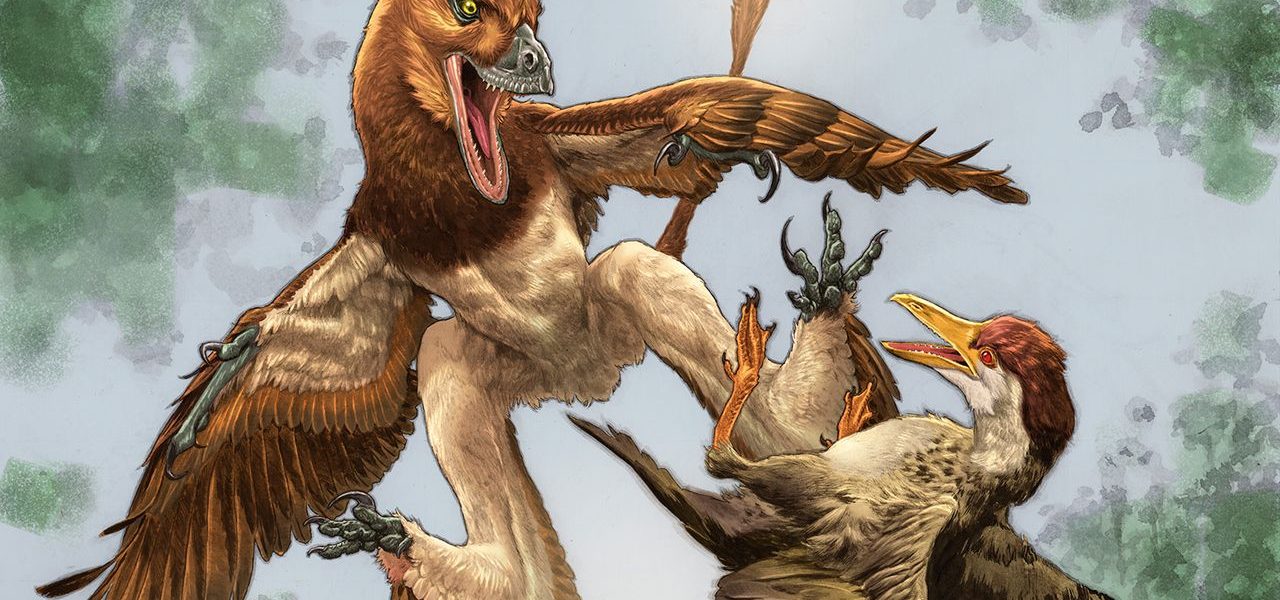
We’ve grown comfortable with the idea of dinosaurs: lumbering brutes, then agile, scaly raptors. But the scientific establishment, a group rarely given to hyperbole, is buzzing. They’re telling us a new genus, now dubbed Ambopteryx longibrachium, wasn’t just lurking in the trees some 160 million years ago—it was hunting from them. This ain’t your standard bird-like dinosaur. We’re talking a ‘four-winged’ marvel, built with a gliding membrane (patagium, for the scientifically inclined) on its forelimbs and perhaps even hind limbs, suggesting a creature that didn’t just hop but actively soared, swooping down with lethal precision. But it’s not simply a glider, its bone structure suggests powerful, if primitive, flapping. It wasn’t quite a bird, but it certainly wasn’t just a feathered reptile trying to get off the ground.
“It forces a complete re-evaluation of avian lineage,” remarked Dr. Li Wei, a senior palaeontologist at the Chinese Academy of Sciences, his voice carrying the faint echo of genuine awe. “We’ve seen evidence of feathers, sure, but this level of adaptation, with both feathering and membrane, pushes the envelope on what we thought was possible during the Jurassic. It’s like evolution ran a fascinating, deadly experiment we’re only just beginning to decode.” You’ve got to admit, it’s pretty mind-bending stuff.
This isn’t some tiny sparrow-sized beast. They estimate it was about the size of a modern crow—compact, yes, but undeniably deadly for its prey. Its name, Ambopteryx, literally means ‘both wings,’ nodding to its dual-winged structure. It had long, pointy fingers for gripping tree bark, claws that could probably make short work of whatever unfortunate creature became its meal, and a mouth full of sharp little choppers. But the real kicker? This wasn’t some slow evolutionary transition. This was an active, successful design—at least for a spell—of a hunter that used multiple surfaces to command its arboreal environment.
“We’d theorized these interim stages, sure, but finding one so utterly, perfectly preserved? It’s like staring directly into the Cambrian explosion again, but for feathers,” said Professor Elena Rodriguez of the Natural History Museum, London, sounding genuinely thrilled during a recent digital conference. Because, let’s be honest, perfect specimens are like gold dust, a direct line to deep time. And this one’s got everything, right down to gastric stones—yes, literal stomach contents—showing its diet included both insects and plants. It’s giving us a full-picture insight, not just a skeletal sketch. These things tell a story, don’t they?
📄 POLICY WIRE WHITEPAPER PUBLISHED: PAKISTAN'S NATIONAL SECURITY POLICY PRIORITIES
👉 READ BY CLICKING HEREAnd it puts China firmly at the forefront of palaeontological discoveries. This region keeps cranking out world-changing fossils. Just in the last decade, over two dozen new species of feathered dinosaurs have been unearthed from Liaoning alone, cementing its reputation as a crucible of early avian evolution, as documented in numerous articles in Nature and Science journals. But more than just the numbers, these finds offer unparalleled snapshots into processes that define how life, particularly flight, came to be. From the deserts of Sindh to the jungles of Sri Lanka—all part of the ancient Gondwana continent—the story of Earth’s creatures is being unearthed, slowly stitching together the ancient puzzle of our planet’s interconnected past, often found in disparate places but leading to global insights.
What This Means
This discovery, while deeply rooted in the past, reverberates into several contemporary arenas. Scientifically, it’s a bombshell. It throws a wrench into older, linear models of avian evolution, suggesting instead a much messier, more experimental, and far more diverse path towards flight. Evolution, it seems, isn’t always a direct line; sometimes it’s a chaotic, ingenious bazaar of innovations, many of which are dead ends, but all offering insights.
Economically, China’s continuous string of significant fossil discoveries bolsters its position as a global leader in natural sciences, attracting top researchers and — eventually — tourism dollars to regions like Liaoning. It’s a soft power play, showcasing intellectual prowess. Politically, Beijing can subtly leverage these scientific achievements to burnish its image as a sophisticated, forward-thinking nation, capable of rewriting history, both ancient and modern. And for Pakistan, or other nations in the Muslim world with a rich tapestry of pre-colonial scientific inquiry and deep historical links to ancient myths and lore of dragons or mythical beasts, such discoveries underscore a shared human fascination with the unknown and the power of scientific pursuit to bridge millennia and cultures. It’s not just a creature; it’s a re-examination of what defines the ultimate predator and the very narrative of life’s complex journey. A formidable shadow, indeed.