


Divine Intervention, or Just Good Marketing? The Saints of San Antonio Hit the Courtside Global Stage
POLICY WIRE — San Antonio, USA — For months, sports analysts and casual viewers alike fixated on Victor Wembanyama’s improbable ascent, his gravity-defying moves captivating audiences. But as...

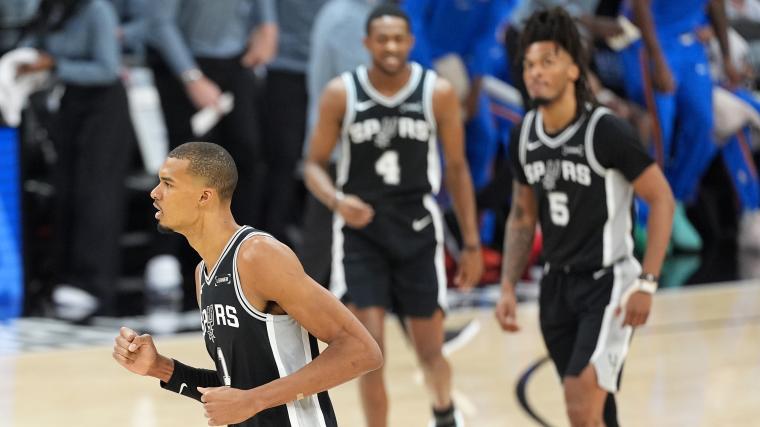
POLICY WIRE — San Antonio, USA — For months, sports analysts and casual viewers alike fixated on Victor Wembanyama’s improbable ascent, his gravity-defying moves captivating audiences. But as the San Antonio Spurs pushed into the 2026 NBA Finals, another, perhaps more improbable, force emerged from the sidelines. Not a coaching masterstroke, not a generational talent from beyond the arc. No, it was a coterie of Salesian Sisters, clad in traditional habits, cheering like it was Judgment Day – and looking perfectly at home amongst the raucous basketball faithful.
It’s a peculiar tableau, isn’t it? A game of fast breaks and commercial timeouts, punctuated by devout women whose mission often involves quiet reflection and service. But this particular congregation from the Salesian Sisters of St. John Bosco wasn’t just observing; they were participating. Their courtside presence, captured in countless viral clips and memes, morphed from local curiosity into a global digital sensation, leaving more than a few scratching their heads and a few others searching for signs.
This isn’t some fly-by-night publicity stunt, either. “Look, we’re Salesians. We go where the youth are,” Sister Bernadette Mota told Policy Wire, her voice possessing the warmth of someone used to explaining the inexplicable. “And right now, frankly, they’re glued to screens, watching this kid Wembanyama—and maybe, just maybe, catching a glimpse of us looking a little silly cheering him on. It helps us connect, builds bridges. It’s what Saint John Bosco would’ve done, honestly, if he’d had season tickets.”
And bridges they built. From snippets on Instagram that racked up millions of views—one showcasing their surprising dribbling skills garnering over 8 million—to their blessings bestowed upon bewildered players (yes, backup center Luke Kornet received one), these nuns didn’t just attend; they transformed the sideline into an unexpected locus of faith and fanfare. It’s a startling blend, tradition — and trending, piety and pizzazz. Because who doesn’t love an underdog story, especially when that underdog is praying for a good defense?
The Spurs’ legendary coach, Gregg Popovich, a man famously laconic but with a deep-seated appreciation for things beyond basketball, has known the Salesian Sisters for years. “Frankly, they’re better behaved than half the guys on my roster. And they pray, which Lord knows we need more of,” Popovich quipped in an exclusive (and characteristically deadpan) statement. “You see ‘em? They just get it. They understand the struggle, the joy. It’s basketball, but it’s more than that, isn’t it?” Popovich’s sentiment rings true; these women have been supporting the Spurs for decades, long before cell phone cameras immortalized their expressions of fervent fandom.
This surge in attention hasn’t just been confined to basketball circles. It’s spilled over into general discourse, provoking discussion about how religious institutions engage with contemporary culture. In an age where digital engagement reigns supreme, the unexpected has become currency. A 2024 Pew Research Center study showed that globally, nearly two-thirds of adults (65%) use social media platforms, including a significant portion who actively seek out cultural content. These Salesian Sisters, through their sheer, unadulterated enthusiasm, have tapped directly into that digital stream, providing a narrative both novel and oddly comforting.
But the viral world isn’t always what it seems. One memorable image circulating widely, depicting Wembanyama surrounded by nuns in what appeared to be a Nike ad, turned out to be an AI-generated concept from a 20-year-old design student. That’s the wild west of the internet for you—where even divine inspiration can be algorithmically manufactured. And it prompted a wider, wry consideration of authenticity in an era saturated by curated experiences.
What This Means
This whole ‘Spurs Nuns’ phenomenon—let’s call it what it’s—signals a few fascinating things. Economically, it’s a testament to the unpredictable nature of modern marketing. Who needs focus groups and seven-figure ad campaigns when an organic, heart-on-their-sleeve moment by a group of cloistered women can generate millions of impressions? For the Spurs, it’s an unforeseen brand boost, associating them not just with athleticism, but with a kind of earnest, community-driven spirit that money can’t buy. Any savvy strategist, watching this unfold, is probably tearing up their quarterly projections.
Politically, it’s subtler but still resonant. In an increasingly polarized society, the sisters’ cheerful, non-ideological engagement cuts through the noise. It represents a different kind of public presence for faith—one that embraces joy and communal celebration rather than judgment or protest. And this unexpected connection, leveraging global platforms, finds echoes far beyond Texas. From the mosques of Istanbul to the temples of Mumbai, devout communities globally grapple with maintaining tradition while navigating the swirling currents of modern media and hyper-consumerism. Just look at the way cricket, a sport with almost religious fervor in Pakistan, uses similar spectacles and hero-worship to captivate audiences and forge collective identity. The mechanism of attachment might vary, but the power of shared spectacle, particularly within religious or community contexts, remains strikingly consistent across continents. This phenomenon is a stark reminder that even in sports, the most secular of stages, moments of unvarnished humanity and unexpected devotion can dominate the narrative, perhaps serving as a quiet counterpoint to the relentless commercialism that undergirds much of our modern world. And for that, we can probably offer a prayer of thanks.