

Retribution’s Routine: Moscow Labels Overnight Ukraine Strikes a ‘Terrorist’ Response
POLICY WIRE — Kyiv, Ukraine — Another night of unsettling sirens across Ukraine. Another morning, another official pronouncement from Moscow. They’re telling us their latest aerial barrages,...

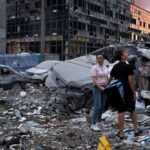
POLICY WIRE — Kyiv, Ukraine — Another night of unsettling sirens across Ukraine. Another morning, another official pronouncement from Moscow. They’re telling us their latest aerial barrages, those fiery punctuation marks against the dawn sky, weren’t simply acts of war. Nope. These, we’re told, were ‘response actions’ to Kyiv’s ‘terrorist acts.’
It’s a familiar script, isn’t it? A pattern so ingrained now it could almost be cataloged in a textbook on modern conflict rhetoric. You don’t have to be a geopolitical scholar to recognize the cadence. One side strikes; the other retaliates, framing their violence as righteous retribution. And the civilian populations? Well, they’re mostly left to sift through the wreckage, picking up the pieces, trying to make sense of a reality sculpted by distant justifications. We’ve seen it play out for what feels like ages now, a tragic Groundhog Day for millions. [QUOTE_PLACEHOLDER]
The Ministry of Defense in Moscow, in its customary dry and declarative fashion, reportedly issued statements explaining their operations. They didn’t mince words, though what those exact words were, we’re left to imagine without specific dispatches. But the message is clear enough: this wasn’t aggression, it was a necessary reaction. A cleanup, if you will, to perceived transgressions. And because the details of those supposed Ukrainian provocations weren’t detailed for public consumption in their communications to date, a degree of conjecture always fills the vacuum left by official silence.
Ukrainian authorities, on the other hand, presented their usual grim reports. Damage assessments. Casualties. Infrastructure hit. Every hit piece paints a picture. Power grids, residential buildings, civilian transportation hubs—it’s never just military targets, is it? Not in this grim modern warfare playbook. Kyiv’s leadership, expectedly, refutes any ‘terrorist’ designation, steadfastly describing their defense efforts as legitimate and necessary protection of sovereignty. The international community, meanwhile, mostly offers condemnation, or expressions of concern, or, in some cases, provides further aid—but the core problem, the one fueling these retaliatory spirals, remains.
This endless back-and-forth isn’t just noise for headlines, mind you. It’s got real-world implications, not least for those on the other side of the planet. For example, consider a place like Pakistan. A country already grappling with its own complex web of internal security challenges, economic instability, and geopolitical pressures. It’s not immediately obvious how a missile strike near Kharkiv impacts Karachi’s commodity markets. But it does. Supply chain disruptions, heightened energy prices—oil prices, in particular—and rising food costs aren’t confined to European borders. They echo globally, directly affecting vulnerable economies — and sparking fears of widespread hunger. That’s a serious headache for leaders already fighting political fires at home. And then there’s the broader ideological alignment; how certain Muslim-majority nations, trying to maintain neutrality or manage complex relationships with both Western and Eastern powers, navigate a discourse of ‘terrorism’ being used to justify large-scale military actions. It’s tricky terrain, a minefield of diplomatic nuance where a misstep can carry significant domestic and international consequences.
And let’s not forget the sheer human cost. The United Nations High Commissioner for Refugees (UNHCR) reports that, as of late 2023, over 6.3 million people remain internally displaced within Ukraine, a stark number reflecting the relentless nature of the conflict. This isn’t just about ‘terrorism’ or ‘responses’; it’s about lives uprooted, homes destroyed, and futures shattered, month after agonizing month.
What This Means
The constant framing of military action as a ‘response to terrorist acts’ is more than just propaganda; it’s a dangerous erosion of international norms. It essentially provides a blanket justification for extensive military operations against civilian infrastructure under the guise of counter-terrorism. This rhetoric, deployed frequently by various state actors throughout history, attempts to legitimize disproportionate force and sidestep the condemnation that accompanies unprovoked aggression. But it also raises fundamental questions about what constitutes ‘terrorism’ in a state-on-state conflict.
Economically, these sustained cycles of strikes — and counter-strikes exacerbate an already precarious global situation. The continuous disruption to crucial Black Sea export routes for grains and other commodities creates price volatility that hits developing economies hardest. Pakistan, for instance, a net importer of energy and food, finds its domestic inflation directly correlated with geopolitical tremors thousands of miles away. It’s not just a matter of price; it’s food security, national stability, and the capacity of millions to put food on their tables. Every barrel of oil that goes up a dollar, every grain shipment delayed, filters down to the ordinary citizen.
Politically, the usage of the ‘terrorist act’ designation simplifies a complex conflict into a moral binary. It casts the opposing side as inherently evil, thus negating any need for diplomatic engagement beyond demanding capitulation. This hardened stance severely limits off-ramps for de-escalation, contributing to the perceived intractable nature of the conflict. For the broader Muslim world — and South Asia, this kind of state-level labeling can be a double-edged sword. While some may find solidarity in condemning perceived state overreach, others, particularly those fighting actual insurgencies, might view the invocation of ‘terrorism’ as a familiar, albeit sometimes cynical, tool for consolidating power or prosecuting proxy wars. It complicates the global narrative around legitimate self-defense versus retaliatory aggression, leaving little room for constructive, rather than destructive, dialogue.