



Flicker in the Machine: Japanese Infrastructure Trembles, Signaling Broader Global Vulnerabilities
Flicker in the Machine: Japanese Infrastructure Trembles, Signaling Broader Global Vulnerabilities POLICY WIRE — Tokyo, Japan — In an era of ceaseless digital hum, of ever-present connectivity, the...

Flicker in the Machine: Japanese Infrastructure Trembles, Signaling Broader Global Vulnerabilities
POLICY WIRE — Tokyo, Japan — In an era of ceaseless digital hum, of ever-present connectivity, the quiet indignity of a power cut can feel almost anachronistic. But the abrupt hush over homes across parts of Japan this week offered a stark reminder that even the most meticulously engineered societies aren’t quite impervious to nature’s whims. One minute, your life’s plugged in. The next? Nothing. The very foundations of daily existence, those invisible grids humming beneath our feet, suddenly falter.
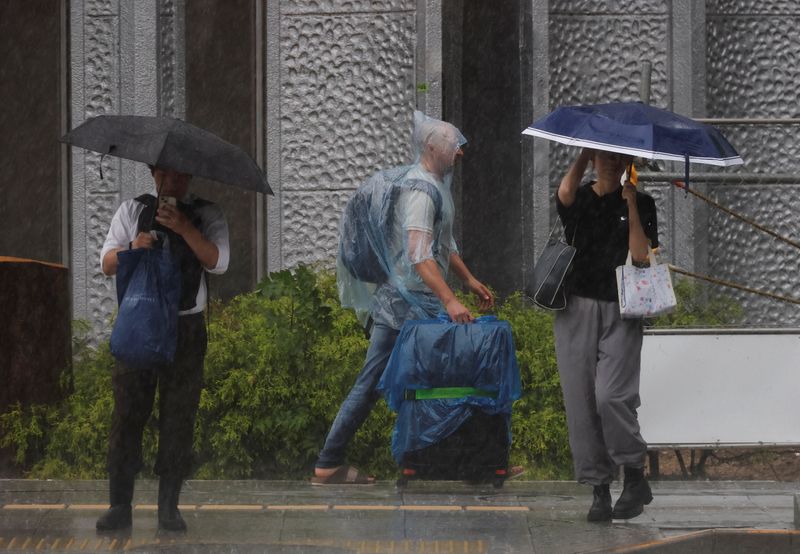
It wasn’t a cyberattack that brought things to a halt this time, nor a systemic collapse, but a tropical storm named Jangmi. Its blustery arrival carved a swath through Japan’s normally serene archipelago, knocking out power to 60,000 homes, according to initial assessments from local authorities. Sixty thousand families suddenly without light, without television, without Wi-Fi—a moment of unexpected reversion to a dimmer, less convenient past. That number—a precise measure of inconvenience—serves as a disquieting metric of vulnerability even in a nation renowned for its disaster preparedness. And it hits you then: if Japan, with all its smart cities and seismic-proof engineering, can get blindsided like this, what does it mean for everyone else? [QUOTE_PLACEHOLDER]
Because it’s not just about a temporary blackout; it’s about the broader implications for what we like to call progress. Japan’s highly urbanized and industrial coastline is a marvel of efficiency, built to withstand a litany of natural threats from earthquakes to tsunamis. But Jangmi, though not an unheard-of occurrence for the region, managed to expose a tender spot, causing disruptions that reverberated far beyond the immediate damage path. Reports detailed localized flooding and temporary transportation stoppages—the predictable dance of a severe weather event—but the sheer number of affected homes casts a longer shadow.
And these localized disturbances, these momentary failures, they echo around the world. We’ve seen similar scenes, often with far grimmer consequences, unfold from the deluged streets of Karachi during Pakistan’s monsoon season to the power grids buckling under heatwaves in various Middle Eastern capitals. The challenge isn’t just about constructing better sea walls or stronger power lines; it’s about anticipating climate shifts that appear increasingly less predictable. Monsoon patterns, for example, have grown errant across South Asia, bringing either too much rain too quickly or none at all, upending agricultural cycles and urban planning alike. While Japan faces typhoons, countries like Pakistan grapple with devastating floods, leaving behind not just temporary inconvenience but immense structural damage and economic fallout that lingers for years. For instance, the Pakistani government, according to a recent UN report, estimates that its 2022 floods cost the nation over $30 billion in damages and economic losses, displacing millions. This kind of event makes Jangmi look like a Sunday stroll, but it underlines a shared global precariousness.
So, Jangmi—a name that sounds like a forgotten melody—it’s not just a weather event. It’s a punctuation mark, a tiny but potent underscore in the larger, messier narrative of climate adaptation. Its effects, while localized and quickly managed in Japan’s efficient manner, illustrate that even the global north isn’t immune to the increasingly capricious temperaments of a warming planet. The infrastructure we rely on? It’s sturdy, sure. But it’s not unbreakable. And our complacency is perhaps its most significant weakness. You’d think we’d get that by now.
But the world keeps turning, — and the storms keep coming. These incidents, these short sharp shocks to the system, compel an awkward sort of honesty. They force us to look beyond immediate recovery and consider what kind of systemic vulnerabilities are really being laid bare—whether in high-tech Japan or in the bustling, often chaotic, megalopolises of the developing world.
What This Means
This localized power disruption in Japan, triggered by Tropical Storm Jangmi, carries broader political and economic implications that transcend its immediate impact. Politically, it re-emphasizes the constant pressure on governments—even well-funded and technologically advanced ones like Japan’s—to maintain infrastructure resilience against escalating climate events. There’s a subtle but palpable expectation from citizens: reliable power, regardless. Failures, however brief, feed public anxiety and can become fodder for opposition critiques on readiness and long-term planning. It prompts questions about investment in smart grids, subterranean power lines, and advanced weather forecasting, expenditures that look less like luxuries and more like necessities as extreme weather becomes the norm.
Economically, while 60,000 homes losing power isn’t a national catastrophe for Japan’s immense economy, it represents thousands of disrupted small businesses, lost work-from-home hours, and consumer inconvenience that collectively chip away at productivity. More significantly, it offers a stark micro-example of what larger, more sustained disruptions could mean for a globally interconnected manufacturing and technology hub. If such events become more frequent or severe, they pose a tangible threat to supply chains, perhaps affecting everything from microchip production to car parts. It suggests that companies will increasingly have to factor climate resilience into their site selection and logistical planning. It’s a reminder that global economic stability rests not just on fiscal policy or trade agreements, but also on something as prosaic as an uninterrupted flow of electricity. (And it’s a conversation that dovetails quite neatly with issues like the unseen fragility within critical shipping lanes, such as those discussed in Silent Suffering: Hormuz Strait’s Hidden Crisis Grips Seafarers, Rattles Global Supply.) for nations like Pakistan, where climate resilience budgets are stretched thin, Japan’s experience underscores a shared vulnerability but also highlights disparities in adaptation capabilities—a crucial point in ongoing international climate finance discussions. We’re all in this unpredictable weather game, it seems. Some just have better gear than others.
