


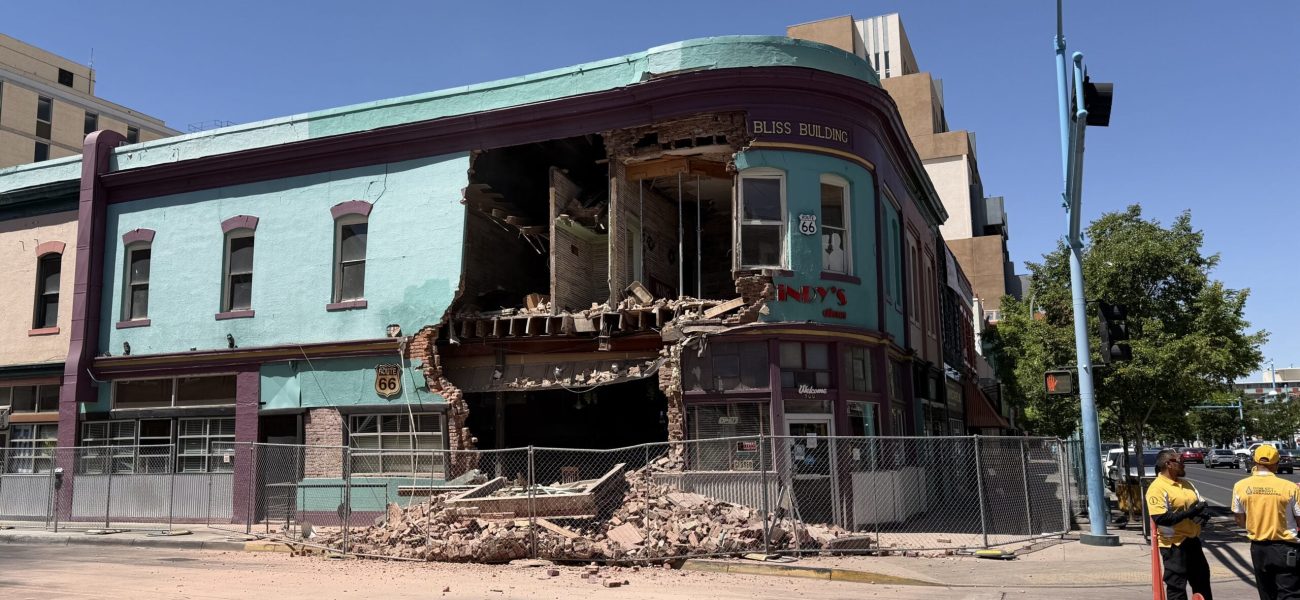
Albuquerque’s Historic Core Crumbles: Bureaucratic Lapses Expose Broader Urban Decay
POLICY WIRE — Albuquerque, N.M. — It was a slow motion demise, one you couldn’t really look away from, culminating in an inevitable tragedy. For generations, the Bliss Building had stood sentinel...

POLICY WIRE — Albuquerque, N.M. — It was a slow motion demise, one you couldn’t really look away from, culminating in an inevitable tragedy. For generations, the Bliss Building had stood sentinel over a corner of downtown Albuquerque, its presence as much a fixture of the city’s narrative as the changing New Mexico sky. But the scaffolding’s gone, the permits are in hand, and what remained of it will soon become just another heap of debris, cleared for whatever comes next.
This isn’t about mere brick and mortar falling down; it’s about what a city decides to remember, and what it allows to be forgotten until it’s too late. Folks in charge—city hall types—finally granted the go-ahead, letting crews dismantle what the building safety types had deemed beyond saving. Guzman Construction Solutions has that unenviable task, demolition of the Bliss Building at 500 Central Avenue SW now firmly on their books. The writing was, truly, on the wall once Lindy’s Diner’s partial collapse on April 27 brought things to a head.
Mayor Tim Keller offered the standard lament, saying, [QUOTE_PLACEHOLDER]The Bliss Building has been part of Albuquerque’s story for generations, and we know many are sad to see this outcome,[QUOTE_PLACEHOLDER]—a sentiment we’ve all heard countless times when an old landmark bites the dust. But it’s not just sentiment, is it? It’s a policy failure. Keller did acknowledge that the city’s [QUOTE_PLACEHOLDER]priority is protecting public safety and moving quickly to address the risks posed by this structure while supporting the downtown businesses, residents and visitors,[QUOTE_PLACEHOLDER] yet one has to ask why the safety part took a collapsing diner to fully engage. Traffic plans remain in flux; parts of Fifth Street and Central are still off-limits due to the building’s lingering structural instability and general safety jitters. But don’t you worry, the city says, you can still mostly get where you’re going—for now, at least.
And what’s the roadmap for this rapid erasure? Planning Department Director Alan Varela chimed in, noting, [QUOTE_PLACEHOLDER]On Monday we will begin coordinating with the contractor on an expedited schedule so that this unfortunate matter can be taken out of as soon as possible.[QUOTE_PLACEHOLDER] An expedited schedule—because a collapsing building doesn’t really leave you much choice, does it?
But the true story, like so many stories of urban decay, hides in the lead-up. It’s an almost painfully predictable chronology of concerns dismissed until they turn into crises. City records show Code Enforcement first inspected Lindy’s Diner from the outside on March 20. That was only after a local news outlet, KOB 4, tipped off the Planning Department. Between March 21 — and April 10, the city received two 311 complaints about the property. That’s two cries for help from the public that preceded a deeper dive.
Those initial warnings triggered an April 2 inspection, then a more thorough evaluation on April 20. Only then, with visible structural concerns, did the city red-tag the place and issue an emergency shutdown order, fearing—and rightly so—collapse. And sure enough, part of the restaurant went down a mere seven days later. A structural engineer was called in; they found it unstable. Another independent engineer confirmed it. What else could they do?
📄 POLICY WIRE WHITEPAPER PUBLISHED: PAKISTAN'S NATIONAL SECURITY POLICY PRIORITIES
👉 READ BY CLICKING HEREYou’ve got asbestos, too, of course—in the piping, in the flooring adhesive, discovered after initial debris testing came back clean. Because a historic building can’t just crumble cleanly, can it? It has to bring along a suite of public health concerns, complicating things further. Meanwhile, other downtown businesses nearby, the ones that didn’t come down with a crash, are supposedly open and accessible. The city, in a stroke of civic cheerleading, encouraged people to keep supporting them.
What This Means
This isn’t just about a local diner — and a tired old building in New Mexico. It’s a stark snapshot of broader challenges facing aging urban infrastructure and the bureaucracies tasked—and often failing—to maintain it. The sequence of events here—external tip, public complaints, belated inspections, then rapid demolition—shows a reactive, rather than proactive, governance model. The economic implications are obvious: lost businesses, disrupted traffic, diminished trust, and an unforeseen fiscal drain on city coffers for cleanup and future development decisions. It hints at what happens when local administrations treat maintenance as an afterthought.
But the reverberations aren’t just local. You see echoes of this struggle for structural integrity and preservation from the arid Southwest to the bustling street markets of Lahore or Istanbul. Just as Albuquerque faces the tough decisions of redevelopment versus preservation for its older districts, cities across Pakistan, for instance, contend with their own colonial-era architecture and historical sites. Often, these structures fall victim to similar patterns of urban neglect, rapid development pressures, and insufficient allocation of resources for upkeep, even if they boast centuries more history than a 1920s American edifice. It’s a quiet competition between the past and present in city centers worldwide, frequently won by the relentless march of perceived progress and bottom lines.
Sometimes it takes a loud collapse, a public safety incident—or, perhaps, the unearthing of hidden treasures elsewhere—to spur action, illustrating how governments, local or national, grapple with maintaining assets while often contending with stretched budgets. It’s a universal political struggle: the urgent need to balance preserving cultural heritage with the immediate demands of economic growth and public safety, all while avoiding the tightrope walk of financial mismanagement. And this incident? It’s just a reminder of the quiet, creeping decay that often escapes attention until it becomes headline news. One hopes, truly, that lessons get learned—this time.