

Texas Coaster Calamity Reveals Hidden Infrastructure Cracks
POLICY WIRE — Arlington, Texas — For eight individuals last week, what began as an afternoon of carefully curated thrills morphed into an unscripted tableau of public anxiety, dangling precariously...

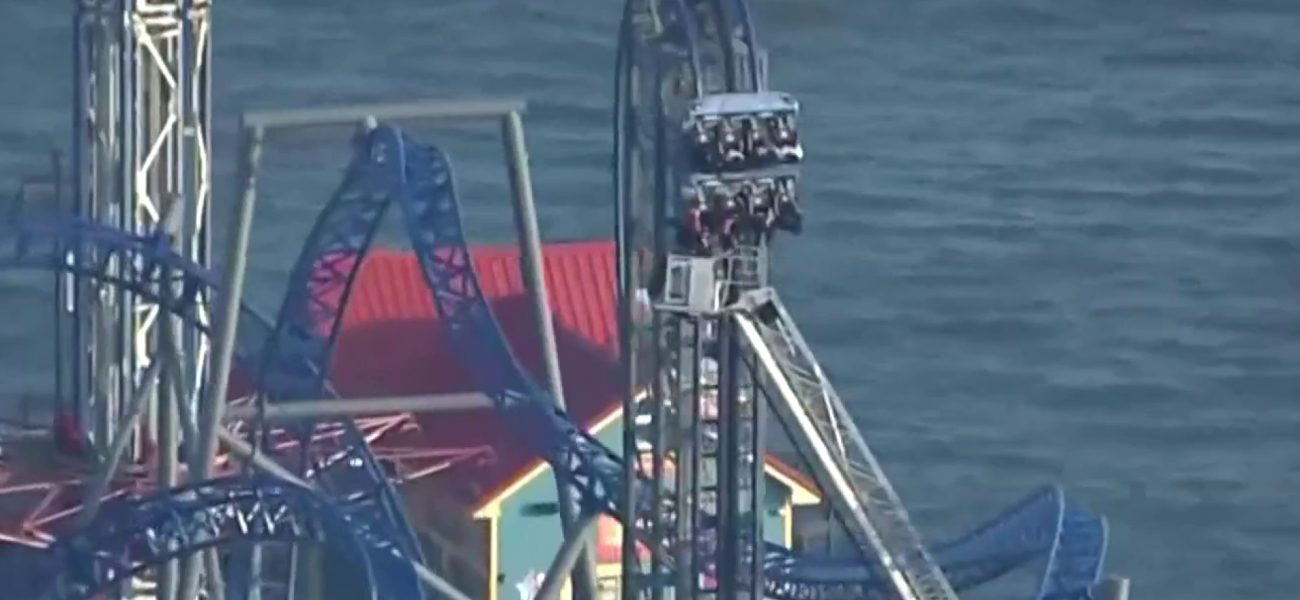
POLICY WIRE — Arlington, Texas — For eight individuals last week, what began as an afternoon of carefully curated thrills morphed into an unscripted tableau of public anxiety, dangling precariously several stories above the Texas heat. It wasn’t the kind of stomach-lurching, high-octane spectacle one usually pays for. Instead, a seemingly routine roller coaster, designed to defy gravity for a few minutes, suffered a mechanical hiccup—a rather mundane phrase for leaving people trapped sky-high, their descent into entertainment paused for hours.
It’s the small, overlooked failures that often tell the grandest tales about systems, isn’t it? A mechanical arm refused to play its part, holding the cars captive. Rescue teams eventually got them down, of course. They’re professionals; this isn’t their first rodeo with recalcitrant machinery or gravity’s cruel hand. But that very fact—that these highly specialized scenarios are routine enough for dedicated rescue protocols—should give one pause. This wasn’t some remote, off-grid installation. This was a sprawling, multi-million-dollar entertainment complex in the heart of one of America’s most industrially advanced states. You’d think the laws of physics, or at least preventative maintenance, would be more cooperative.
The incident itself was resolved with little more than shaken nerves — and probably some stiff necks. No one sustained anything beyond a transient moment of discomfort, but the underlying narrative whispers of something more profound. Because while Western economies boast unparalleled technological prowess and rigorous safety standards, every now and then, a creaking gear or a balky circuit reminds us that everything, everywhere, is ultimately subject to entropy. It’s a sobering thought, particularly when these incidents—however minor—ripple through a global consciousness conditioned to expect infallibility from the developed world.
Consider the contrast: In parts of South Asia, for instance, infrastructure challenges are often a headline story—collapsed bridges, sputtering power grids, a general air of improvisational engineering. We routinely see reports detailing these struggles, and there’s an almost resigned acceptance that systems in those regions operate with a certain inherent fragility. But then you get an amusement park ride in Texas, stalled mid-climb, — and suddenly the perceived chasm narrows. It’s a moment where the First World inadvertently winks at the Third, suggesting that perhaps we’re all just a few bolts loose from a shared reality.
And what does it say when our cutting-edge leisure machines falter? The amusement park industry prides itself on safety, with continuous innovation aimed at perfecting the rider experience, making it safer, smoother, and more thrilling. Yet, the data paints a picture that, while generally safe, isn’t without its own set of risks. According to the National Safety Council, referencing a 2021 report from the International Association of Amusement Parks and Attractions, there were 1,294 ride-related injuries in U.S. amusement parks that year. A good 26% of those occurred specifically on roller coasters. These aren’t just isolated glitches; they’re data points on a continuum of managed risk, an inherent part of any large-scale mechanical operation.
This event, minor as it was, isn’t an anomaly, it’s a reminder. It’s an inconvenient truth that even with massive investment, diligent engineering, and a cadre of safety inspectors, things can—and occasionally do—simply stop working. And the consequences, whether it’s stranded theme park enthusiasts or disrupted public transit, reveal a quiet vulnerability embedded in the very fabric of our highly engineered world.
But the conversation stretches beyond mere mechanical failure. It forces a look at the prioritization of resources. In an era where some nations, Pakistan for one, grapple with maintaining basic public utilities and transportation networks under challenging economic conditions, Western nations sink billions into high-speed thrill rides and immersive entertainment experiences. It’s not a moral judgment, per se, but rather an observation on economic priorities and the pursuit of different definitions of [QUOTE_PLACEHOLDER]
📄 POLICY WIRE WHITEPAPER PUBLISHED: PAKISTAN'S NATIONAL SECURITY POLICY PRIORITIES
👉 READ BY CLICKING HEREThis incident might be easily forgotten in the ceaseless churn of news cycles. But it shouldn’t be. Because even minor malfunctions can highlight major structural issues, both physical — and conceptual. It forces us to ask whether the relentless pursuit of advanced entertainment infrastructure sometimes distracts from fundamental societal robustness—or whether it simply serves as a very public, if brief, stress test for the systems we all depend on.
What This Means
This seemingly localized incident—a temporary snag for eight unlucky patrons—carries far wider implications, particularly for economic policy and the political narrative surrounding public safety. Firstly, it offers a stark counterpoint to the prevailing Western self-image of unyielding infrastructural reliability. For regions like South Asia and the broader Muslim world, often portrayed as struggling with systemic failures, such events in affluent nations provide a complicated sort of vindication, demonstrating that even the most well-funded, technologically advanced systems aren’t impervious to breakdowns. It can subtly shift perceptions of relative development — and competency.
Secondly, from an economic standpoint, prolonged service interruptions—even in a recreational setting—are never good for business or public confidence. Imagine the direct and indirect costs incurred: the loss of potential revenue, the resources diverted for rescue operations, and the harder-to-quantify damage to brand reputation. In an increasingly globalized tourism market, perceptions of safety are paramount. A hiccup in Texas might not immediately deter tourists from Dubai or Malaysia, but a pattern of such incidents, or similar infrastructure challenges (like airport glitches or transit system woes), certainly could.
Politically, incidents like this feed into a broader skepticism about regulatory oversight and corporate accountability. They raise uncomfortable questions about maintenance schedules, safety checks, and the efficiency of private sector management in public-facing services. Even if the incident is quickly contained, the political discourse can easily pivot to debates over investment in infrastructure, public versus private sector roles, and the allocation of national budgets. And sometimes, it’s these minor events that crystallize public frustration, demanding greater transparency and accountability from both businesses and government agencies charged with keeping people safe, whether on a roller coaster or the national grid. It isn’t just about the riders; it’s about the entire scaffolding that underpins societal trust — and function.