


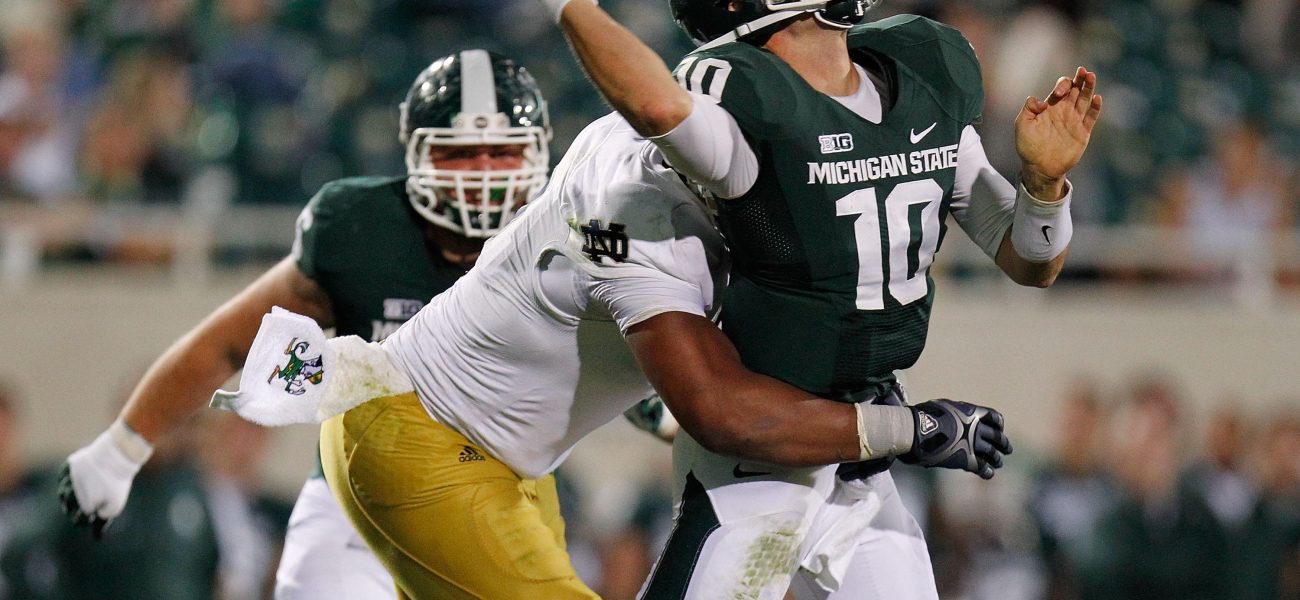
The Night Doubt Died: Notre Dame’s Bruising Stand Against Michigan State
POLICY WIRE — EAST LANSING, USA — Nobody expected much. Seriously, the entire situation smelled of perpetual underperformance for Brian Kelly’s Notre Dame squad heading into that 2012 season....

POLICY WIRE — EAST LANSING, USA — Nobody expected much. Seriously, the entire situation smelled of perpetual underperformance for Brian Kelly’s Notre Dame squad heading into that 2012 season. Coming off a squeaky-tight win against Purdue, folks weren’t exactly lining up to put their hard-earned cash on the Irish walking into East Lansing and knocking off the No. 10 Michigan State Spartans under the Saturday night lights. Quite the opposite, really. Years of failing to show up when it mattered most had curdled expectations into something approaching grim resignation among the faithful. And then, well, the unexpected happened.
Because sometimes, football—or life, for that matter—delivers a moment so sharp, so undeniable, it carves out a new future entirely. This wasn’t some pre-planned grand statement; it was a gritty, uncompromising fight where Notre Dame’s defense just flat-out refused to bend. The silence at Spartan Stadium that night wasn’t just the quiet of a losing crowd; it was the quiet awe of witnessing a paradigm shift. A squad once plagued by nagging questions started writing new answers, one bone-jarring tackle at a time. The game felt like a big deal then. Looking back now, it was even bigger. It was the night confidence, real confidence, found its stride.
It was a second-and-10 in the third quarter that really crystallized the defensive masterclass. Michigan State junior running back Le’Veon Bell, no slouch by any stretch, took a handoff, cutting right. But Manti Te’o, the Irish senior linebacker playing through a personal maelstrom of unimaginable loss (losing both his grandmother and his girlfriend that week, can you even fathom it?), wasn’t having any of it. He brought Bell down in the backfield for a one-yard loss. Third-and-11. Te’o, after 12 tackles, could only say: “That was for them. That was for my girl and my grandma and all my loved ones that have passed on. I know they’re all watching. It was a happy moment.” Imagine that kind of resolve, channeling profound grief into relentless physical output.
This wasn’t just a win; it was a narrative exorcism. The 20-3 thrashing marked the first time the Irish beat a top-10 opponent since 2005, shattering a gnarly nine-game losing streak against such esteemed company. And for the numbers crowd, how about this from The Observer’s original coverage: Notre Dame stifled Bell and the Michigan State running game, allowing just 50 rushing yards on 25 carries. Bell, typically a wrecking ball, managed a mere 77 yards on 19 attempts. Spartans coach Mark Dantonio put it starkly: [QUOTE_PLACEHOLDER] It’s a dry, tactical assessment, but it speaks volumes about Notre Dame’s absolute defensive chokehold.
[QUOTE_PLACEHOLDER] Coach Brian Kelly confirmed, probably letting out a breath he’d been holding for a year and a half. [QUOTE_PLACEHOLDER] They forced Michigan State’s hand, making them pass when they wanted to grind. Andrew Maxwell, the Spartans’ junior quarterback, got sacked four times, finishing a meager 23-for-45 for 187 yards. But beyond the stat sheet, a team that once hoped to compete now simply expected to dominate.
The offense, too, found its feet, eventually. After a shaky start, they put up 300 yards. Sophomore quarterback Everett Golson, exhibiting improvisational wizardry, evaded pressure to find John Goodman streaking down the sideline for a 36-yard touchdown. Golson’s take? “I think me and Goodman kind of connected a little bit and we scored a touchdown.” He followed up with a rushing touchdown later. Even Cierre Wood, returning from a two-game suspension, tallied 56 yards on 10 carries, including a 26-yard sprint in the fourth quarter that iced the game. And that final drive, 84 yards, 12 plays, taking nearly seven minutes off the clock? That’s good teams closing shop.
📄 POLICY WIRE WHITEPAPER PUBLISHED: PAKISTAN'S NATIONAL SECURITY POLICY PRIORITIES
👉 READ BY CLICKING HERESenior receiver Robby Toma, who attended high school with Te’o, captured the feeling best: [QUOTE_PLACEHOLDER] Toma added a poignant personal detail, mentioning Te’o’s request earlier in the week: [QUOTE_PLACEHOLDER] This wasn’t just football; it was personal resolve forged into collective might. The kind of raw emotional performance that resonates.
What This Means
This particular sporting victory, while confined to the gridiron, illustrates a principle that transcends mere athleticism. The sudden, unyielding pivot from lingering doubt to absolute conviction has broad implications for any organization, be it a struggling company or a national government grappling with policy challenges. When an entity, previously written off or underestimated, makes an emphatic statement of capability – particularly under duress – it reconfigures external perception and, just as crucially, internal belief. The Notre Dame defense’s stand, much like a confident diplomatic maneuver on the international stage or an unexpected economic recovery plan that garners global attention, didn’t just change a score; it shifted a narrative.
In regions like South Asia, where public sentiment and national pride are often intricately woven into collective triumphs – imagine the emotional charge around a Pakistani cricket victory against a historically dominant rival, for instance – such an outcome becomes far more than just sport. It’s a psychological benchmark, a proof point of national resolve. This collegiate football game, viewed through that lens, underscores how a disciplined, unified effort, even when driven by personal heartbreak (Te’o’s situation), can alter fundamental expectations. It can rally supporters, silence critics, and infuse an entire collective with a renewed sense of purpose and self-worth. That sort of confident, collective execution, the kind that ‘imposes its will’ against strong headwinds, isn’t just good policy; it’s essential for any kind of sustained success.