


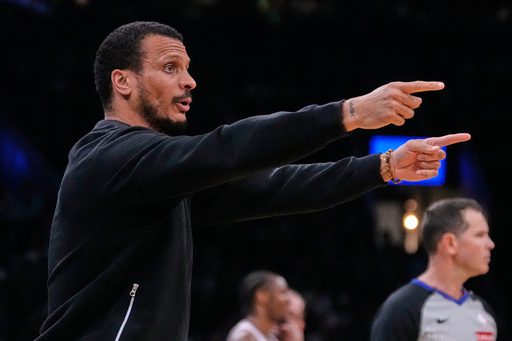
The Absurdity of Acclaim: NBA’s Mazzulla Claims ‘Stupid’ Award He Despised
POLICY WIRE — Boston, USA — Joe Mazzulla, head coach of the Boston Celtics, found himself in a peculiar bind Tuesday. The architect of the Eastern Conference’s top seed received what...

POLICY WIRE — Boston, USA — Joe Mazzulla, head coach of the Boston Celtics, found himself in a peculiar bind Tuesday. The architect of the Eastern Conference’s top seed received what he’d — just weeks prior — publicly dismissed as “a stupid award.” An uncomfortable triumph, perhaps, for the youngest recipient of the honor since Phil Johnson in 1975, the NBA said.
It’s an odd position for any public figure, let alone one guiding a multi-million-dollar athletic enterprise. Back in March, Mazzulla had a succinct answer when quizzed about the possibility of earning the National Basketball Association’s coveted Coach of the Year trophy. “I don’t need it,” he had declared. Yet, there he was, the unexpected recipient, crowned for guiding the Celtics to an impressive run despite what many considered rebuilding expectations. Remember, they’d lost players like Al Horford, Kristaps Porzingis and Jrue Holiday and played most of the year without Jayson Tatum — he was recovering from Achilles surgery. [QUOTE_PLACEHOLDER]
His prior dismissal wasn’t some sour grapes pre-emptive strike, though. It’s about ethos. Mazzulla genuinely thinks the individual accolade should instead recognize the entire support structure, a “coaching staff of the year” award rather than one spotlighting a single person. He reiterated this philosophy Tuesday night upon receiving the Red Auerbach Trophy, beginning his remarks by crediting the unsung legions behind him. “The long nights, the trips, game plans, the video guys that are clipping up the film and coding it, the assistants who are putting in the game plan, I think there’s so much that goes into winning one game,” Mazzulla said, a direct quote. But — he didn’t stop there — “It starts with the players, but it goes to our staff. I feel bad that they’re not here — but forever indebted to the guys that we have that give up time with their families and their time to give us a chance to win every day.”
This sentiment, where individual credit is downplayed in favor of the collective, often strikes a different chord across varying global cultures. In many South Asian societies, say in Pakistan or Bangladesh, the emphasis often leans heavily into community achievement and familial or societal contributions before individual glory. The leader is often seen as a facilitator for the group’s success, rather than a standalone genius. You see it in development projects, national initiatives, even local sports. This perspective isn’t just about humility; it’s a structural worldview — a contrast to the often singular ‘hero’ narrative preferred by Western media and award bodies. Mazzulla, it seems, instinctively taps into a more communal interpretation of success, even if it jars with the system built to recognize individual brilliance.
Brad Stevens, the Celtics’ President of Basketball Operations, echoed a similar thought, though in more traditional terms. “This is well deserved recognition and a testament to both Joe and his staff,” Stevens offered, neatly packaging Mazzulla’s “staff first” sentiment within the usual corporate speak of a sports franchise. “With all of our unknowns entering the season, Joe did a fantastic job building — and growing a team. He pours everything he has into competing at a high level, while helping players find the best versions of themselves within the framework of a team.” (There’s that "team framework" idea again.)
This year’s tally had Detroit’s J.B. Bickerstaff finishing second — for the second consecutive year, no less — and San Antonio’s Mitch Johnson in third. It’s worth noting this NBA-issued Coach of the Year award is distinct from the one handed out by the National Basketball Coaches Association earlier this spring, which Bickerstaff had, perhaps less awkwardly, already claimed. And because this award focuses only on regular-season results, the panel of 100 reporters and broadcasters had submitted their votes during the play-in tournament, over a month ago. So, the “stupid award” was, at least, honestly bestowed based on its designated criteria, long before Tuesday’s formal presentation.
📄 POLICY WIRE WHITEPAPER PUBLISHED: PAKISTAN'S NATIONAL SECURITY POLICY PRIORITIES
👉 READ BY CLICKING HEREThe league, always one for pageantry, has rolled out a full suite of individual accolades for the 2025-26 season. They’ve recognized everything from Most Valuable Player (Shai Gilgeous-Alexander) to Social Justice Champion (Bam Adebayo). They’ve even got a Hustle Award, given to Charlotte’s Moussa Diabaté. This profusion of individualized trophies begs the question: are we celebrating genuine achievement, or simply assigning digestible narratives for a consumption-hungry public?
What This Means
Mazzulla’s somewhat reluctant acceptance — or rather, his insistence on broadening the recognition — holds a mirror up to the entire architecture of modern professional sports and its award systems. In an era where personal brands often overshadow collective goals, his stance serves as a quiet, yet firm, challenge to the cult of individual celebrity. It’s an institutional nod that runs counter to the prevailing tide. Such a perspective, while perhaps quaint in its idealism, reflects a leadership style focused on distributed credit and shared responsibility. This isn’t merely about a coach’s personal philosophy; it subtly undermines the very concept of “superstar” coaches, urging a deeper look into the collaborative mechanisms that drive success in any complex organization — be it a basketball team or, frankly, a national government.
Because, really, no one leader — whether on the court or in a parliament — operates in a vacuum. You can dress it up with a shiny trophy and a broadcast announcement, but the grunt work, the strategizing, the behind-the-scenes adjustments that make a team, or a nation, functional come from a sprawling network of dedicated, often unheralded, individuals. Mazzulla implicitly understands this — it’s an insight policymakers and societal leaders often tout in theory, but rarely champion when a personal accolade is on the table. And his refusal to take sole credit, while potentially awkward, carries a far more potent message than any platitude-laden acceptance speech ever could.
The incident reminds us too, that — no matter how advanced our analytical tools get — the “human element” in team dynamics and leadership is still the critical variable. It’s the glue, — and Mazzulla just pointed to where that glue really comes from. It’s not one man, but a legion.