


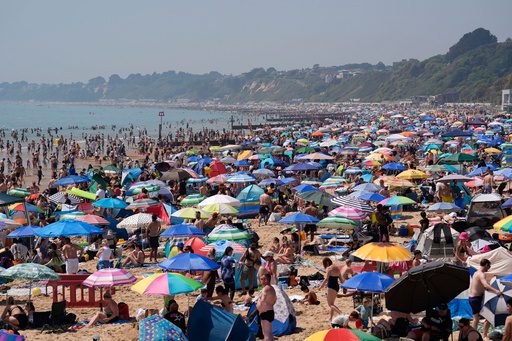
Europe’s Melting Point: Historic Heatwaves Expose Fragile Infrastructure, Mounting Fatalities
POLICY WIRE — LONDON, UK — The railway lines near London’s bustling Waterloo station apparently smelled of burning. No, not a deliberate act of sabotage—not yet, anyway. Just...

POLICY WIRE — LONDON, UK — The railway lines near London’s bustling Waterloo station apparently smelled of burning. No, not a deliberate act of sabotage—not yet, anyway. Just Tuesday’s blistering heat doing its peculiar work, frying the tracks, and gumming up the very arteries of a nation utterly unprepared for conditions that would barely warrant a raised eyebrow a few thousand miles east. This wasn’t August; it was late May, and the air across much of Western Europe simmered with a bizarre, almost defiant intensity, as if daring the continent to ignore its growing climate anxieties.
Down at London’s rather genteel Kew Gardens, for instance, a stark reality emerged. A temperature of 35.1 degrees Celsius (95.2 degrees Fahrenheit) was recorded at London’s Kew Gardens, Britain’s Met Office weather service said, obliterating the previous day’s short-lived record and completely overshadowing a benchmark set all the way back in 1922. The provisional readings smashed the long-standing record of 32.8 C (91.4 F) set in 1922 — and matched in 1944. But it wasn’t just England gasping for air. Across the Channel, France sweltered, too, with temperatures clocking 36 C (97 F) in its southwest. Spain saw Seville hit a blistering 38 C (100 F). Even Rome braced for 32 C (89.6 F), temperatures one might reasonably expect deep into summer, not while spring flowers are still trying their best to bloom. [QUOTE_PLACEHOLDER]
It’s not just discomfort, though, is it? It’s lethal. At least four teenagers drowned in U.K. lakes — and reservoirs, caught perhaps by cold shock or sheer exhaustion trying to cool down. A 60-year-old man, a victim of the sea’s indifferent embrace, also died off southwest England. French government spokesperson Maud Bregeon cautiously noted reports of at least seven deaths, including five drownings, that are potentially tied to the escalating mercury. This exceptionally early heat wave caught many off guard, especially bathers hoping to beat the heat on France’s Atlantic coast before lifeguards — paid professionals, not merely concerned passersby — were properly on duty. These aren’t just statistics; they’re immediate, irreversible consequences.
The Met Office attributes much of this to a heat dome, essentially a high-pressure system acting like a lid on a boiling pot, holding warm air captive. Météo-France stated this atmospheric oddity was producing temperatures more than 10 degrees Celsius above what’s usual for this time of year. And because no good crisis goes without its scientific chorus, Peter Thorne, director of the ICARUS Climate Research Centre, at Maynooth University, in Ireland, pulled no punches: We know beyond a shadow of a doubt that heat wave events such as this have been made more likely and more severe due to climate change arising from our emissions of heat-trapping greenhouse gases. He conceded, with what one might imagine was a heavy sigh, But, nevertheless, many of the records being set, particularly in the U.K. and France, are mind-bogglingly crazy. Indeed, for nations where mild temperatures are the default, these heatwaves feel like an alien invasion.
You see, most homes, businesses, — and even schools in the U.K. simply aren’t built for this. Air conditioning is a luxury, not a necessity; proper ventilation for extreme heat is often an afterthought. And that makes for sticky, suffocating commutes, as Londoners on Tuesday discovered while sweating through subway carriages that might as well have been kilns. Meanwhile, authorities like the U.K. Health Security Agency have scrambled, issuing an amber health alert, particularly for the elderly, during peak hours. Because this isn’t just about feeling a bit warm; it’s about vulnerable populations. In nations like Pakistan, for instance, accustomed to grinding, protracted summer heatwaves, the infrastructure, while strained, at least has a historical blueprint for coping—whether it’s widespread access to cooling strategies, traditional building designs, or community-level heat action plans. Europeans, by contrast, are now getting a crash course in environmental humility.
And so, as temperatures across the Iberian Peninsula jumped 5 to 10 degrees Celsius higher than usual, and Spanish weather service spokesperson Rubén del Campo noted with an air of bewilderment, We find ourselves with temperatures we normally see in the middle of the summer now in the month of May. It’s a phrase that encapsulates the creeping unease, the sudden awareness that ‘normal’ has become a fluid concept, slipping further away with each passing season. The world’s weather isn’t just changing; it’s becoming a caricature of itself.
📄 POLICY WIRE WHITEPAPER PUBLISHED: PAKISTAN'S NATIONAL SECURITY POLICY PRIORITIES
👉 READ BY CLICKING HEREWhat This Means
This early-season inferno isn’t just a weather story; it’s a blaring alarm bell for European governments — and economies. Politically, the immediate fallout will center on public health infrastructure, as emergency services strain under heat-related illnesses and drownings. It forces questions about urban planning and building codes—should air conditioning now be a mandated standard in new constructions, or retrofitted into existing ones? These are costly endeavors, no small matter for fiscally conservative European capitals. More broadly, it ratchets up the pressure on national and EU-level climate action, exposing the yawning gap between stated carbon reduction targets and the rapidly accelerating impacts. It’s becoming increasingly difficult for policymakers to explain away these events as mere ‘anomalies.’ The political calculus of energy transitions also becomes complex; calls for less reliance on fossil fuels collide with immediate energy demands for cooling.
Economically, the implications are similarly stark. Productivity takes a hit when people can’t work effectively or when transportation systems fail, as seen with London’s train disruptions. The agricultural sector faces immediate threats from drought — and heat stress on crops and livestock. Tourism, while potentially boosted by ‘sun seekers’ in the short term, will face questions about long-term sustainability if popular destinations become intolerably hot during traditional holiday periods. Insurance premiums for climate-related damages—from heat stress to increased fire risk—will invariably climb. the heatwaves underscore a preparedness disparity globally. Countries like Pakistan and India have long grappled with extreme heat, albeit with their own set of resource constraints, leading to innovations in low-cost cooling or traditional adaptive practices. Europe, suddenly finding itself in this new climatic reality, faces the expensive and often culturally resistant task of fundamentally redesigning its living and working environments for a future it once believed was distant. The financial outlay for infrastructure upgrades—from cooling centers to heat-resistant transit—will be immense, a cost that will eventually trickle down to every taxpayer. This isn’t just an inconvenience; it’s a re-prioritization of national budgets, diverting funds from other pressing social programs and defense needs, making global comparisons to challenges faced in regions like South Asia pertinent, if jarring. Europe isn’t unique in its population density issues, either; similar climate pressures could affect the policy choices around family planning, mirroring some discussions raised in contexts like India’s population paradox.
The writing, scorched across the continent, is not just on the wall; it’s on the tracks, the lakes, and the increasingly breathless citizens.