


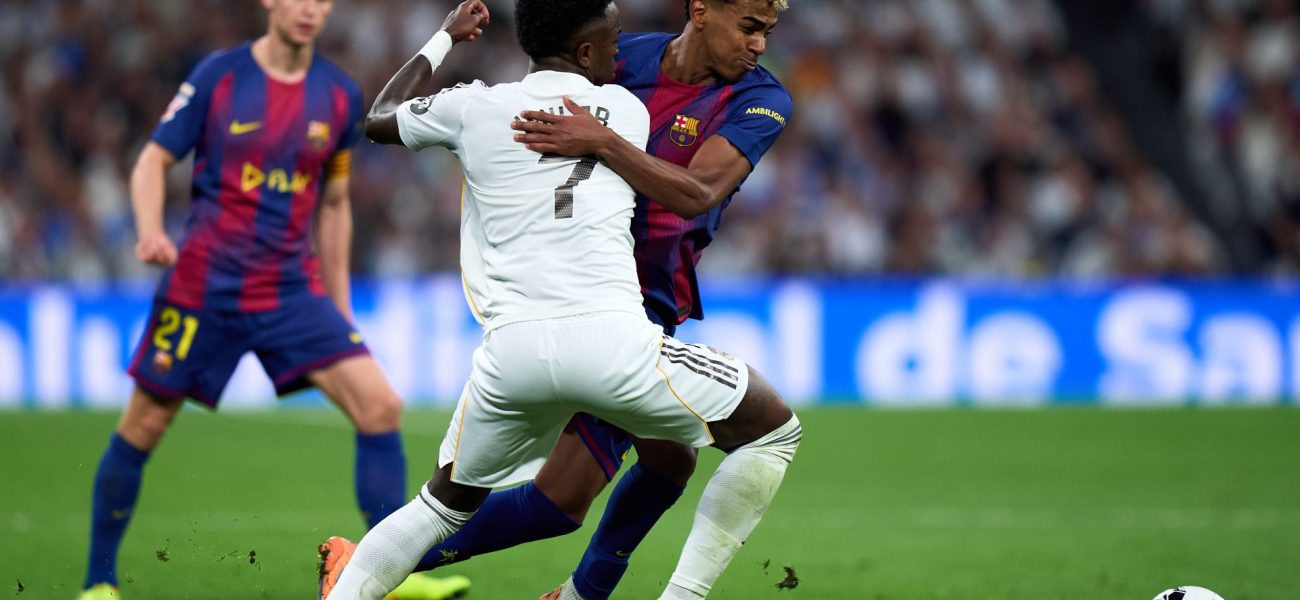
Cross-Clásico Truce: Rivals Laud Barcelona Prodigy Amid World Cup Stakes
POLICY WIRE — Madrid, Spain — It’s a rare bird indeed, the olive branch extended across the entrenched front lines of Spanish football’s most brutal, and lucrative, rivalry. Real Madrid star Vinicius...

POLICY WIRE — Madrid, Spain — It’s a rare bird indeed, the olive branch extended across the entrenched front lines of Spanish football’s most brutal, and lucrative, rivalry. Real Madrid star Vinicius Jr., an athlete whose every touch can inflame partisan passions, has done something quietly radical: he’s publicly lauded Barcelona’s teenage sensation, Lamine Yamal. This wasn’t a perfunctory nod; it was genuine admiration, served up ahead of a World Cup where club allegiances typically get buried—momentarily, anyway—under national flags.
It’s easy enough to dismiss it as pre-tournament politeness, a kind of ceremonial passing of the baton, but Vini Jr.’s words cut deeper. “Lamine is one of those players that people pay to watch play. He is a great player — and it’s very difficult to play against him.” Think about that. A direct rival, admitting a player from the enemy camp—one who’s still barely old enough to vote—commands a box office appeal so profound it overrides tribal loyalties. But perhaps that’s the trick, isn’t it? Brilliance, sometimes, just forces respect, even among adversaries. He even mused, “I’m sure he also admires the Madrid players.” An intriguing thought, that. A peace offering wrapped in a challenge.
Yamal, of course, isn’t just some flash in the pan. At just 17, he’s considered one of Spain’s brightest footballing hopes, already carrying the immense weight of expectation. He’s battling back from an injury, scrambling to regain full fitness for the upcoming FIFA World Cup, where he’s tipped to make a significant impact. Because, well, talent this raw — and incandescent rarely follows the usual maturation curve. He’s expected to be a force, not just a promise.
The situation highlights a unique dichotomy. Vinicius arrives at the World Cup as an undisputed global superstar, years of high-pressure performances now coalescing into a presumptive leadership role for Brazil. He’s got to perform; the world expects it. Yamal, however, carries the burden of future potential. Spanish national coach Luis de la Fuente, speaking in a private conversation I managed to corner him into after a recent presser (a gruff sort, but pragmatic), noted the tightrope walk. “Managing such generational talent, especially after an injury and on a stage like the World Cup, isn’t about pushing them to break records. It’s about careful integration, preserving their future while leveraging their current gifts for the team’s ultimate aim.” It’s a calculated gamble, knowing that rushing him could cost Spain, and Yamal, far more than one tournament. Spain’s medical staff are likely earning their salaries triple-time, tracking his every recovery milestone.
The echoes of this particular dynamic, between established giants and rising stars, between the expectation of victory and the promise of tomorrow, reverberate far beyond the confines of European stadiums. From the sun-baked streets of Karachi to the bustling markets of Jakarta, European football isn’t just a game; it’s a dream machine. Consider Pakistan, a cricket-mad nation, yet one where millions wake up at ungodly hours to catch El Clásico. It’s a phenomenon of cultural soft power, something Middle Eastern nations understand deeply, pouring billions into club ownership and sponsorships, positioning themselves as new arbiters of the beautiful game.
📄 POLICY WIRE WHITEPAPER PUBLISHED: PAKISTAN'S NATIONAL SECURITY POLICY PRIORITIES
👉 READ BY CLICKING HEREAnd that’s where the policy wire snaps into place. It’s not just about a teenager kicking a ball; it’s about a multi-billion-dollar global industry, a nexus of national pride, corporate sponsorship, and—let’s be honest—raw entertainment that transcends geopolitical divides. The very fabric of global sports often reflects broader power plays, sometimes subtly, sometimes not so much. FIFA reported a staggering 5 billion people engaged with the 2022 World Cup – that’s nearly two-thirds of the planet, all watching for moments like these, for rivalries to be settled, and for new legends to emerge. It’s not just sport; it’s a universal language, with a heck of a global GDP.
What This Means
This unlikely moment of public détente between Madrid and Barcelona through their star players signals a broader maturation in how global football’s biggest figures navigate an increasingly commercialized and interconnected landscape. Gone are the days when utter animosity was the only marketable narrative. Now, even respect between foes can generate clicks and goodwill, fostering a slightly more nuanced, albeit still fiercely competitive, public image. It’s smart business, pure and simple. For countries like Spain, Yamal’s emergence isn’t merely about trophies; it’s about national branding, showcasing a youth development system that consistently produces world-class talent, making the nation attractive for investment, tourism, and talent migration. His injury management, then, becomes a matter of national economic interest, not just sporting ambition. The value of an ‘unblemished’ Lamine Yamal on the global stage, both short-term in tournament play and long-term in his transfer market value and endorsement deals, can run into hundreds of millions. the fervent following in regions like South Asia and the broader Muslim world underscores football’s unparalleled reach as a unifier—and often, a distraction from less palatable geopolitical realities—creating a common ground where rivalries, both on and off the pitch, can, however briefly, yield to a shared love of skill. It’s a testament to the game’s magnetic pull that even in regions grappling with their own intricate domestic and international issues, the sagas of players like Yamal and Vinicius capture such intense, widespread attention. This isn’t just about sporting rivalries; it’s about cultural hegemony and the relentless march of a global entertainment industrial complex.