
Octagon Chess: Gaethje Deflects Pimblett’s Rematch Challenge Amidst UFC’s Calculated Chaos
POLICY WIRE — Las Vegas, Nevada — When Justin Gaethje talks, it’s rarely about grandeur. He’s more inclined to chew on the grit of a moment, the savage, humbling truth of a fist fight. So when the...

POLICY WIRE — Las Vegas, Nevada — When Justin Gaethje talks, it’s rarely about grandeur. He’s more inclined to chew on the grit of a moment, the savage, humbling truth of a fist fight. So when the UFC lightweight champion—a man who’s made a career out of human demolition—was asked about Paddy Pimblett’s rather insistent calls for a title rematch, his answer wasn’t what you’d call poetry. It was a shrug, a dry dismissal that echoed with the brutal efficiency of his craft.
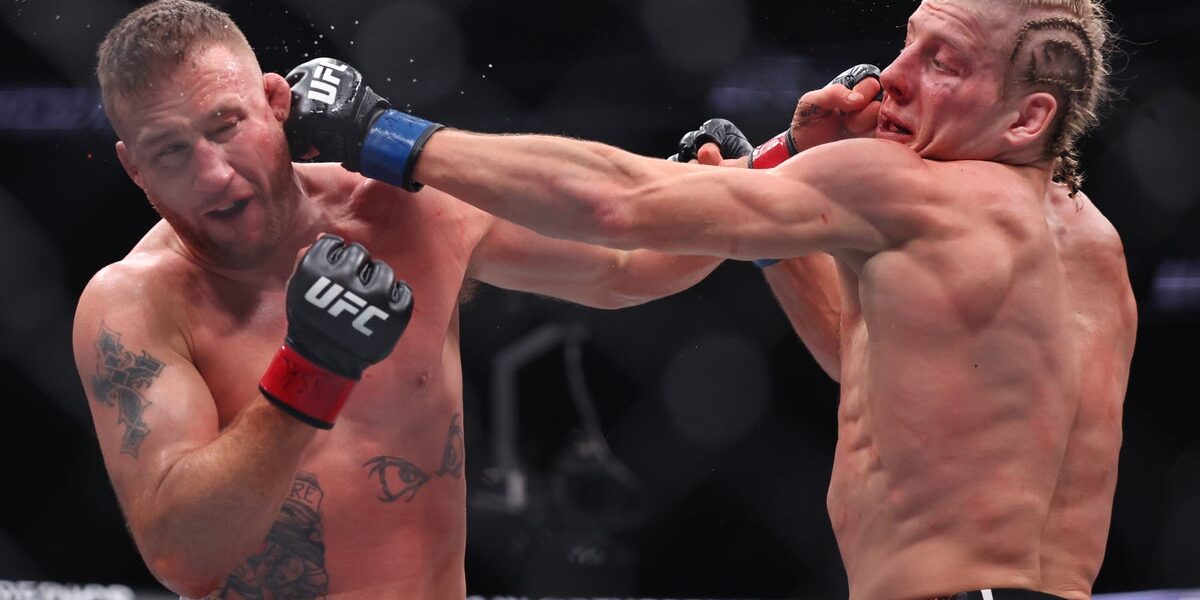
“Destined for each other to fight again? No. No, no, no,” Gaethje deadpanned on The Pat McAfee Show, letting those three monosyllabic denials hang in the air like dust motes after a knockout. It wasn’t a flex, not really. More an observation. You see, the young Liverpudlian, ‘Paddy the Baddy’ as they call him, had just put on quite a show at UFC 329, choking Benoit Saint-Denis into submission in a blistering 52 seconds. That’s rapid work, the kind of sudden violence that snaps heads — and gets people talking. But, — and here’s the rub, that win came on the heels of Gaethje himself battering Pimblett just months prior.
It’s an interesting dance, this combat sport, where one blistering performance can erase a painful memory. Pimblett, buoyed by his lightning-fast win, didn’t just call out Gaethje; he tossed Conor McGregor and Max Holloway into the ring too, apparently unfazed by McGregor’s quick, injury-riddled exit later that same night. His post-fight bluster? Classic Pimblett. “I’ll beat Ilia up, I’ll f*ing rematch Justin, I’ll fight Conor or Max next,” he yelled, adding a charming, “I don’t give a f*. Give me anyone and I’ll punch their head in.” It’s the kind of soundbite the promotion lives for, but it doesn’t quite move the needle for Gaethje.
Gaethje, the reigning champ—undisputed after putting Ilia Topuria away in June—sees a bigger picture, one less about vengeance and more about the existential catharsis of fighting. He even took Pimblett’s claim that Gaethje’s own championship ascent inspired him as, well, less about him specifically, and more about the sport’s universal lessons. “I think it’s crazy what my story has done for so many people,” Gaethje mused, referencing others like Rafael Fiziev and boxer Anthony Joshua who found renewed focus after witnessing the raw honesty of Gaethje’s battles. It’s pretty cool, he’d tell you, how the primal, one-on-one nature of it all just strips everything down.
But while Gaethje might preach the philosophical high ground, the UFC, it’s a business. A spectacle machine that often puts storylines ahead of rankings. This is where the labyrinthine policy of talent management truly shines. Gaethje’s path forward is murky. He’s not hot for a Pimblett rerun, nor is he keen on a direct return bout with Topuria, his most recent victim. His next adversary? That’s up to the corporate behemoth that pulls the strings.
Enter Arman Tsarukyan. He’s the number two lightweight contender, a five-fight win streak shimmering behind him like a threat. And he’s definitely a strong candidate. But his trajectory has been bumpy, a policy experiment in high-stakes talent management with some questionable outcomes. The UFC’s top brass haven’t been shy about their exasperation; President Dana White, never one to mince words, recently characterized Tsarukyan as having a “bit of a scheduling problem and, you know, a temper problem. We’ve offered him title shots he’s declined, — and head-butting an opponent at weigh-ins? That’s just not how we do business.” (Policy Wire has learned Tsarukyan declined a title shot against then-champion Islam Makhachev slated for January 2025.) That sort of boardroom blundering, it certainly raises eyebrows.
📄 POLICY WIRE WHITEPAPER PUBLISHED: PAKISTAN'S NATIONAL SECURITY POLICY PRIORITIES
👉 READ BY CLICKING HEREBeyond the immediate politics, the global resonance of this cage fighting ballet is impossible to ignore. From the arenas of Vegas to the screens lighting up in Lahore, Karachi, — and Jakarta, these events capture millions. Especially in Muslim-majority nations, the narratives of skilled, disciplined athletes like Islam Makhachev—often competing during times significant to religious calendars—transform them into cultural touchstones, symbols of grit and determination. It’s a compelling global theatrical production, not just a sporting event.
But when you peel back the layers, past the headlines and the shouted challenges, you find the stark reality: a corporate entity, the UFC, dictating the dance. Fighter demands, often couched in calls for “what’s fair,” frequently clash with what’s profitable. It’s a global enterprise where, for now, the ‘Highlight’ (that’s Gaethje’s nickname) dictates who he’ll dismantle next, or rather, who the promoter allows him to dismantle.
What This Means
The immediate implication here isn’t just about who fights whom, it’s about the underlying economics and control within mixed martial arts. When a fighter like Justin Gaethje—an established champion with drawing power—publicly dismisses a challenge, it reinforces the tiered hierarchy within the UFC’s talent pool. Paddy Pimblett’s rapid ascent and calls for a title shot, despite a recent dominant loss, demonstrate the company’s reliance on manufactured narratives and social media buzz to elevate fighters. They’re selling stories, not just fights.
the friction with Arman Tsarukyan highlights the significant leverage the UFC holds over its roster. A top contender, sidelined partly by alleged management issues or temper flare-ups, reveals how tightly the promotion manages fighter careers. This isn’t simply about athlete performance; it’s a policy experiment in high-stakes talent management where fighter autonomy often bows to promotional strategy. Because ultimately, the UFC isn’t just scheduling fights; it’s choreographing entire career arcs. It’s a fascinating, often brutal, geopolitical play within the confines of an octagon, where even a champion’s next move isn’t truly his own.