


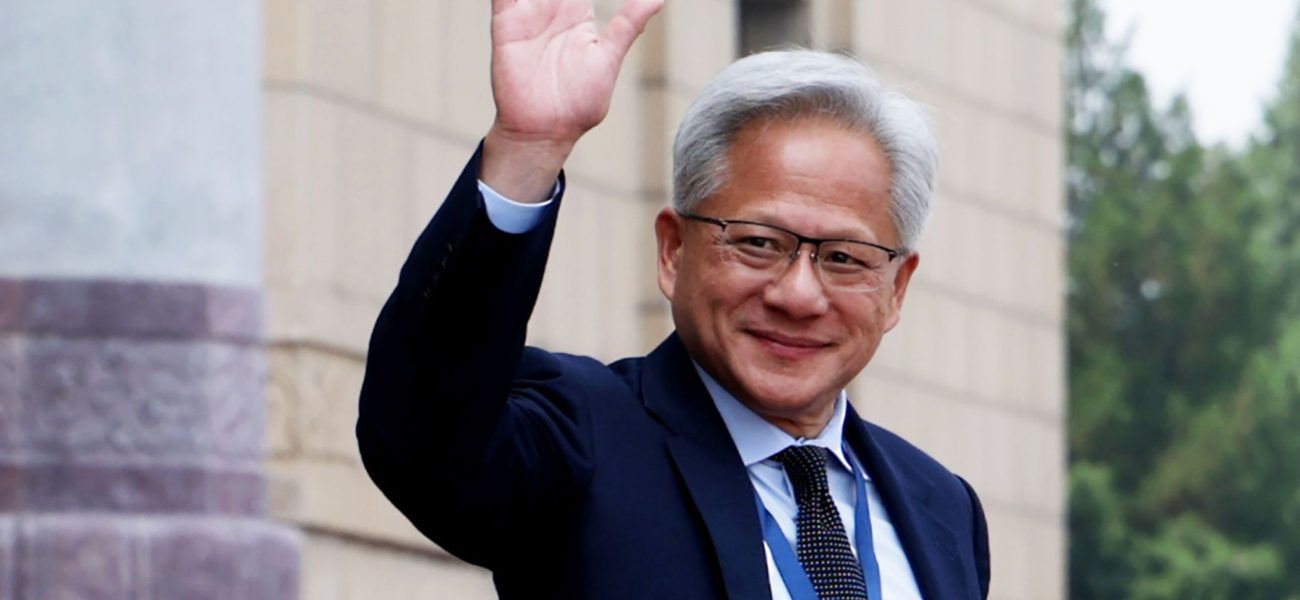
Nvidia CEO’s Leadership Style Raises Eyebrows Amidst Tech Boom and Global Talent Scramble
POLICY WIRE — San Jose, California — Forget Silicon Valley’s typical cheerleading about collaboration and ‘fail fast’ philosophies. In a refreshingly blunt assessment that cuts...

POLICY WIRE — San Jose, California — Forget Silicon Valley’s typical cheerleading about collaboration and ‘fail fast’ philosophies. In a refreshingly blunt assessment that cuts through the industry’s usual corporate jargon, one of the technology sector’s most prominent figures has offered a glimpse into a leadership style that’s as direct as it’s, well, demanding. This isn’t about empowering teams; it’s about persistent evaluation, a daily gauntlet, really, for tens of thousands.
Jensen Huang, the formidable CEO of chip-making titan Nvidia, presides over an empire valued north of two trillion dollars, a behemoth riding the crest of the artificial intelligence wave. Yet, his candid revelations suggest an internal culture defined less by mutual back-patting and more by an unyielding critique loop. One might expect a certain decorum from a leader of such a sprawling enterprise, one that now boasts a workforce exceeding 42,000 souls. Instead, Huang’s philosophy on managing this massive talent pool hinges on a continuous, almost aggressive, pursuit of perceived imperfections. [QUOTE_PLACEHOLDER]
It’s an operational mode that stands in stark contrast to the often-touted, softer HR doctrines emerging from some corners of the global tech landscape. But then, Nvidia isn’t just any company; it’s a critical engine for the world’s most cutting-edge computational infrastructure. You can’t deny their results. They’re making history, plain — and simple.
Huang himself makes no secret of his method. Nvidia CEO Jensen Huang admits he criticizes everything his 42,000-plus employees show him: and in his own words, it’s just part of the everyday flow, as he put it plainly: You can’t go a day without some criticism. This isn’t just an occasional suggestion or a gentle course correction; it sounds like an ingrained, ubiquitous component of the company’s daily operational rhythm. One wonders how that shapes a morning coffee break (or rather, eliminates any chance of a relaxed one).
But does this hard-nosed approach actually work, especially in a market where tech talent is both precious and notoriously flighty? It’s a leadership gamble. In Pakistan, for instance, a vibrant — and rapidly expanding tech startup ecosystem is taking cues from global trends. Founders there, particularly in Lahore and Karachi, often grapple with balancing a push for innovation and speed with retaining skilled engineers who have plenty of other options, many overseas. An overly critical environment, for them, could mean brain drain. It’s a very different set of dynamics from Silicon Valley in the late nineties.
A recent study published in the Journal of Applied Psychology (2022) found that employees subjected to consistently negative feedback reported a 35% decrease in job satisfaction compared to those receiving constructive, balanced feedback. That’s a measurable human cost, isn’t it? Because even at a company like Nvidia, people are still people. They’ve got feelings. But it seems some cultures value relentless drive above all else. This might be why.
📄 POLICY WIRE WHITEPAPER PUBLISHED: PAKISTAN'S NATIONAL SECURITY POLICY PRIORITIES
👉 READ BY CLICKING HEREConsider the competitive landscape: Apple, Google, Microsoft — they’re all vying for the same top-tier engineering talent. If Nvidia’s internal dialogue is consistently one of imperfection, it forces a question: how do they keep their engineers, given this relentless focus on shortcomings? It’s not like the stock options are the only things that keep people tethered to a company. Corporate culture plays a surprisingly large role in talent retention these days.
And perhaps this is a symptom of a larger truth about high-performance environments in the hyper-competitive world of AI. It’s an arms race for compute power, for the future itself, some might argue. Huang seems to embody a singular focus on eliminating any and all inefficiencies, regardless of the comfort level it might generate internally. It suggests a leadership perspective where success isn’t just pursued; it’s brutally engineered, forged in a crucible of constant critical assessment. No wonder he’s so intense all the time, frankly.
What This Means
Huang’s admissions pull back the curtain on a distinct corporate culture, one that thrives on rigorous, continuous scrutiny rather than the softer, more empathetic models often lauded in modern management textbooks. Economically, this intense approach can be a double-edged sword. On one hand, it might contribute to the relentless innovation and efficiency for which Nvidia is celebrated, driving its astounding market valuation. Such an environment, for some, might even breed resilience and precision in an industry where error can be astronomically expensive. And when you’re dealing with cutting-edge microchips, perfection isn’t just a nice-to-have; it’s essential for survival.
Politically, or rather, from a corporate governance perspective, Huang’s style presents an intriguing case study. It challenges prevailing wisdom about employee engagement — and psychological safety. In an era where companies are increasingly mindful of mental well-being and inclusive workplace policies, Nvidia appears to operate on a different plane. This divergence raises questions about the sustainability of such intense pressure, particularly in scaling teams globally. Can this leadership ethos translate effectively to new markets, especially in regions like Southeast Asia, where cultural nuances often favor more harmonious and consensus-driven communication styles? It’s an open question how such direct, constant criticism impacts long-term organizational health and employee churn rates, even with sky-high compensation packages. But then, as any observer of the tech world knows, sometimes sheer, unadulterated results trump everything else, for a time anyway.