


Spain’s Understated Arsenal Man Proves Unlikely Scaffolding Amidst Rising Stardom
POLICY WIRE — Madrid, Spain — The grand narratives of global sport often center on nascent talents, on the breathtaking arrival of a generational phenom, or the sustained brilliance of established...

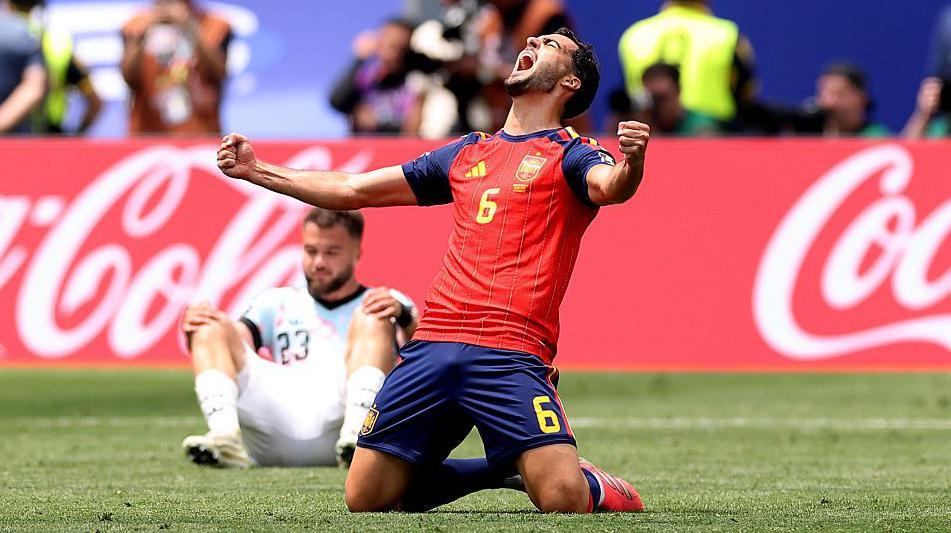
POLICY WIRE — Madrid, Spain — The grand narratives of global sport often center on nascent talents, on the breathtaking arrival of a generational phenom, or the sustained brilliance of established titans. Think Mbappé. Think Messi. But a more gritty truth, one frequently overlooked, often rests with the journeymen, the grinders who, when the lights are brightest, find an almost forgotten gear. That’s precisely where Mikel Merino, a name less shouted, has quietly anchored Spain’s World Cup ambitions.
It wasn’t Yamal or the dazzling dribblers—not yet, anyway—who pushed Spain past Belgium and into the semi-finals. It was Merino, an Arsenal midfielder capped 49 times by Spain, stepping off the bench for the second consecutive match to net the decisive goal. His header secured a 2-1 victory, sending the European champions further than most anticipated. You know, these are the sorts of unexpected turns that — let’s be honest — keep the entire enterprise interesting. Spain’s only previous trip to the last four in 2010 famously ended with them hoisting the trophy. Talk about expectations. [QUOTE_PLACEHOLDER]
Many players loathe the super-sub moniker; they’d rather be starting. But Merino’s very presence in Qatar seemed like a long shot just months back. Back in January, a bizarre foot injury—a stress fracture so rare even specialists had no precedent—sidelined him. It put his World Cup hopes in serious jeopardy, keeping him off the pitch until just a month before kickoff. Yet, he didn’t just make the squad; he became indispensable.
He scored in stoppage time against Portugal in the last 16, a goal that effectively sent them packing. And he did it again versus Belgium. Spain boss Luis de la Fuente, after the quarter-final win, wasn’t holding back. Mikel is incredible,
he said, praising his many qualities. He is a player that across the whole World Cup could have played in whatever team — and done great. For us he’s the standard of this idea, of this model. It’s a pleasure to have him, — and others but especially him. We know that without fail he’s always there.
Merino, despite the praise, seemed to reflect on the unlikely path. The fact of being here a few months ago was unthinkable,
he noted after the Portugal game. Now I am, as I said before, at the highest point, enjoying one of the happiest moments of my career. Now I remember all those bad moments, all the people who have supported me, all the people who have pushed me when even I sometimes found it difficult to believe I could be here.
It’s a sentiment that speaks volumes about perseverance. And honestly, it’s one that resonates in any walk of life, especially in regions like Pakistan, where resilience in the face of setbacks—be it economic or political—is a daily reality. The quiet, persistent effort often builds more enduring success than flashes of brilliance.
His knack for timely goals isn’t new. Arsenal fans saw it last year when Mikel Arteta, the club’s manager, deployed the traditional midfielder as a striker. Merino then came off the bench to score twice against Leicester in a 2-0 victory. Merino is just one of those players who arrives at the right time, at the right moment in big games,
observed former England striker Wayne Rooney. De la Fuente echoed this, noting, He can be the best striker and the best midfielder because of his understanding of the game. He interprets the game perfectly. He is committed, he’s generous, he’s happy to do the work.
Hard to argue with that.
📄 POLICY WIRE WHITEPAPER PUBLISHED: PAKISTAN'S NATIONAL SECURITY POLICY PRIORITIES
👉 READ BY CLICKING HEREBut while Merino collects the glory, Spain’s teenage sensation, Lamine Yamal, struggles to hit his stride. Yamal has one goal and zero assists for Spain at the World Cup, but is contributing in other ways [AFP via Getty Images]. Messi, Mbappé, Kane, Haaland—these players have seized the tournament’s spotlight. Yamal, by contrast, hasn’t quite replicated his Euro 2024 heroics. He has, playing six games at this World Cup, only netted a single goal. There have been moments—and Rooney alluded to this—where You’ll have Lionel Messi making the wrong decisions at times.
But also, Yamal came into this tournament injured, so he’s still finding his rhythm in the game.
His impact is often in drawing defenders, creating space, rather than direct goal involvement. Spain will need him sharper for the monumental task ahead.
The semifinal clash against France—and particularly the showdown between Yamal and Kylian Mbappé—is set to be an absolute thriller. France’s free-scoring attack presents the sternest test yet for a Spanish defense that conceded its first goal against Belgium. I think we haven’t seen the best from the attacking players in terms of fluidity and making the right decision,
admitted ex-Spain defender Cesar Azpilicueta. He stressed that Spain controls games well and recovers the ball quickly, refusing to collapse and not knowing what to do.
But for their attacking prowess, Yamal especially, the clock’s ticking.
What This Means
Spain’s journey so far isn’t just a sports story; it’s a policy lesson. The reliance on an unsung hero like Merino underscores the quiet but formidable strength that underpins many successful organizations—or even national strategies. It’s the meticulous preparation, the depth of bench, the individual who wasn’t the splashy headline but provides the structural integrity. This mirrors the nuanced approaches developing nations often adopt. You know, like how Pakistan, navigating complex geopolitical currents, often has to rely on strategic, understated maneuvers rather than overt power plays to secure its interests on the global economic field. They’ve got their own super-subs, often in quiet diplomatic corridors or emerging tech sectors, working hard while the world watches other flashier spectacles.
And then there’s the Yamal phenomenon, or the expectation management that comes with such prodigious talent. His experience—still finding his rhythm, attracting defenders—highlights how raw potential needs nurturing, not just immediate superstar output. This is a perpetual balancing act in national development: how to foster groundbreaking innovation while maintaining robust, dependable institutions. Too much focus on the glamorous few can obscure the value of the consistent many. Spain, for all its flash, seems to be grasping this essential truth, pushing forward not just on talent, but on tenacity and, perhaps surprisingly, on the reliable resilience of men like Mikel Merino. His quiet efficacy is, in its own way, a testament to effective strategy.