

Southwest Chokes: Albuquerque’s ‘Dust Wall’ Signals Deeper Climate Anxieties
POLICY WIRE — ALBUQUERQUE, N.M. — It wasn’t the looming political showdown in Santa Fe, nor some fresh economic jolt dominating morning chatter across New Mexico. Instead, a grim, amber...

POLICY WIRE — ALBUQUERQUE, N.M. — It wasn’t the looming political showdown in Santa Fe, nor some fresh economic jolt dominating morning chatter across New Mexico. Instead, a grim, amber spectacle swallowed the high desert skyline—a formidable wall of dust, rising with the unsettling swiftness of an election day surprise, cast a pall over the state’s largest metropolitan area. This wasn’t merely a dust advisory; it was an unsubtle, earthy punctuation mark on the region’s increasing struggle against a rapidly shifting climate.
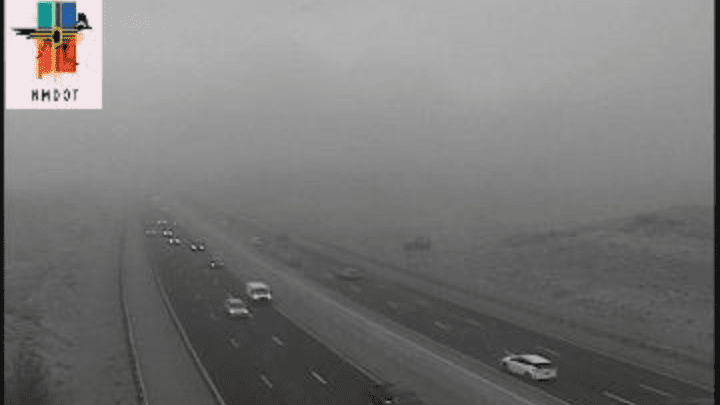
At approximately 12:35 p.m., what the National Weather Service (NWS) euphemistically termed a “wall of dust”—locally, and far more accurately, known as a haboob—materialized. It marched inexorably northeast at a casual 20 mph, carving a path from east of Mesita straight for the urban sprawl of Albuquerque. Suddenly, visibility plummeted to less than two miles. Wind gusts pushed past 40 mph, turning the otherwise tranquil spring afternoon into a gritty, disorienting nightmare for drivers and pedestrians alike. You couldn’t ignore it; it was a physical manifestation of environmental strain.
For most residents of Bernalillo — and Sandoval counties, this isn’t uncharted territory. But it’s growing more frequent, more intense. And it brings a kind of creeping dread. But, this particular event impacted significant stretches of Interstate 40 (between mile markers 135 and 168), Highway 550, and I-25 (between mile markers 220 and 259), effectively strangling the region’s primary arteries.
“We’ve definitely seen an uptick in the frequency and intensity of these types of events over the last decade,” confirmed Sarah Chen, Lead Forecaster for the NWS Albuquerque office, in a call earlier today. “It’s not just an anomaly anymore; it’s becoming part of the new normal. We’re pushing advisories more often, trying to get ahead of what frankly feels like a worsening trend.”
The economic toll isn’t just about disrupted traffic, though that’s bad enough for commerce. It’s also about health—particulate matter exacerbating respiratory conditions, particularly among vulnerable populations. Rep. Miguel Sanchez, a Democrat representing parts of Bernalillo County in the state assembly, didn’t mince words. “Every one of these dust storms, these haboobs, isn’t just a weather event; it’s a public health burden. We’re talking emergency room visits, lost productivity, and long-term consequences that we’re barely beginning to tally. We’ve got to consider more than just a short-term traffic hazard—this touches everything.” Sanchez, who’s been vocal on environmental policy, implied that the state is facing a reckoning it can’t indefinitely postpone. According to a 2021 New Mexico Department of Health report, hospital admissions for respiratory ailments, including asthma attacks, show a 23% correlation with days experiencing moderate to high PM2.5 concentrations—much of which is linked to these dusty onslaughts. Because when you can’t breathe, nothing else matters.
New Mexico, sitting as it does on the edge of aridification, is an unwilling laboratory for climate change’s more direct, visceral effects. What’s unfolding in the American Southwest isn’t an isolated incident; it’s a symptom of broader planetary shifts—the desertification of agricultural lands, changing weather patterns, and the resultant human migration. Regions like Pakistan’s Thar Desert, for instance, have contended with sand — and dust storms (SDS) for centuries. But even there, studies suggest an increase in severity and impact, exacerbating issues from water scarcity to crop failure, often creating socio-economic instability and forcing hard choices for communities—much like we see mirrored in the policy challenges now confronting policymakers from Islamabad to Albuquerque.
What This Means
This ‘wall of dust’—a mundane descriptor for a decidedly un-mundane event—forces state and federal policymakers into an uncomfortable corner. The immediate response focuses on traffic warnings and public health advisories, but the long-game implications are substantial. Economically, these events mean not just traffic snarls, but also higher insurance costs for property damage, reduced tourism, and strains on healthcare infrastructure. Politically, the recurring nature of these phenomena creates pressure on officials to develop more robust climate adaptation strategies—something far beyond mere weather forecasts. Do we invest in dust mitigation, better public alert systems, or more ambitiously, tackle the underlying drivers of aridification? Or, heaven forbid, do we just acclimate, allowing our towns to become ghostlier versions of their former selves, choked by the detritus of a dying landscape? This isn’t just about protecting drivers from low visibility; it’s about safeguarding livelihoods, preserving regional identity, and facing the music on climate. It’s an uncomfortable conversation that many would rather sweep under a very dusty rug, but one that policy decisions—or lack thereof—will invariably decide. It requires not just warnings, but genuine introspection about what’s happening beneath our feet and, sometimes, right over our heads. There are no easy fixes here.
So, the dust advisory fades, but the underlying questions linger. This isn’t just a local weather report; it’s a dispatch from the frontline of climate disruption, offering a gritty, unavoidable preview of environmental instability—a kind of canary in the desert coal mine, if you will—for regions across the globe. You can read more about how unexpected forces can shake stability, even in unlikely places, like the Philippines’ architectural woes in the wake of dust and deceit. We’re all tied together in this.