


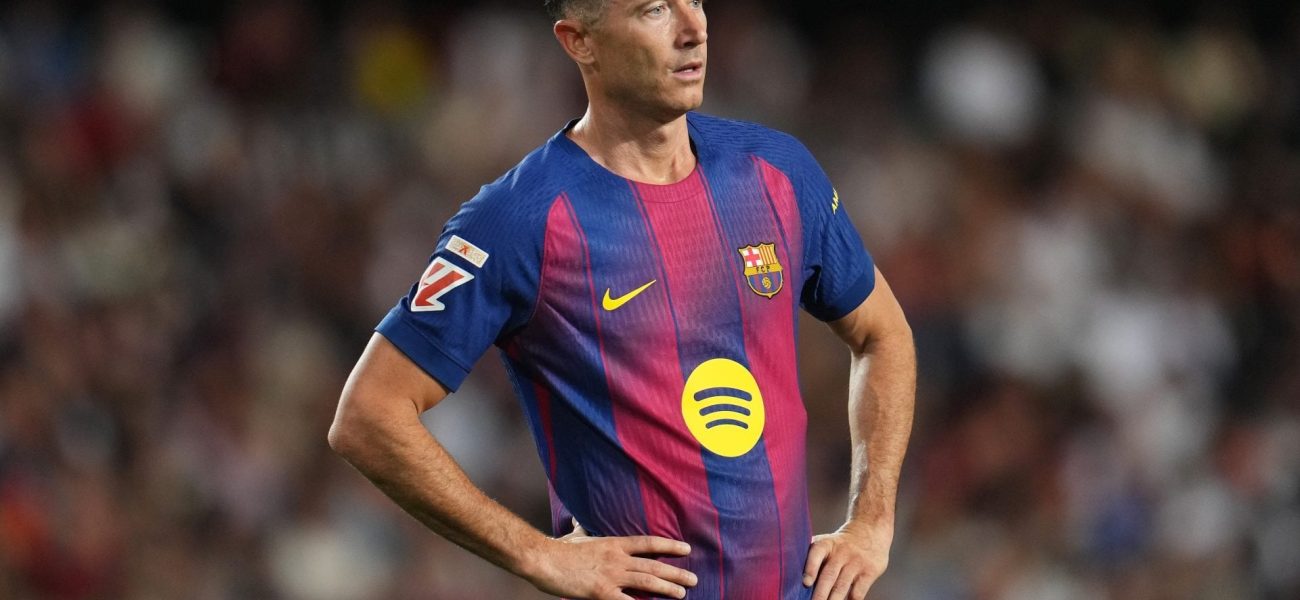
Fading Empire: Lewandowski’s Quiet Exit Signals Deeper Instability at Barcelona
POLICY WIRE — Madrid, Spain — The final whistle blew on a Saturday night at Mestalla, and with it, a certain era—or at least a very expensive chapter—closed for Barcelona. Robert Lewandowski netted...

POLICY WIRE — Madrid, Spain — The final whistle blew on a Saturday night at Mestalla, and with it, a certain era—or at least a very expensive chapter—closed for Barcelona. Robert Lewandowski netted the team’s only goal in a rather dismal 3-1 defeat to Valencia, marking not a triumphant exit, but a somewhat perfunctory farewell for the Polish marksman. He’s now off, an expensive commodity traded, a number etched onto an ‘elite list,’ they say. But don’t mistake that for glory. It’s more like a subtle tremor, shaking the already precarious foundations of one of football’s most storied—and financially troubled—institutions.
Barcelona’s official statements are, predictably, full of the usual saccharine goodbyes. The club thanked Lewandowski for his service, his goals, his whatever. And he did deliver, that’s not up for debate. But for anyone paying attention, the narrative isn’t about legacy anymore. It’s about balance sheets, about leveraging marketable assets, and the relentless, unsentimental grind of modern sport as big business. A mere four years he spent there; hardly enough time for his boots to collect dust.
Because let’s be brutally honest, this wasn’t some organic parting of ways between a club legend and his adoring masses. This was a decision—hard-nosed, pragmatic—about what a thirty-something striker, even a prolific one, still brings to the table versus what he costs. They needed to offload that salary, didn’t they? Every penny counts when you’re teetering on the financial brink, staring down insolvency threats like a forgotten utility bill.
“Look, Robert did what we asked,” stated Barcelona President Joan Laporta, perhaps with a slight forced smile for the cameras. “His time had its brilliant moments, absolutely. But the modern game… it’s always moving, isn’t it? Players come, players go. We wish him well, but Barcelona, she sails on. The institutional integrity, that’s our guiding star.” His words, steeped in managerial detachment, reveal more than they conceal—the cold calculation beneath the veneer of sporting sentiment.
But others see through it. “They talk about elite lists, but the truth? Barcelona’s built on a revolving door now. Another star departs, another hole to fill,” lamented Tariq al-Hamdani, head of the Global Blaugrana Supporters’ Network, an umbrella organization connecting fan clubs from Morocco to Malaysia. “This ain’t your grandad’s club, mate. We—the fans, especially those in places where every penny counts to even buy a jersey—we just want some stability, some vision. Not another commercial reshuffle presented as natural evolution.”
📄 POLICY WIRE WHITEPAPER PUBLISHED: PAKISTAN'S NATIONAL SECURITY POLICY PRIORITIES
👉 READ BY CLICKING HERELewandowski’s tally of 120 goals during his tenure, a statistic placing him level with Josep Escola as Barcelona’s tenth all-time leading scorer per official club records, sounds impressive on paper. He stands shoulder-to-shoulder with historical greats like Rivaldo — and Samuel Eto’o, certainly. Yet, it feels different. His stint, while potent, lacked the visceral, career-defining commitment once embodied by names higher on that very same list—players who truly became synonymous with the Catalan identity. Messi’s astronomical 672 goals for the club, for instance, represents an entirely different league of devotion, practically an immutable law of physics for anyone trying to compete in the record books today.
And consider the global implications. In places like Karachi, or Cairo, or Kuala Lumpur, millions aren’t just watching a football match; they’re buying into a brand. They’re investing their cultural capital and discretionary income into a European spectacle that promises — often delivers — excitement. When a player like Lewandowski, a true global name, moves on from a club with Barcelona’s massive following in South Asia and the Muslim world, it reverberates. Does it dampen interest? Does it shift allegiances? It’s a dynamic, complicated equation with real-world economic inputs.
What This Means
Lewandowski’s somewhat unceremonious departure isn’t just another transfer; it’s a symptom. It’s an undeniable marker of Barcelona’s persistent struggle to balance its colossal legacy with a crippling financial reality. The club’s model, once envied, now often seems less about cultivating homegrown talent and more about a strategic—sometimes desperate—rotation of high-priced, established stars. This strategy provides intermittent sparks but fails to ignite a consistent, long-term blaze, leaving them in the shadow of rivals operating with greater economic dexterity. Think about the public feuds over transfers, the frantic efforts to sell assets, even the naming rights on their stadium; these aren’t the hallmarks of robust health. But it’s what they’ve got to do. It forces a conversation about the sustainability of a footballing empire built on colossal debt and an almost feudal attachment to individual superstar talent rather than systemic stability. Bayern, for one, hasn’t shied away from openly stating Barca’s predicament. This reliance on transactional star power rather than structural integrity leaves the club vulnerable to the whims of the market and the inevitable aging curve of even the most phenomenal athletes. What’s left behind is an increasingly cynical footballing landscape, where loyalty is a commodity, not a creed.
📖 GET YOUR FREE COPY NOW OF POLICY WIRE DIGITAL MAGAZINE JULY 2026 EDITION
👉 READ & DOWNLOAD FREE MAGAZINE