


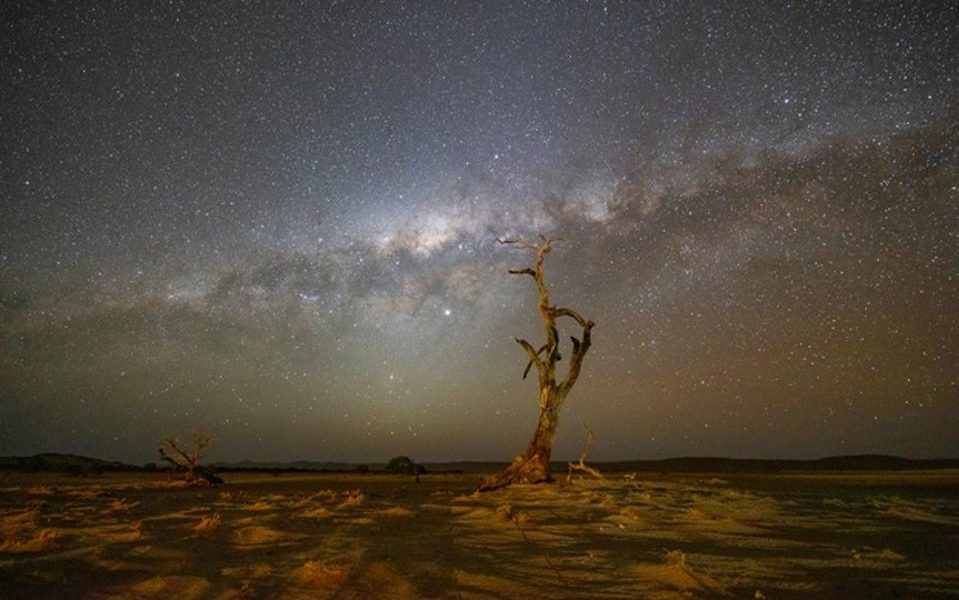
The Allure of the Abyss: Namibia’s Sunset Tourism and a World Craving Darkness
POLICY WIRE — Windhoek, Namibia — While much of the developed world struggles to mute the incessant glow of its urban sprawl, a silent, sun-baked nation on Africa’s southwestern shoulder has found...

POLICY WIRE — Windhoek, Namibia — While much of the developed world struggles to mute the incessant glow of its urban sprawl, a silent, sun-baked nation on Africa’s southwestern shoulder has found its improbable economic sweet spot: profound, unadulterated darkness. Namibia, it turns out, is the undisputed champion of the dusk, a phenomenon known in academic circles—and now increasingly in tourism brochures—as ‘dusking.’ Forget bustling markets or glitzy resorts; Namibia sells the quiet vanishing act of day into night, an experience some might call — wait for it — a profound aesthetic.
It’s not about watching the sun set, not precisely. It’s about the absolute immersion that follows. The absence of light pollution, the unyielding quiet, the canvas of stars blooming as if flipped on by some cosmic switch. This isn’t some whimsical discovery, mind you. The International Dark-Sky Association (IDA) formally recognized the NamibRand Nature Reserve as Africa’s first International Dark Sky Reserve back in 2012, confirming what local communities probably knew for centuries: their nights are simply spectacular. And now, they’re monetizing it.
But how, one asks, does one brand the lack of something? Turns out, brilliantly. While others chase daylight saving benefits or struggle with dwindling water tables, Namibia positions its vast, sparsely populated landscapes as sanctuaries. For the truly unplugged experience. For souls tired of the digital buzz. Tourists aren’t just taking photos; they’re sitting in absolute silence, watching the sky change. It’s quite the trick, really.
“We’ve always understood the immense value of our pristine environment,” remarked Namibia’s Minister of Environment, Forestry and Tourism, Pohamba Shifeta, in a recent policy briefing. “But transforming the purity of our night sky into an internationally recognized asset—that takes a commitment to conservation. It’s about stewardship, yes, but it’s also smart economics. People crave this. They genuinely do.” He isn’t wrong; tourist arrivals have seen a steady, if modest, uptick, largely thanks to its emerging reputation as a dark-sky destination.
But there’s a deeper, perhaps more unsettling, truth lurking in Namibia’s astronomical success. It underscores a global deficit. While some African nations eye sustainable growth models through innovation, Namibia highlights the value of maintaining—or reclaiming—what once was ubiquitous. Because the fact is, the rest of the world is largely awash in artificial light. A 2017 study published in Science Advances, using satellite data, revealed that over 80% of the world’s population lives under skies obscured by light pollution. In Europe — and North America, that figure jumps to 99%. Most folks, it seems, have never truly seen the Milky Way.
📄 POLICY WIRE WHITEPAPER PUBLISHED: PAKISTAN'S NATIONAL SECURITY POLICY PRIORITIES
👉 READ BY CLICKING HERE“We’re witnessing a subtle shift in what affluent travelers define as luxury,” noted Dr. Fatima Iqbal, a development economist specializing in post-colonial economies. “It’s no longer just about opulent accommodations, but about unique, sensory deprivation — a disconnection from the cacophony. Namibia offers the ultimate reset.” She pauses, a hint of irony in her voice. “The very things some nations lost through ‘progress’ are now drawing others to pay premium prices.”
And that, right there, is the nub. In densely packed South Asian cities like Karachi or Dhaka, the sky’s often a permanent orange-grey smudge. You’d be hard-pressed to spot Venus, let alone the galactic core. Even the moon can feel like an intrusion, battling against streetlights — and neon signs. For many, the closest experience to ‘dusking’ is often a fleeting moment during a power outage — a sudden, unsettling intimacy with a once-familiar void. But for devout Muslims across the world, the meticulous observation of twilight — Maghrib and Isha prayer times — remains a fundamental, unbroken link to celestial rhythm, regardless of the urban glow.
What This Means
Namibia’s pivot to dark-sky tourism isn’t just about pretty sunsets; it’s a shrewd, albeit quiet, masterstroke in branding and sustainable economic development. By leveraging an inherent natural asset—its exceptional lack of population density and clear desert skies—the nation taps into a growing global yearning for authentic, unpolluted experiences. It’s a testament to the idea that sometimes, less is indeed more.
But it’s also a stark mirror for countries grappling with the environmental downsides of rapid industrialization. Light pollution isn’t just an aesthetic nuisance; it messes with circadian rhythms, harms wildlife, and wastes enormous amounts of energy. Namibia’s success could serve as an unlikely blueprint, perhaps encouraging other sparsely populated regions – maybe even arid stretches of Pakistan or Oman – to consider similar niche eco-tourism, if they can maintain their environmental integrity. It’s a challenging balance, of course, to invite the world in without losing the very ’emptiness’ that makes the experience so profound. The next big question isn’t just whether more people will come, but whether Namibia can preserve the night even as the world flocks to see it disappear.
📖 GET YOUR FREE COPY NOW OF POLICY WIRE DIGITAL MAGAZINE JULY 2026 EDITION
👉 READ & DOWNLOAD FREE MAGAZINE