


The Global Echo Chamber: When Digital Lies Ignite Real-World Fury
POLICY WIRE — London, UK — The digital ether, for all its supposed transparency, frequently behaves more like a murky swamp, teeming with half-truths and outright falsehoods. And sometimes, one...

POLICY WIRE — London, UK — The digital ether, for all its supposed transparency, frequently behaves more like a murky swamp, teeming with half-truths and outright falsehoods. And sometimes, one particular swamp monster gets out—sprints, really—before anyone can properly identify it. We’ve seen it time and again, where a few pixels, stripped of context, detonate a firestorm of outrage thousands of miles away. It’s not about what happened; it’s about where it’s claimed to have happened, and that, my friends, is the game-changer.
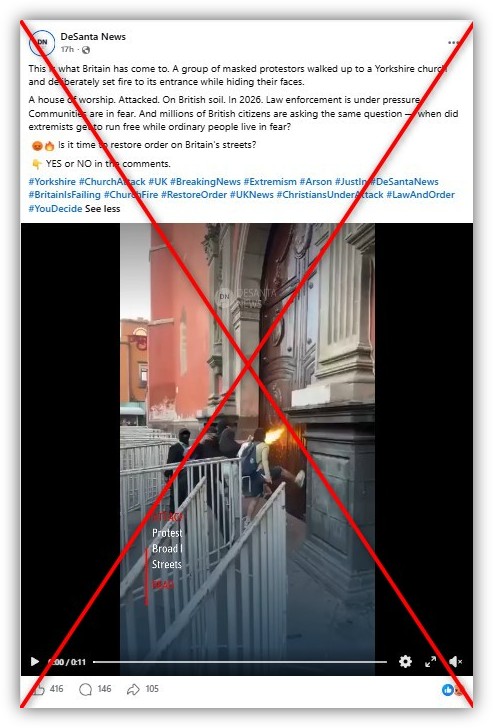
Take, for instance, a recent clip that whipped around social media platforms like a virulent contagion. It showed an unsettling incident: an alleged arson attempt on a church. Ugly stuff, no question. But the sinister overlay here, the deceptive packaging that sent many users into an indignant lather, was the insistence that this attack had transpired in the United Kingdom. Turns out, it hadn’t. Not even close. The raw footage, the verifiable location markers, they pointed unequivocally to Mexico. A rather significant geographical and cultural discrepancy, you’d think, yet it barely registered for the millions who had already digested the lie.
But that’s the way it goes in this age of instant dissemination, isn’t it? Accuracy is a luxury, an afterthought perhaps, while outrage is the currency. We don’t verify; we react. We share. And just like that, an isolated, albeit disturbing, act in one nation gets co-opted to fuel a narrative of persecution, neglect, or simmering social unrest in another.
Baroness Martha Finch-Hatton, a junior minister at the UK Home Office, didn’t mince words when she addressed the wider phenomenon. “This isn’t just about one video; it’s about the fabric of trust in our society,” she told Policy Wire. “Malicious actors—and sometimes just plain ignorant ones—leverage these ambiguities. We must be vigilant, because every instance erodes faith in reliable information.” Her frustration, palpable even in a formal statement, speaks volumes about the constant battle against the tide of online deceit.
Because the real danger isn’t merely the false attribution itself. It’s what these falsehoods ignite in the collective subconscious. In a nation like the UK, where debates around religious freedoms, immigration, and community cohesion are already sensitive, injecting a viral (and fabricated) clip of a church under attack serves only to inflame, to divide. It lends supposed credence to pre-existing biases, solidifying them in the minds of those already predisposed to believe the worst.
Dr. Elara Vance, director of the Digital Accountability Initiative, put it quite plainly. “The digital frontier? It’s the wild west, truly. A clip uploaded with intent to deceive can outrun fact-checkers tenfold before anyone’s had their morning coffee,” she explained, echoing a widely cited finding by the MIT Media Lab, which reported that false news is 70% more likely to be retweeted than true news, often reaching people six times faster. “It’s not just about debunking; it’s about building societal resilience against engineered discord.”
And consider the implications beyond Europe or North America. Imagine the sheer destructive power if a similar video, mislabeled as depicting, say, an attack on a mosque in India or a church in Pakistan, were to flood WhatsApp groups and social media feeds in those regions. These are nations where religious — and communal tensions frequently sit just beneath the surface. The smallest spark, whether deliberate or accidental, can — and often does — lead to very real, very tragic, offline consequences. The memory of communal riots sparked by social media rumors about desecration of holy sites, for instance, is still fresh for many in the Subcontinent. The fragility of peace there’s a lesson the UK, perhaps, isn’t considering quite seriously enough in its domestic digital policy. This kind of disinformation isn’t an isolated British or Mexican problem; it’s a global contagion. For more on how digital narratives challenge factual integrity, see Gaza’s Faded Sun: Vintage Photos Ignite Disquieting Truths.
What This Means
This episode, seemingly minor on the grand geopolitical stage, is actually a stark indicator of profound and growing instability within the information ecosystem. Politically, it signals a further erosion of public trust in not just online media, but potentially in traditional institutions tasked with upholding truth and order. When citizens repeatedly encounter sensational, emotionally charged content that later proves false, their capacity for critical thought can wane, and they become more susceptible to narratives that align with their preconceived fears or hatreds. This creates a fertile ground for populism and extremism, because verifiable facts are supplanted by convenient fictions. Economically, the cost of this pervasive misinformation isn’t easily quantified, but it’s substantial: think about the resources diverted to fact-checking teams, the societal cost of fractured communities, and even the potential for investment volatility when narratives are manipulated. More critically, the ease with which digital content can be weaponized poses an ongoing national security threat. Bad actors—whether state-sponsored or domestic—don’t need complex cyberattacks to sow discord; they just need a widely shared, easily believable lie. For other examples of how geopolitical dynamics intertwine with media manipulation, take a look at Shadow Games in Berlin: Iran’s European Reach.