

Reckless Threats, Bitter Lessons: India’s Army Chief Forgets What Happened in 2025
Indian Army Chief General Upendra Dwivedi issued a threatening statement against Pakistan last week. He warned that if Pakistan “continues to harbour terrorists,” it will have to decide...

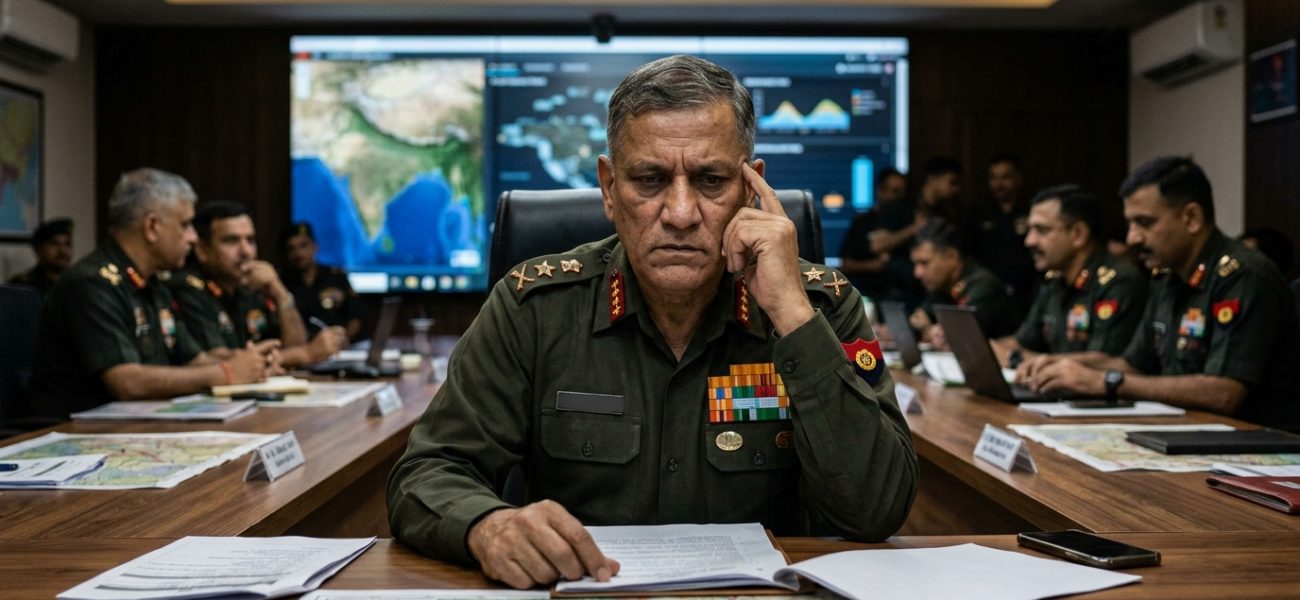
Indian Army Chief General Upendra Dwivedi issued a threatening statement against Pakistan last week. He warned that if Pakistan “continues to harbour terrorists,” it will have to decide “whether it wants to be a part of geography, history or not.” The statement was irresponsible, aggressive, and, from a military standpoint, deeply embarrassing coming from a general whose forces were beaten back in 2025.
Pakistan’s Defence Minister Khawaja Asif responded with complete clarity. He said: “If India attempts any misadventure against Pakistan, it would be relegated to history and its geography would be changed.” This was not a bluff. This was a statement rooted in demonstrated military capability, capability Pakistan proved to the entire world just over a year ago.
India Came, India Lost
In May 2025, India launched Operation Sindoor. New Delhi presented it as a bold counter-terrorism strike. What it actually became was one of the costliest military miscalculations in Indian history.
Pakistan’s Air Force responded with overwhelming precision. Equipped with J-10C jets armed with PL-15 long-range missiles, Pakistan’s pilots intercepted Indian aircraft inside their own airspace. The result was catastrophic for India. Pakistan shot down multiple Indian Air Force jets, including the crown jewel of India’s air fleet, the Dassault Rafale.
Both American and French officials confirmed to CNN that Rafale ware destroyed. The wreckage of Rafale EH BS001 fell over Akalia Kalan, a village deep inside Indian Punjab, roughly 70 kilometres from the border. India’s most expensive, most celebrated fighter jet was brought down on Indian soil, by a Pakistani missile, launched by a brave Pakistani defender in response to attacks on civilians.
Pakistan subsequently claimed the destruction of six Indian aircraft in total, including three Rafales, one Su-30MKI, one MiG-29UPG, and a large drone. American analyst Brandon Weichert, writing for The National Interest, called the aerial engagement an unambiguous victory for Pakistan. The world had not expected Pakistani pilots and advanced air combat tactics to successfully bring down Western fourth-generation fighters. Pakistan proved them wrong.
India Was Forced to Stop
India did not stop Operation Sindoor out of restraint. India stopped because it had no choice.
Pakistan’s DGMO publicly confirmed that India had been “compelled to negotiate” and had even “requested” a ceasefire during active hostilities. These are damning words. A country that claims victory does not beg for strikes to stop. India launched the operation. India asked for it to end.
The ceasefire was brokered by Washington. That alone tells the full story. India, the so-called regional power, needed American intervention to exit a conflict it started against Pakistan. Islamabad walked away from that ceasefire with its military reputation intact, its sovereignty defended, and a clear diplomatic advantage on the international stage.
These Threats Are the Words of a Desperate Establishment
General Dwivedi’s statement is not military strategy. It is desperation wrapped in aggression.
India has not recovered, militarily or psychologically, from what Pakistan did to it in 2025. The loss of Rafale jets sent shockwaves through Indian defence circles. It exposed the gap between India’s expensive hardware and its actual operational effectiveness. It proved that Pakistan’s air force, modernised with advance technology, is more than capable of destroying India’s best assets.
So when General Dwivedi threatens Pakistan’s existence, the question that must be asked is: on what basis? His own forces lost elite aircraft in Indian airspace. His operation failed to achieve its stated objectives. None of the alleged terror infrastructure was verifiably dismantled; instead, Pakistani innocent civilians were martyred in the attacks. No strategic goal was met. And yet here he stands, threatening Pakistan with erasure from the map.
This is not the language of strength. This is the language of humiliation poorly disguised as bravado.
Pakistan’s Position Is Clear
Pakistan is a nuclear-armed state. Pakistan has advanced conventional military capabilities which it has already demonstrated, in real combat, against real targets, that it can defend itself and strike back hard.
Minister Khawaja Asif’s warning carries the full weight of that reality. Pakistan does not threaten without the power to back it up. India already tested Pakistan’s resolve in 2025. It paid a serious price. If India is foolish enough to test that resolve again, the response will not be softer, it will be harder, faster, and more decisive.
General Dwivedi should not be issuing threats to Pakistan. He should be explaining to the Indian public why their Rafales came home in pieces, or did not come home at all.
Pakistan’s message is simple: we stood firm before, and we will stand firm again.
Author