


Beyond the Chalkboard: Browns’ QB Drills Reveal a Fraught Economic Landscape
POLICY WIRE — BEREA, OHIO — Forget the crisp Ohio spring air. Forget the perfectly manicured practice fields, an island of precision in a region often defined by industrial grit. What really hangs...

POLICY WIRE — BEREA, OHIO — Forget the crisp Ohio spring air. Forget the perfectly manicured practice fields, an island of precision in a region often defined by industrial grit. What really hangs heavy over the Cleveland Browns’ recent Organized Team Activities isn’t the promise of a new season; it’s the quiet, crushing weight of expectation—and, let’s be honest, an astonishing pile of cash—strapped to the shoulders of a handful of men tossing an oblong ball.
Day two, and the script writes itself. Every glance, every drill, every imperfect spiral becomes a headline, a market indicator, a referendum on careers, even a subtle echo of the immense public scrutiny faced by high-profile figures globally, from Islamabad to Islington. These aren’t just players; they’re walking investments, their movements dissected with an intensity usually reserved for geopolitical negotiations. And honestly, it’s a bit much sometimes.
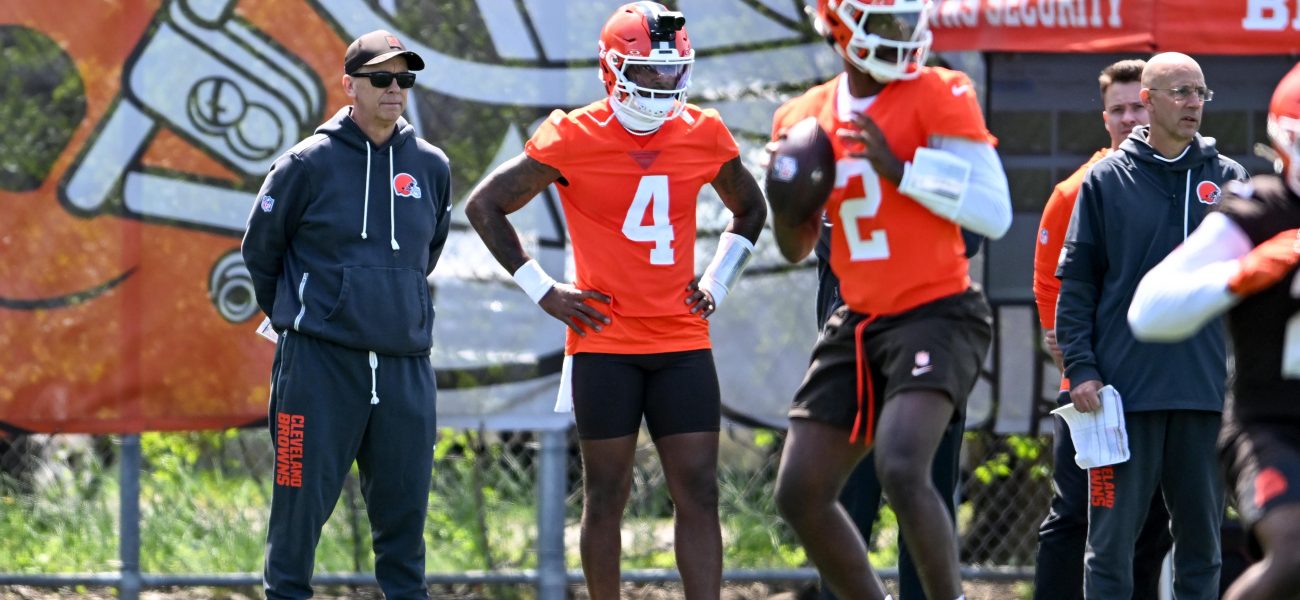
Head Coach Todd Monken, a man whose pragmatism is as finely honed as a surgeon’s scalpel, tried to tamp down the media frenzy. He watched quarterbacks Deshaun Watson and Dillon Gabriel run with the first-team offense, while Shedeur Sanders and rookie Taylen Green jockeyed for reps with the second. During the day’s lone full-speed 11-on-11 session, Sanders—yes, Sanders—was called up before Gabriel, then Watson. A momentary disruption to the hierarchy, perhaps, or a mere coincidence in the coach’s grand scheme. Hard to say with these things.
But the numbers don’t lie, not entirely. While media outlets dutifully charted phantom “stats” (Watson allegedly threw a touchdown, while Sanders and Gabriel each logged an interception—in 7-on-7 drills, no less), the broader narrative is etched in greenbacks. And, Monken knows this. Every word he utters about his signal-callers, particularly Watson, is weighted, every rehabilitation arc a gamble.
“Deshaun’s athleticism still jumps out at you,” Monken told reporters after practice, the quote appearing in team-provided transcripts. “He’s always had that superpower. It’s been injuries that have tripped him up, but watching him now, it’s just exciting—it’s a weapon. And you can see Shedeur, he’s made big strides. Big, big strides in reading defenses, getting the ball out fast. That kid’s come a long way.”
The ‘come a long way’ part, particularly regarding Watson, isn’t just about on-field technique. It’s about optics. It’s about earning back trust—or at least a reasonable facsimile of it—from a fanbase that’s seen it all and a league office that isn’t shy about suspensions. For a player like Watson, whose guaranteed contract alone stands at a staggering five-year, $230 million, as reported by ESPN, the stakes are existential. It’s not just a game; it’s an entire economy predicated on performance, redemption, — and public relations.
Monken, ever the realist, addressed the business of giving high-profile players another shot at glory. “I’m always for a clean slate,” he declared, perhaps a bit wearily, having probably said it a dozen times that day. “I just want the best for our players, our coaches—everybody in this crazy world to just live a decent life. He’s had successes, disappointments, things he couldn’t control. But the desire to fight back, to change his own story? That’s something.”
Indeed it’s. And, this relentless push for redemption isn’t unique to American football. Think of the enormous pressures on athletes and public figures in countries like Pakistan, where cricket stars carry the weight of national pride and vast financial endorsements, their careers hinging on every match, every scandal, every opportunity to reclaim narratives under intense public scrutiny. It’s the same fundamental human drama, just with a different shaped ball.
When pressed on those reported interceptions from Sanders — and Gabriel, Monken’s dry wit cracked through. “Interceptions? In seven-on-seven? Good grief. I mean, no pass rush. That’s just… embarrassing.” A telling slip, perhaps, of the actual competitive heat underneath all the springtime politeness. It’s the kind of blunt assessment that reminds you that despite all the money and the carefully managed messages, this is still a gladiatorial arena. But, it’s an arena with a complex financial engine churning beneath it all.
What This Means
The micro-drama unfolding at the Browns’ facility offers a neat, compact lens through which to view the macro forces at play in professional sports. For a club like Cleveland, perennially searching for consistency and relevancy, the quarterback position isn’t merely about wins and losses; it’s an economic driver. It dictates ticket sales, merchandise revenue, regional sponsorships, and broadcast ratings—everything tied into a corporate sports entity’s valuation. A strong, successful quarterback elevates the franchise’s public standing and, critically, its profitability. Conversely, instability here doesn’t just frustrate fans; it chips away at the bottom line.
The emphasis on ‘second chances’ for high-value athletes like Watson, despite significant personal baggage, isn’t purely an act of magnanimity. It’s a calculated risk by team management—a wager that on-field performance can rehabilitate image and, crucially, secure future returns on massive investments. This model, this willingness to reinvest in perceived talent even when public sentiment is fractured, isn’t unique to the NFL. We see similar calculations in various public-facing sectors globally, where the potential for high economic or political yield can overshadow past transgressions, especially when those individuals wield significant cultural or financial sway. It’s a pragmatic, if ethically thorny, approach to asset management in the public sphere, from Hollywood to policy circles, mirroring shifts in sports economics that allow athletes multiple career arcs and redemptions. Because at the end of the day, someone’s always crunching the numbers. And often, they’re very big numbers.