


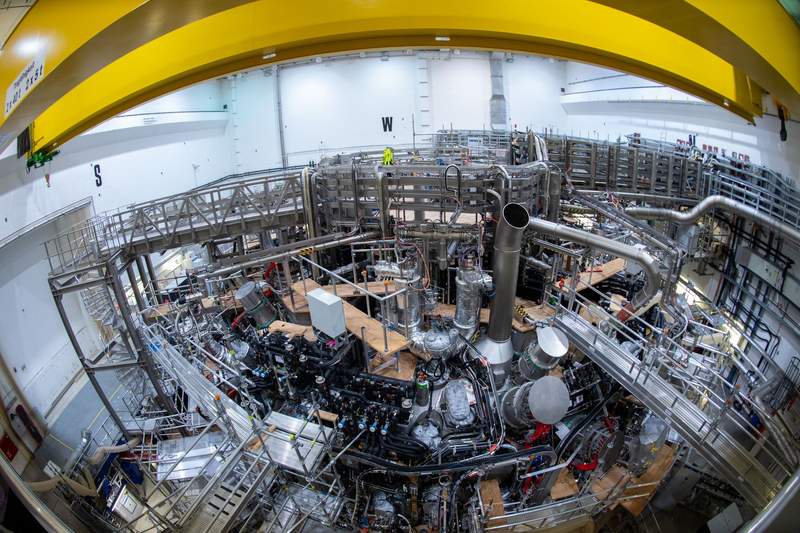
Germany’s Great Plasma Leap: From Nuclear Aversion to Fusion Fantasies by 2040s
POLICY WIRE — Berlin, Germany — You gotta admire the Germans. The whole world’s watching its collective energy crisis boil, — and what do they pull out of the hat? A commercial nuclear fusion power...

POLICY WIRE — Berlin, Germany — You gotta admire the Germans. The whole world’s watching its collective energy crisis boil, — and what do they pull out of the hat? A commercial nuclear fusion power plant by the 2040s. Not some vague research push. A fully fledged, glow-in-the-dark energy factory. It’s a moonshot, plain and simple, from a nation that only just — and begrudgingly — finally shut down its last conventional nuclear fission plants, a saga that played out over decades, a stubborn refusal that even had Kyiv eyeing Minsk’s silent maneuvers a bit nervously.
Talk about whiplash. One minute, you’re convinced all nuclear energy’s the devil’s own work. The next, you’re banking your entire industrial future on harnessing a mini-sun right here on Earth. The federal government, under Chancellor Olaf Scholz, isn’t just dreaming; they’re pushing public funds into private ventures, throwing support behind what’s effectively science fiction attempting to morph into heavy industry. Because, let’s face it, Germany needs energy. A lot of it. And they don’t much like paying someone else for it.
It’s not just the sheer technological audacity that’s striking. It’s the almost defiant pivot. For ages, ‘nuclear’ was a four-letter word here, a hangover from Chernobyl and Fukushima that shaped an entire generation’s energy policy. But fossil fuels are, well, fossil. And renewables, for all their sunny optimism and wind-blown might, don’t quite cut it for the insatiable demands of a global manufacturing powerhouse. Not yet, anyway.
“We’ve learned hard lessons from our reliance on imported fossil fuels, particularly during recent geopolitical turbulences,” explained German Minister for Economic Affairs and Climate Action, Robert Habeck, in an unusually direct statement to Policy Wire. “Fusion offers the long-term, stable, and clean energy future we need, without the drawbacks of traditional nuclear power or the intermittency of renewables. It’s an investment in independence.” And let’s be clear, independence is a high priority these days.
But chasing controlled stellar fire? It’s not a cheap hobby. Experts estimate that developing a commercially viable fusion reactor will demand hundreds of billions in global investment over the next few decades, with significant scientific breakthroughs still needed. For instance, the world’s most advanced tokamak experiment, ITER, a gargantuan international collaboration, is already years behind schedule and billions over budget, with its first plasma now targeted for 2025. This isn’t a quick flip project; it’s a marathon, not a sprint.
So, Berlin’s move — a nation that recently imported over 60% of its primary energy, according to data from the Federal Statistical Office (Destatis) for 2022 — feels less like a firm plan and more like a high-stakes gamble on tomorrow. It’s less about a done deal, and more about planting a flag in a distant future, perhaps to distract from the gnawing anxieties of the present energy crunch.
“Frankly, it’s a brilliant PR move,” scoffed Dr. Anya Sharma, an independent energy policy analyst based in Brussels, during a recent panel discussion. “It lets them talk about a perfect future, an endless well of clean energy, without having to grapple with the truly difficult decisions that need making right now. Because, while Germany dreams of fusion, places like Pakistan are wrestling with immediate energy poverty, climate-induced flooding, and reliance on carbon-heavy infrastructure. Fusion isn’t helping them today or tomorrow.” Her point? Reality bites.
Indeed, while European industrial titans gaze at their glowing fusion aspirations, developing nations, particularly in South Asia and the broader Muslim world, remain ensnared by energy realities that are anything but clean or secure. They’re stuck with fossil fuels or expensive, often unreliable, alternatives. Imagine what even a fraction of Germany’s fusion R&D budget could do for distributed renewable energy grids in these vulnerable regions today.
Because ultimately, when we talk about energy, we’re talking about geopolitics, industrial might, and who gets to prosper. Germany knows this game. They always have. This fusion push isn’t merely about electrons; it’s about cementing Germany’s role as an innovator and ensuring its economic leverage far into an uncertain century, even if it feels a tad like watching a grim prospect’s abrupt ascent in an unforgiving circus – all eyes on the show, future TBD.
What This Means
Germany’s audacious foray into commercial nuclear fusion by the 2040s isn’t just about kilowatts; it’s a profound repositioning, a calculated bet against an increasingly volatile energy landscape. Economically, this move could, if successful, transform Germany into an energy independent powerhouse, insulated from global fossil fuel price swings and geopolitical leverage wielded by gas-rich states. It promises unparalleled cheap, clean energy, making German industry hyper-competitive in a carbon-constrained world. The trick, of course, is *if* it works, — and *when*. The political implications are immense too. Domestically, it’s a Hail Mary for a Green party attempting to square its anti-nuclear legacy with dire industrial needs. Internationally, it sets a challenging bar, forcing other industrial nations to re-evaluate their long-term energy strategies or risk being left behind in a new technological race. But it also risks creating a narrative that postpones urgent action on more immediately achievable renewable and energy efficiency measures, diverting focus and capital from solutions that could be deployed much sooner, particularly in parts of the world desperate for current relief, not future fantasies.