

The Body Politic of Basketball: NBA Western Finals Hinge on Bruised Egos and Questionable Ankles
POLICY WIRE — Oklahoma City, USA — When San Antonio’s phenom Victor Wembanyama launched a baseline jumper in Game 1, it wasn’t just two points; it was a pronouncement. A young, ostensibly fragile...

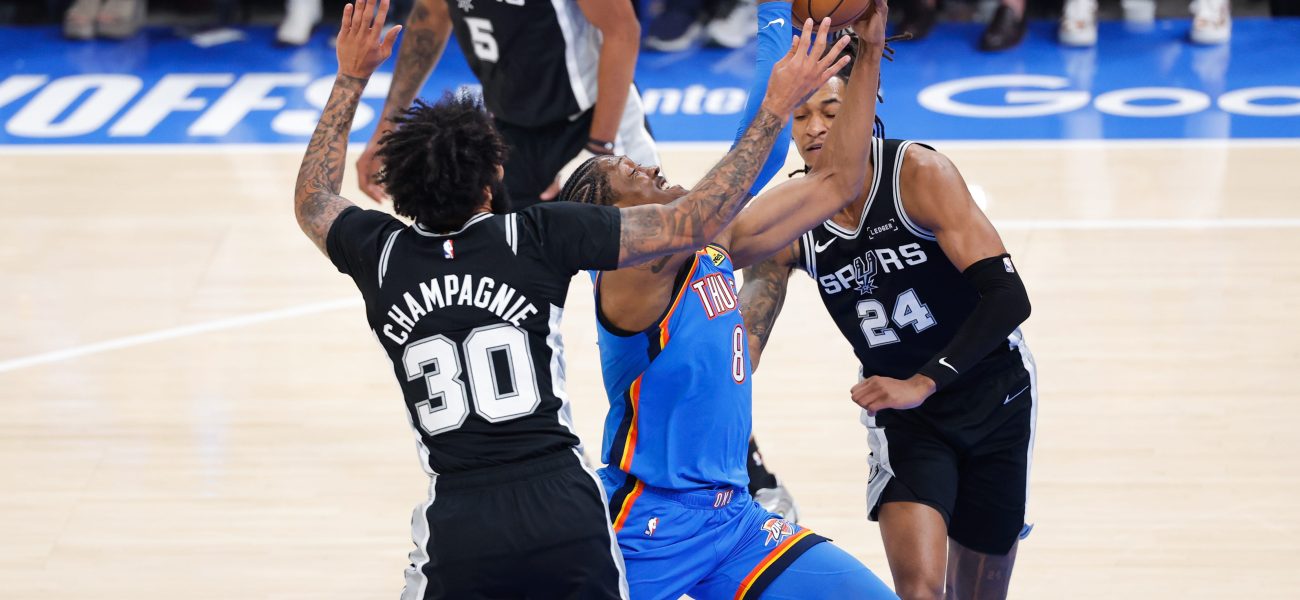
POLICY WIRE — Oklahoma City, USA — When San Antonio’s phenom Victor Wembanyama launched a baseline jumper in Game 1, it wasn’t just two points; it was a pronouncement. A young, ostensibly fragile titan—a kind of modern economic engine disguised as a basketball player—had not just arrived, he’d swallowed an entire opponent whole, reshaping the Western Conference narrative in a single, jaw-dropping performance. His monstrous 41 points and 24 rebounds didn’t just win a game; they set a terrifying precedent, especially for the Oklahoma City Thunder.
Because that’s the thing about grand statements: they often come with fine print, often scribbled in a doctor’s shaky hand. And now, the Spurs find themselves eyeing their own bulletin board with a particular dread. Their All-Star guard, De’Aaron Fox, is staring down the very real possibility of sitting out Game 2 of the Western Conference Finals against the Thunder, sidelined by persistent ankle soreness. A whisper that’s quickly grown into a very loud concern in the Alamo City, even as Wembanyama’s statistical supernova still sizzles in the aftermath of Monday’s 122-115 double-overtime victory.
On the Thunder side, Shai Gilgeous-Alexander seemed, frankly, a bit off-key. Just 24 points and a dozen assists don’t usually signal a seismic collapse, but against Wembanyama’s epic stat-line, it felt like a retreat. And what a shame for Alex Caruso, whose 31 points off the bench—the sort of gritty, unexpected heroics fans dream of—ultimately felt like a scream into the void. It didn’t net a win. The Thunder’s physical health appears, on paper anyway, far less precarious; only Thomas Sorber, sidelined with a torn ACL, sits on the long-term list. But their psychological state after such a gut-wrenching loss? That’s a whole different kind of injury report.
You’ve got to hand it to Spurs coach Gregg Popovich, who, in a rare moment of semi-public introspection following the news about Fox, quipped to reporters, “This isn’t about heroic stands or pushing boundaries. It’s about keeping grown men upright. It’s about asset management, frankly.” A typically terse, dry observation that, when parsed, speaks volumes about the precarious nature of athletic dynasties and the fortunes tied to individual human performance.
And those fortunes, incidentally, aren’t minor. NBA revenues surpassed $10 billion in the 2022-23 season, with player salaries constituting a substantial portion of that gargantuan pie. Any absence from a star player, therefore, doesn’t just impact a box score; it sends ripples through endorsements, viewership ratings, and team valuations. It’s a very modern, hyper-capitalized gladiatorial spectacle, where the gladiator’s heel is insured for millions.
Meanwhile, across the floor, Thunder General Manager Sam Presti maintained his usual poker face, though a distinct weariness creased his brow. “We build for resilience,” Presti stated calmly in a press conference that bordered on a philosophy lecture. “One game, even one player, doesn’t define our trajectory. We’ve always focused on the next evolution, the systemic advantage. Tomorrow’s Game 2 is just the next iteration of that.” He wasn’t about to give the Spurs any comfort.
It’s this ongoing fragility of talent that captivates. An athletic contest, when boiled down, often comes to resemble a geopolitical dance. The dominance of a Wembanyama, much like a rapidly expanding economic superpower, draws awe but also apprehension. His sudden ascendance to near-mythic status changes the global basketball landscape, inspiring young athletes everywhere—from the bustling streets of Karachi to the remote villages of rural Pakistan. They’re watching, dreaming of their own path to such a stage, often navigating significantly harsher realities to get there. It’s a compelling global narrative of aspirational achievement.
This dynamic tension, this interplay of raw individual prowess against collective strategic genius, mirrors quite a bit of what we cover on Policy Wire. The idea that a single person’s condition—a strained muscle, a bad ankle—can derail months, even years, of planning for a multi-million-dollar enterprise. It’s a humbling thought, isn’t it?
What This Means
The immediate implication of Fox’s potential absence is clear: it throws an unpredictable wrench into the Spurs’ championship aspirations and injects a sudden surge of hope into a Thunder team that frankly looked like they’d just seen a ghost after Game 1. But there’s a broader economic undercurrent here. The NBA, like many global industries, relies heavily on the ‘star system.’ A player like Fox or Wembanyama isn’t just an athlete; they’re intellectual property, marketing gold, and walking financial engines. The economics of professional sports are intrinsically linked to player availability. When a top-tier player is sidelined, even with ‘soreness,’ it’s not merely a coaching adjustment; it’s a direct impact on broadcast numbers, ticket sales, and merchandise—factors that policy-makers, keen on civic pride and local economic impact, ought to consider.
But the real long-term game is played not just on the court, but in the boardroom and, yes, even in diplomatic circles. The global reach of the NBA means that the narratives of these playoffs aren’t contained to North America. Fans in the Middle East and South Asia are following these developments with fervent interest, consuming sports media with the same intensity as they do political news. They see the drama, the resilience, the unexpected turns—narratives that resonate in cultures often grappling with their own geopolitical turbulences. The unpredictability of sports, whether it’s NBA playoffs or the seismic shifts in cricket, serves as a universal metaphor for life’s own chaotic beauty. And this particular series? It’s not just a game; it’s a proving ground for theories on fragile power — and the indomitable human spirit.