


Europe’s Backyard Blazes: Ukraine’s Silent Toll, Russia’s Burning Refineries, and Global Echoes
POLICY WIRE — Kyiv, Ukraine — The latest headline read like so many others, a morbid Mad Libs of suffering: “Drones hit this place, X people dead, Y infrastructure damaged somewhere else.” But...

POLICY WIRE — Kyiv, Ukraine — The latest headline read like so many others, a morbid Mad Libs of suffering: “Drones hit this place, X people dead, Y infrastructure damaged somewhere else.” But beneath the grim familiarity of each morning’s news bulletin lies a stark, unsettling reality. The sheer, monotonous grind of destruction continues, a slow-motion unraveling where civilian lives evaporate amidst steel and smoke, while energy arteries — the very veins of Russia’s war machine — catch fire hundreds of miles from any conventional front line. This isn’t just news; it’s a chilling echo of perpetual conflict, its human toll often reduced to statistics, its global implications only cursorily examined.
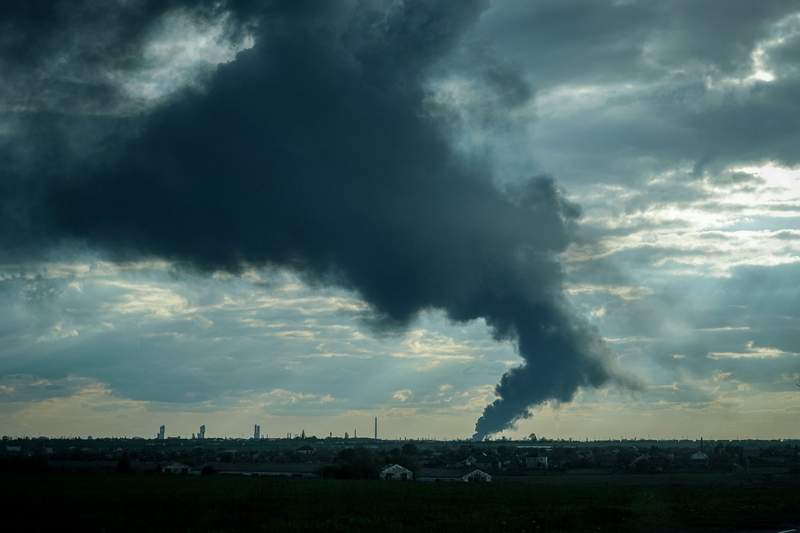
Two lives in Dnipro were snuffed out just the other day, an infant amongst them, caught in the haphazard, horrifying sweep of yet another drone attack. Kyiv was quick to condemn. And frankly, they should. Civilian deaths, even in the fog of war, retain their chilling potency, don’t they? They’re not just numbers; they’re families shattered, futures obliterated, stark reminders of what this conflict truly costs ordinary people. Russia, on its part, reported another significant fire at an oil refinery, a testament to Ukraine’s increasingly audacious long-range drone strategy. These weren’t isolated incidents, of course; they’re threads in a constantly weaving, violent tapestry, a conflict that refuses to confine itself to the trenches.
“They hit residential areas again. It’s a calculated terror,” fumed Andriy Yermak, Head of the Office of the President of Ukraine, his voice laden with a weariness that’s become almost a national trait. “Our people won’t break, no matter what barbarity Moscow throws at us.” He wasn’t just talking about resilience; he was articulating a profound, deep-seated resolve born of relentless adversity. It’s an inconvenient truth for those who wish this whole mess would just quietly fade away.
Because, really, how much of this can Europe—or the world—tolerate before the casual dismissal of these faraway conflicts gives way to a real reckoning? While headlines track every minor geopolitical twitch, the steady dehumanization on both sides of the Ukrainian border seems to pass by, almost unnoticed. Civilian casualties from these types of attacks have been steadily rising; the UN Human Rights Office, for example, verified a total of 10,810 civilian deaths and 20,556 injuries in Ukraine since the full-scale invasion began on February 24, 2022, as of April 2024. But then, who’s counting every single one, outside of the immediate families?
Meanwhile, thousands of kilometers east, Russia’s energy infrastructure remains a high-value, high-risk target. Moscow sees these drone strikes on its refineries not as collateral damage but as direct aggression against its economic might, a move that stings precisely because it hits the purse. “Our special military operation continues to achieve its objectives,” Kremlin spokesman Dmitry Peskov stated, with that familiar blend of deflection and stern warning. “These are legitimate targets, regrettable though any unintended consequences may be. Russia will respond proportionately to threats to its energy infrastructure.” A ‘proportionate’ response, in this grim arithmetic, usually means more drones, more missiles, and more civilian deaths somewhere in Ukraine. It’s a macabre feedback loop.
For Pakistan, and indeed much of the developing world, the continuing saga of attacks on energy infrastructure, especially in a major oil and gas producer like Russia, isn’t just abstract news. It impacts the global crude market, and any sustained disruption, any major price spike, filters down directly to every household in Karachi and Islamabad, already grappling with inflation. It’s a reminder of just how deeply interconnected—and disturbingly fragile—our world remains, where a blaze in Ryazan or a bombed apartment block in Dnipro sends ripples to the quietest corners of South Asia. There’s an uneasy parallel too, perhaps, in the way international attention waxes and wanes, leaving communities in conflicts like this to fend for themselves, much like those caught in long-ignored skirmishes elsewhere.
What This Means
This escalating drone tit-for-tat isn’t just about daily attrition; it represents a strategic shift that’s beginning to bite both parties where it hurts most. For Ukraine, striking Russian refineries is an attempt to hobble Moscow’s war funding, complicate its logistics, and inflict economic pain at home, forcing a reconsideration of strategy. But it’s a tightrope walk—it invites harsher retaliation, putting more Ukrainian civilians at risk, a perverse equation no state really wants to balance. And while Washington often discourages these strikes for fear of escalating global oil prices—a truly galling bit of realpolitik, if you ask me—Kyiv clearly views it as a necessary evil, a form of asymmetrical warfare they can wage effectively.
On Russia’s side, these refinery attacks don’t just cost money; they dent prestige and complicate domestic narratives, even for a tightly controlled state media apparatus. They also strain an economy already under sanctions. The immediate political implication is a hardening of resolve, and an ongoing justification for the continued violence in Ukraine, repackaged as ‘self-defense.’ Economically, continued attacks on Russia’s energy choke points could, in the long run, destabilize global markets, pushing up prices for consumers everywhere and complicating the delicate energy balance Europe has been trying to strike since the war began. It’s a situation where everyone loses a little bit more each day. But because neither side seems ready to blink, this grim rhythm of fire and destruction, unfortunately, isn’t ending any time soon. For Russia, this long conflict has also significantly altered its geopolitical alignments, increasingly pushing it closer into the orbit of countries like China, creating a complex dance that shapes global power dynamics far beyond Ukraine’s borders.