


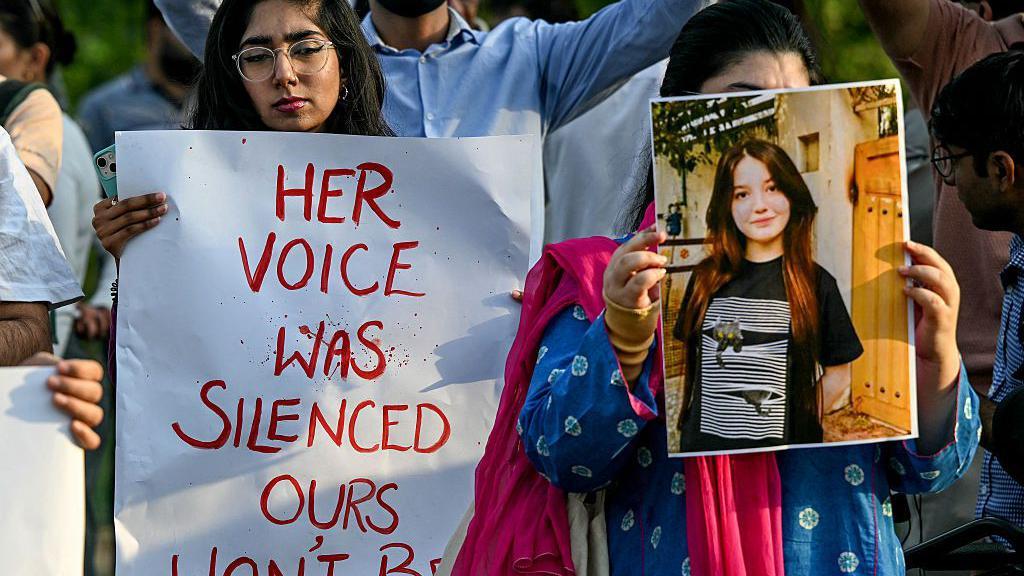
Digital Ghost in the Machine: Death Sentence for TikTok Star’s Killer Stirs Pakistan’s Unquiet Streets
POLICY WIRE — Lahore, Pakistan — The gallows. That’s where the legal pendulum, usually prone to long, agonizing swings in this part of the world, decided to rest. A rather swift judgment, all things...

POLICY WIRE — Lahore, Pakistan — The gallows. That’s where the legal pendulum, usually prone to long, agonizing swings in this part of the world, decided to rest. A rather swift judgment, all things considered, that saw an enraged jilted suitor—or alleged one, depending on whom you ask—condemned for the cold-blooded murder of a young digital luminary. This isn’t merely about a crime and punishment; it’s a grim footnote in the ever-unfolding saga of traditional society grappling, and sometimes failing, with the dizzying pace of digital culture.
It was a district and sessions court in Lahore that handed down the ultimate penalty to Syed Ali Hasnain, pinning him for the murder of the 18-year-old TikTok sensation, identified publicly only as Saima. Her on-screen persona, bubbly — and accessible, garnered thousands of followers. Off-screen? A target, apparently, for a narrative that veered from infatuation to a horrifying possessiveness. He’d stalked her, pressed her, then, in what the prosecution painted as a final act of grotesque control, allegedly strangled her to death in April 2022. He was given two life sentences as well, one for abduction — and another for rape. Convictions of this nature—particularly the expeditious kind—aren’t exactly commonplace here, raising eyebrows and perhaps a few uncomfortable questions about the cases that don’t capture the public imagination quite so fiercely.
And because the wheels of justice in Pakistan can often grind slow, sometimes to a near halt, this sentence, arriving a mere 18 months post-crime, feels like an outlier. Many families here spend years, even decades, pursuing redress, navigating labyrinthine legal structures and institutional inertia. But Saima wasn’t just any victim; she was a symptom of a new reality—a burgeoning digital native navigating fame in a conservative landscape. Her story, sadly, joins a growing roster of online personalities whose lives become public battlegrounds, their autonomy challenged by both admirer and detractor.
But what does a swift verdict mean in a country where judicial backlogs are the stuff of legend? “This judgment, while offering some measure of closure to the victim’s family, also serves as a potent reminder that our courts, when pressed, can deliver timely justice,” stated Judge Aslam Farooqi, the presiding judge in the Lahore court. He added, quite matter-of-factly, “It’s a clear message against violence, particularly against our young women who are increasingly present in the public sphere.” Indeed. Though for every Saima who gets a headline, there are countless others whose fates remain whispered stories in villages, their cries for justice muted by circumstance or power. It’s an inconvenient truth for many that the prominence of a victim can, sometimes, dramatically accelerate the due process.
Because the digital domain has exploded in Pakistan. As of January 2023, Pakistan boasted over 60 million social media users, a remarkable surge that hasn’t only unleashed creative torrents but also unforeseen vulnerabilities, particularly for young women. (Source: DataReportal’s Digital 2023 Pakistan report.) These platforms are now vital arteries of social life, economic opportunity—and, regrettably, a new arena for harassment and control. This particular case throws a harsh light on the dangers lurking beneath the surface of internet glamour. Online spaces, initially hailed as liberating, often become hunting grounds for individuals prone to obsession—shadow networks that ensnare unsuspecting users. For more on how digital vulnerabilities are being exposed, see this report.
And this judgment might just be a small crack in the monolithic wall of impunity. A death sentence, yes, — and likely facing a lengthy appeal process. But the sheer decisiveness here signals a legal system, however imperfect, slowly, grudgingly, acknowledging the perils of a society increasingly lived online. “While we welcome any step toward accountability, the underlying issues of gender-based violence, especially within the context of rising online interactions, require systemic, not just punitive, solutions,” argued Faria Nazir, Director of the Women’s Rights Collective Pakistan. “We can’t just execute our way out of a cultural crisis. We’ve got to rethink societal norms, educate, and offer better protections long before a crime occurs.” She’s got a point. One might even say it’s quite a shrewd observation.
What This Means
This verdict, while certainly satisfying to those who champion swift justice, likely signals more than just the end of one man’s murderous chapter. Economically, it could subtly impact foreign investment perceptions, particularly if it hints at improved law and order—a perpetual concern for businesses eyeing the South Asian market. Politically, the ruling government could, and almost certainly will, leverage this as evidence of their commitment to justice, particularly appealing to segments of the population demanding stricter law enforcement. However, it also highlights the precarious tightrope walked by young people, especially women, seeking visibility and economic opportunity through digital platforms in culturally conservative societies. The irony isn’t lost on many observers: the very tools meant to democratize fame often come with a hidden, dangerous price tag. For Islamabad, balancing social conservatism with the undeniable global march of digital trends remains a headache they’re not quite ready to solve, just bandage when things get messy.