


The Wembanyama Gambit: Underdog Spurs Disrupt Western Elite, Hinting at Broader Market Shifts
POLICY WIRE — San Antonio, USA — When the opening buzzer sounded for Game 1 of the Western Conference Finals, many expected a coronation. The Oklahoma City Thunder, a relentless, perfectly sculpted...

POLICY WIRE — San Antonio, USA — When the opening buzzer sounded for Game 1 of the Western Conference Finals, many expected a coronation. The Oklahoma City Thunder, a relentless, perfectly sculpted juggernaut, had sliced through their playoff competition, undefeated and unchallenged. But basketball, much like geopolitics, loves an inconvenient truth—and on Friday night, that truth came wrapped in the improbable frame of a San Antonio Spurs upset, holding a surprising early lead against all expectations. This wasn’t just a sports score; it was a blip on the radar for those tracking tectonic shifts in franchise valuations and emerging market appeal.
It was never supposed to be this messy. The Thunder had sailed through their initial series, demonstrating a clinical efficiency that hinted at an inevitable sweep of the West. Their youthful trio—Shai Gilgeous-Alexander, Chet Holmgren, and Jalen Williams—had collectively averaged over 65 points per contest in earlier rounds. Teams simply hadn’t found an answer, save for a fleeting Lakers aberration.
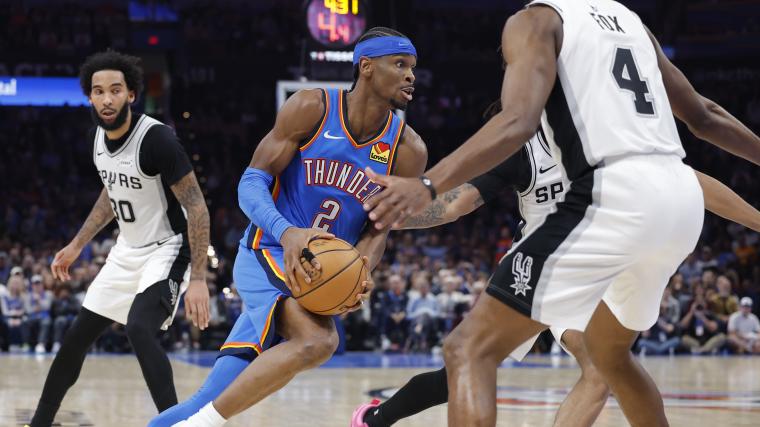
And then there was San Antonio. A team many had already written off for anything beyond ‘future prospects,’ a holding pattern built around the generational anomaly that’s Victor Wembanyama. Yet, against a team practically bathed in statistical superiority, the Spurs finished the first half with a tenacious 51-44 advantage. Wembanyama, in under 19 minutes, racked up 14 points — and 10 rebounds. This wasn’t merely a stat line; it was a declaration. It’s what happens when a unique talent meets a strategy capable of—even momentarily—rattling the established order.
But what does this all mean beyond the hardwood? This isn’t just about jump shots — and defensive rotations. The performance, however partial, offers a stark reminder of the fragile balance between perceived dominance and emergent disruption. Think about it: the market had priced in an OKC cakewalk. Broadcasters, advertisers, even the civic boosters of Oklahoma City—they’d all started drafting their ‘Western Conference Champions’ memos. And suddenly, there’s a hitch. A very tall, French hitch, actually. It sends ripples. Investment bankers recalibrate projected viewership figures; sports betting houses tighten their spreads; policy wonks quietly ponder the ‘economic halo’ effect this kind of sustained underdog narrative could have on a relatively smaller market like San Antonio.
“It’s not just about wins and losses on the court; it’s about the morale of our city, the buzz around our businesses,” remarked Councilwoman Eleanor Vance of Oklahoma City, a strong advocate for public funding in sports infrastructure. “A dominant team translates into tourism, brand recognition—it’s an economic engine. And frankly, this hiccup, however temporary, serves as a harsh reminder of how fleeting momentum can be.” She’s not wrong, you know. But that’s the point.
The global sports market, valued at approximately $488.5 billion in 2023, according to a report by Grand View Research, illustrates the sheer scale of the commercial interests at play here. Franchises are no longer just local enterprises; they’re international assets, their fortunes intertwined with media rights, endorsement deals, and merchandise sales that span continents. The rise of a singular global talent like Wembanyama, for instance, instantaneously diversifies the NBA’s appeal. Fans in places like Karachi or Dhaka, who might once have exclusively followed cricket, now tune in for glimpses of this extraterrestrial talent. His games are translated, simulcast, debated in languages far removed from traditional North American sports discourse.
This reach isn’t accidental. It’s the product of years of strategic expansion, of cultivation. Consider the NBA’s focused efforts in South Asia — and the Gulf states. Because where do you think the next billion dollars in sponsorship — and media rights come from? Not always from established markets, that’s for sure. It’s about cultivating new fan bases, even in regions where basketball was, until recently, a curiosity. “The NBA’s expansion into new markets, particularly in places like Pakistan and India, isn’t just about selling jerseys,” explained Dr. Farhad Zahidi, a London-based economic strategist with expertise in sports diplomacy. “It’s a form of soft power projection, an invitation to participate in a shared global culture. A talent like Wembanyama accelerates that engagement, creating a direct human connection that transcends national borders. This isn’t just about Game 1; it’s about the next generation of global fandom.” And that, my friends, is a policy brief in itself.
What This Means
The early upset of Game 1, even if San Antonio couldn’t sustain it through a full series, isn’t merely a footnote for sports enthusiasts; it’s a bellwether for market strategists and policy analysts. For one, it highlights the increasing importance of singular ‘transcendent’ talent in driving value. Wembanyama’s presence, irrespective of his team’s final standing, injects volatility and unforeseen pathways into predictable narratives—something corporate sponsors and international broadcasters pay a premium for. For established powerhouses like the Thunder, it forces a re-evaluation of assumptions. You don’t get to simply walk into a championship; you’ve got to earn it, often against the inconvenient resistance of talent on a mission.
Economically, unexpected upsets sustain interest. They drive viewership for longer series, spur debate, — and ultimately fatten the coffers of the league and its partners. Politically, the narrative of the underdog provides a potent storyline that resonates across cultures, often paralleling the aspirations of developing nations challenging global incumbents. It speaks to the idea that with enough ingenuity—and a phenomenal talent—the status quo can be challenged. That’s a powerful message, whether you’re selling tickets or crafting international policy, especially when navigating the brutal arithmetic of glory. This contest, however modest in its initial outcome, becomes a microcosm of broader global shifts: established giants challenged, new markets eagerly consuming, and the constant, relentless pursuit of something—anything—that defies expectation.