


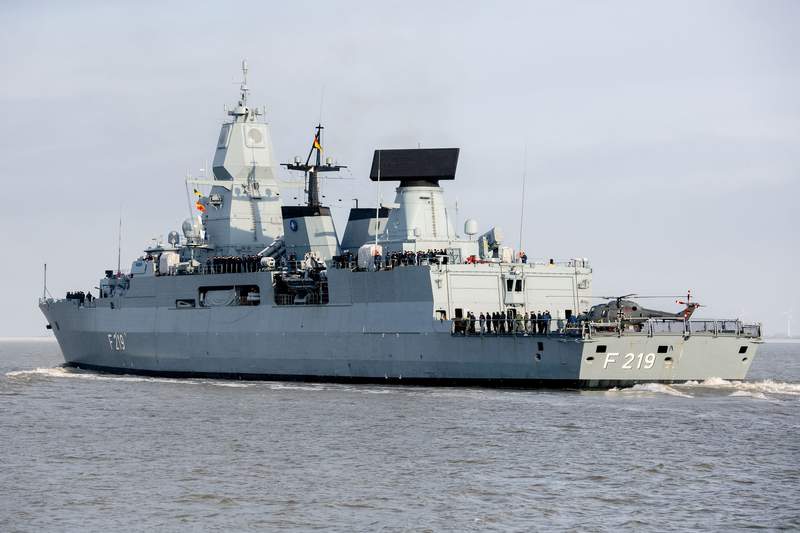
Shadow Games: Russian Warship’s German Fly-By Stirs Baltic Brew
POLICY WIRE — Berlin, Germany — It wasn’t the sudden clang of a dropped anchor or the boom of a ceremonial gun that announced its presence. Instead, it was the low hum of advanced surveillance...

POLICY WIRE — Berlin, Germany — It wasn’t the sudden clang of a dropped anchor or the boom of a ceremonial gun that announced its presence. Instead, it was the low hum of advanced surveillance equipment, likely from some offshore vantage point, that picked up on the ‘Admiral Kasatonov’ — a Russian frigate, part of their northern fleet, cruising a little too comfortably near Germany’s Sassnitz on the island of Rügen. For all the bluster and high-decibel rhetoric that usually accompany Moscow’s global messaging, this was something else: a cold, clinical, maritime dance in a region already wired for paranoia.
It’s not that we haven’t seen this before. We have. Time and again, Moscow’s naval assets like to poke and prod at the fringes of NATO territory, reminding everyone exactly where they stand and—more importantly—where they think they don’t have to. But the understated nature of this latest appearance felt…different. It was less about flexing muscle, more about a calculated sigh, a message slipped under the geopolitical door: ‘We’re here. We always are.’ And it rattled nerves precisely because of that casual disdain.
Defense circles in Berlin weren’t exactly surprised, but they weren’t amused either. German Defence Minister Boris Pistorius didn’t mince words, even if they were delivered with that weary patience only veteran politicians seem to master. “This isn’t an isolated incident; it’s a deliberate, calculated gesture,” Pistorius stated in an unofficial briefing, his voice reportedly tinged with an exasperated sigh. “Russia clearly enjoys rattling our cage, but we’re not rattling. We’re watching. And our defenses are rock-solid, regardless of what the Kremlin sends our way.” His office later reiterated a firmer stance, sans the sigh.
But what does ‘watching’ truly mean when these probes become commonplace? It’s an exercise in mental gymnastics for policymakers—balancing firm deterrence with avoiding outright escalation. This specific sighting comes amidst a palpable shift in NATO’s strategic thinking. As a top NATO naval command official, speaking anonymously due to protocol, observed: “We’re under no illusions about Moscow’s intentions. They’re probing, and we’re watching—always. Our collective defense remains absolute, because frankly, it has to. The days of dismissing these as mere exercises are long gone. Every move tells a story.”
And these stories have far-reaching implications, not just for the immediate neighborhood but for the broader global stage. Consider Pakistan, for example, a country navigating its own precarious path through an increasingly fractured international system. Any significant increase in European instability, catalyzed by these constant strategic face-offs, funnels away global attention and investment. It impacts aid flows, complicates trade routes for crucial resources, and shifts diplomatic priorities, subtly (or not so subtly) affecting economies thousands of miles away that depend on a relatively stable global order. It’s a domino effect, even if the initial push feels like a gentle nudge.
The ‘Admiral Kasatonov’ wasn’t just a ship; it was a ghost of a bygone era haunting modern waters. Its presence is part of a pattern that saw at least 54 significant air and sea incursions into NATO’s areas of interest by Russian forces over the last twelve months alone, as compiled from public military reports and private intelligence estimates. These aren’t accidents, you see. They’re rehearsals. They’re statements.
They’re also expensive, these displays of presence. Every deployment costs a pretty penny, sucking resources that Moscow — currently facing heavy sanctions and the immense fiscal drain of its grinding conflict in Ukraine — could scarcely afford to divert. Because, when you come right down to it, maintaining an active blue-water fleet, ready to menace or merely observe, isn’t just about naval power; it’s about signaling a continued capacity for mischief, even when your economy might be gasping for air. It’s bravado, certainly. But it’s also a deeply embedded element of the strategic communications strategy: ‘We’re still here, we’re still a threat.’
📄 POLICY WIRE WHITEPAPER PUBLISHED: PAKISTAN'S NATIONAL SECURITY POLICY PRIORITIES
👉 READ BY CLICKING HEREBut the true cost isn’t just in fuel or operational hours; it’s in the continuous erosion of trust. It’s in forcing nations to re-evaluate what ‘peace’ actually means in a region that desperately craves it. We’ve seen NATO members — particularly those on the Baltic rim — ramp up their defense budgets, often by considerable margins. Estonia, Latvia, and Lithuania, for instance, now consistently allocate well over the NATO benchmark of 2% of GDP to defense, reacting directly to what they perceive as an ever-present, very real, menace from their eastern neighbor. They’ve got long memories, those nations.
And they don’t forget. Small provocations today often become larger ones tomorrow, in ways you can’t always predict. So when a frigate slips quietly past Rügen, it isn’t just a naval curiosity. It’s another small stitch in a growing quilt of international unease.
What This Means
The silent approach of the ‘Admiral Kasatonov’ serves less as a direct military threat and more as a psychological play in Moscow’s long-running game of geopolitical chess. Politically, it forces NATO members, particularly Germany, into a delicate dance: demonstrate strength without providing ammunition for Russian propaganda to frame them as aggressive. It also entrenches the idea of Russia as an unpredictable, revisionist power, justifying increased defense spending and closer NATO integration—a bitter irony for the Kremlin, whose stated aim is to weaken the alliance.
Economically, this persistent low-level friction extracts a toll. Heightened security concerns lead to further diversion of state funds towards military build-up, rather than into civilian infrastructure or social programs. For maritime trade in the Baltic, it creates an undercurrent of nervousness that, while not immediately disruptive, certainly doesn’t foster investor confidence or easy commercial operations. It’s an expensive tit-for-tat, not in bombs and bullets, but in prolonged tension and opportunity cost, impacting everything from regional stability to global supply chains—even those that connect through distant ports and influence economies like Pakistan’s.