


Policy Wire Dispatch: Beyond the Dugout — Boston’s Athletic Fortunes Hang by a Hamstring
POLICY WIRE — Boston, Massachusetts — There’s a curious alchemy to modern sports, an often-unacknowledged economic delicate balance, where the finely-tuned mechanics of a human body can send...

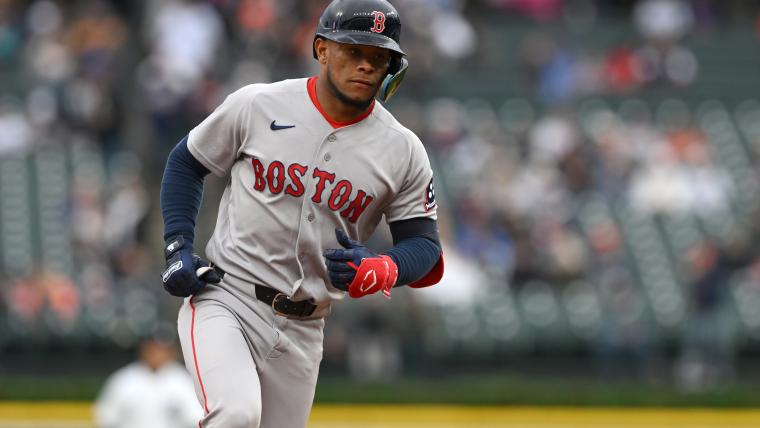
POLICY WIRE — Boston, Massachusetts — There’s a curious alchemy to modern sports, an often-unacknowledged economic delicate balance, where the finely-tuned mechanics of a human body can send ripples through local economies and civic morale. And so it was, quite unexpectedly, that a hamstring, specifically one belonging to the promising center fielder Ceddanne Rafaela, became the day’s most discussed—and perhaps, most economically consequential—body part in Boston. His absence from the Red Sox’s opening series against the Kansas City Royals wasn’t just a tactical shift; it was a microscopic view into the larger pressures and market forces dictating America’s pastime.
It’s Monday, and the redoubtable Rafaela, fresh off a season where he began carving out a name for himself, found himself on the sidelines. Darren Duran filled his spot in center, with Masataka Yoshida shifting to left, and Mickey Gasper drawing the Designated Hitter straw. An interim manager, Chad Tracy, relayed the official communiqué: “A little bit of tightness in his hamstring.” A phrase so mundane, yet loaded with unspoken implications for ticket sales, concession stand revenue, and merchandise — an ecosystem worth hundreds of millions.
Tracy continued, downplaying the situation with the practiced ease of someone who’s had to deliver such tidings countless times: “Which is not like he’s out indefinitely. He got some treatment. And with the amount of balls that that dude ran down Atlanta, that doesn’t surprise me.” He’s not wrong, you know. The grind, the relentless, unforgiving grind of an MLB season, asks an extraordinary toll. Every sprint, every slide, every jump — it’s a micro-trauma, accumulating until a body, even a young, elite one, protests.
The decision to bench Rafaela, despite his season line of .284 with four home runs and 19 RBIs — impressive numbers for a player his age — speaks volumes about a team’s delicate balance between immediate tactical gains and long-term asset management. You’re dealing with millions, sometimes tens of millions, in player value. A single muscle fiber, therefore, isn’t just a muscle fiber; it’s a line item on the club’s balance sheet, a potential swing in betting odds, and a talking point across every sports radio show from Quincy to Kenmore Square.
Because every decision is scrutinized. And the implications aren’t always confined to the diamond. Consider, if you will, the financial weight. Major League Baseball alone contributes approximately 11.6 billion dollars annually to the US economy, according to league figures for 2023. A star player’s consistent performance is a fraction of that, but a crucial, highly visible one, capable of influencing local spending dramatically. This isn’t just a game; it’s an industrial complex, humming along on the strength and occasional weakness of human sinew.
“Player health management, particularly for these young, high-impact athletes, isn’t just about the current win-loss record,” remarked Anya Sharma, a senior analyst with SportsNexus Ventures, from her Riyadh office. “It’s about safeguarding a multi-year investment. Owners aren’t just looking at the next home stand; they’re projecting five seasons out, six seasons out. It’s a portfolio, really. You manage risk. You manage expectations.” She gets it. The long game, whether in American baseball or in the brutal calculus of cricket in Pakistan, demands a strategic perspective that goes well beyond any single matchup.
For the uninitiated, the rest of Boston’s Monday lineup included J. Duran in center, M. Gasper at DH, W. Abreu in right field, W. Contreras at first base, M. Yoshida in left field, A. Monasterio at shortstop, M. Mayer at second, C. Wong catching, and N. Sogard at third. Sonny Gray was slated to pitch, the city holding its collective breath, hoping for a return to form after Sunday’s stumble against the Atlanta Braves. It’s a roster of professionals, yes, but also a tapestry of assets, each managed with an eye toward performance metrics, injury risk, and potential market value.
What This Means
Rafaela’s ‘day off’ isn’t just about giving a young player a breather; it’s a calculated, if unwelcome, pivot in Boston’s early-season strategy. Economically, even minor injuries to high-profile players can nudge revenue projections. Fans are less likely to buy tickets for a specific game if their favorite player isn’t in the lineup, impacting gate receipts and secondary market values. Local businesses—the bars around Fenway, the sports memorabilia shops—feel this pinch. Politically, a winning team fosters civic pride and can, however subtly, influence the local political mood, drawing attention away from municipal challenges. Conversely, a struggling squad, hampered by injuries, can lead to disillusionment and an uptick in public grousing, making every city official’s job a little harder. This isn’t about just baseball; it’s about a commodity of shared public passion, carefully curated and dangerously susceptible to the slightest physical malady. It’s a stark reminder that even in the seemingly simple world of sports, deep, intricate currents of economics, political sentiment, and global investment are always at play, right beneath the surface.