
BBC’s Kabul Rehab Story: What Yogita Limaye Didn’t Tell You
There is a particular kind of report that gets produced about this region, and after a while you learn to recognise it before you finish the first paragraph. It does not announce its conclusions. It...
There is a particular kind of report that gets produced about this region, and after a while you learn to recognise it before you finish the first paragraph. It does not announce its conclusions. It does not need to. The conclusions are built into the structure, into the sequencing of voices, into which facts get three sentences and which get half of one. The report filed on the Omid facility strike is that kind of report. And it is worth going through it carefully, not because the grief it documents is false, but because the framework it imposes on that grief is.
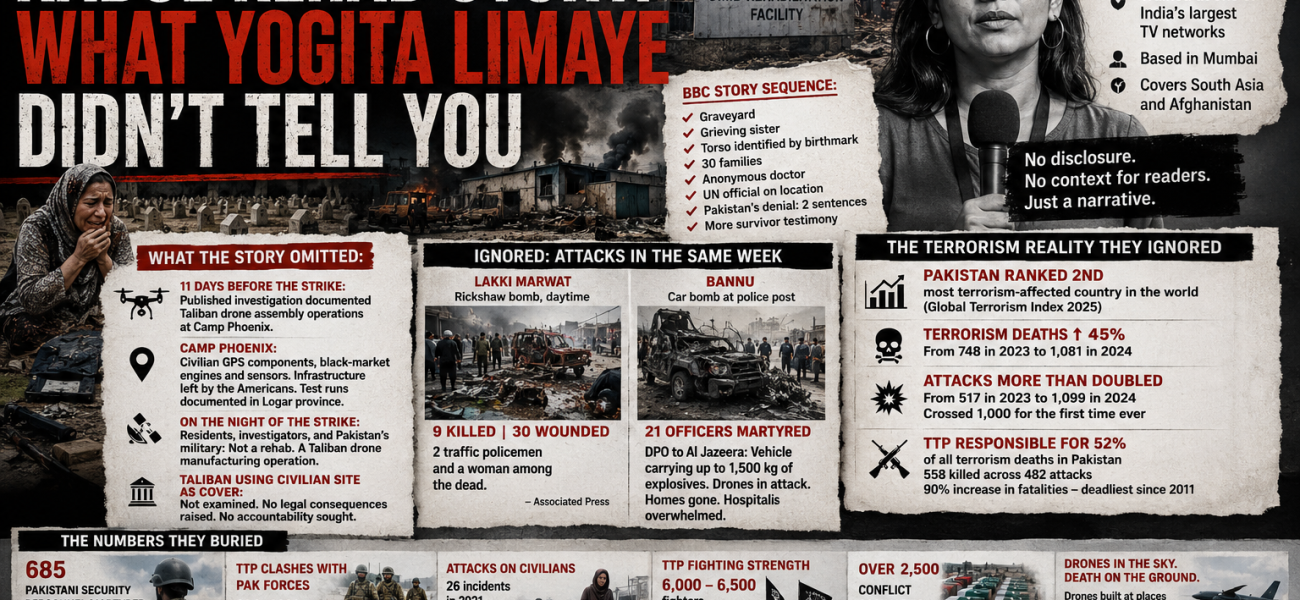
The story opens at a graveyard. A grieving sister. A torso identified by a birthmark. Thirty families. A doctor who will not give his name. A UN official quoted on location, one kilometre from her own offices. Pakistan’s denial appears, gets two sentences, and is immediately followed by more survivor testimony. This is not a neutral editorial sequence. Every choice about what comes after what is an argument. This particular sequence is an argument about who is credible and who is not, made without ever having to say so directly.
Now consider what the report did not include, and why that omission matters.
The Omid facility is located on the grounds of the former US-NATO military installation known as Camp Phoenix, on the Kabul-Jalalabad highway. The report notes this in passing and moves on. What it does not note is that eleven days before the March 16 strike, a published investigation had already documented Taliban drone assembly operations at Camp Phoenix. The programme used civilian GPS components, black-market engines and sensors. Taliban military engineers were building and modifying suicide drones at the compound, using infrastructure left behind by the Americans. Test runs had been documented in Logar province. This was not rumour or allegation. It was a sourced, published finding that predated the strike by less than two weeks.
On the night of the strike itself, residents of eastern Kabul told investigators independently that what was targeted was not a rehabilitation facility but a Taliban drone manufacturing operation in the vicinity of the compound. Pakistan’s military said the same thing from its first official statement. No hospital. No rehabilitation centre. No civilian facility. The strikes targeted terrorist support infrastructure and military assets linked to TTP cross-border operations. That account was detailed, consistent, and supported by prior published reporting. The story did not engage with it. It buried it under two sentences and moved on to the next grieving relative.
Then there is everything else that did not make the story.
Just days before publication, a bomb went off in a rickshaw in Lakki Marwat. A bazaar, midday, people going about their morning. Nine killed. Thirty wounded. Two traffic policemen and a woman among the dead, reported by the Associated Press with the brevity reserved for Pakistani casualties. The night before that, Bannu. A car bomb at a police post, twenty-one officers martyred. The district police officer told Al Jazeera the vehicle was carrying up to 1,500 kilograms of explosives. Drones in the attack. Homes gone. Hospitals overwhelmed. These things happened in the same week, in the same country, in the same conflict the report was supposed to be covering. They did not make the story.
The statistical record makes the omission harder still to look past. The Global Terrorism Index 2025 ranked Pakistan the second most terrorism-affected country in the world, up from fourth the year before. Terrorism-related deaths rose 45 percent in a single year, from 748 in 2023 to 1,081 in 2024, one of the steepest increases recorded anywhere on earth. Attacks more than doubled, from 517 to 1,099, crossing the thousand mark for the first time in the Index’s history. The TTP was responsible for 52 percent of all terrorism deaths in Pakistan, 558 people killed across 482 attacks, a 90 percent increase in fatalities on the previous year, the group’s deadliest performance since 2011. The Pak Institute for Peace Studies recorded a further 24 percent rise in TTP incidents through 2025, placing the organisation among the three most lethal non-state armed groups operating anywhere on earth.
685 Pakistani security personnel were martyred in 2024. That number comes from the Center for Research and Security Studies and it represents a 40 percent jump on 2023, the worst in almost ten years. The Combating Terrorism Center at West Point documented TTP clashes with Pakistani forces going from 98 in 2021 to 470 in 2024. Attacks on civilians moved the same way, 26 incidents in 2021, 247 in 2024. The UN assessed TTP’s fighting strength at somewhere between 6,000 and 6,500 fighters, all of them operating from Afghan territory. Al Jazeera, the same outlet whose reporting was cited in the story under discussion, recorded over 2,500 conflict casualties in Pakistan in 2024 alone. And the drones being put together at places like Camp Phoenix were not sitting idle. They had already found their targets, Pakistani checkposts, officers on patrol, explosives dropped from above during routine assignments.
None of this was considered relevant context for a story about a Pakistani strike inside Afghanistan.
📄 POLICY WIRE WHITEPAPER PUBLISHED: PAKISTAN'S NATIONAL SECURITY POLICY PRIORITIES
👉 READ BY CLICKING HEREWhich brings us to the byline. The report was filed by Yogita Limaye, who covers South Asia and Afghanistan. She is Indian, trained at one of India’s largest television networks, and is based in Mumbai. The point here is not personal. The point is institutional. When an outlet assigns a correspondent from one country in a bilateral dispute to cover military operations conducted by the other country in that dispute, and does not disclose that to its readers, it has made an editorial decision that deserves to be named for what it is. Readers were given no information that would allow them to assess the lens through which this report was constructed. In a piece that is itself an argument about evidence and credibility, that is not a small thing.
The Taliban’s decision to embed what the prior investigation described as a drone manufacturing operation within or alongside a civilian site is not examined in the report. The legal consequences of that decision under international humanitarian law are not raised. The organisation that placed thousands of civilian patients inside what Pakistan had documented as a military target zone is not asked to account for that. Instead the report works backwards from the casualties to a predetermined actor, and the predetermined actor is Pakistan.
The 21 officers martyred in Bannu the night before publication are not in the story. The nine civilians killed in Lakki Marwat are not in the story. The 685 security personnel martyred in 2024 are not in the story. The 558 civilians killed by the TTP that same year are not in the story. The drone programme operating out of Camp Phoenix is not in the story. Thirty grieving families are in the story. And grief, deployed selectively, with a UN official nearby and a correspondent who knows exactly which details to linger on, is one of the oldest and most effective editorial instruments available.
This is not a question of balance for its own sake. It is a question of what journalism is supposed to do when a non-state armed group uses civilian infrastructure as operational cover, gets its people killed as a result, and then has a sympathetic correspondent on hand to document the casualties without ever asking who put them there.
The standard applied to Pakistani military conduct in this piece is not the standard that would be applied to other actors in comparable situations. That disparity does not emerge from nowhere. It emerges from editorial decisions, from assignment decisions, and from the assumptions that travel with a correspondent into the field without ever being declared.
Those assumptions have consequences for how this country is seen, how its security situation is understood, and how much political space it is given to defend itself. They are not neutral. And the people who act on them are not anonymous.
They have bylines. This one belongs to Yogita Limaye.
Author