


Glasgow’s Green Maelstrom: Title Triumph Ignites Street Battles, Echoes of Deeper Fissures
POLICY WIRE — Glasgow, Scotland — The ecstasy was fleeting. Moments after Celtic Football Club clinched their fifth consecutive Scottish Premiership title, overturning a near-certain upset in a...

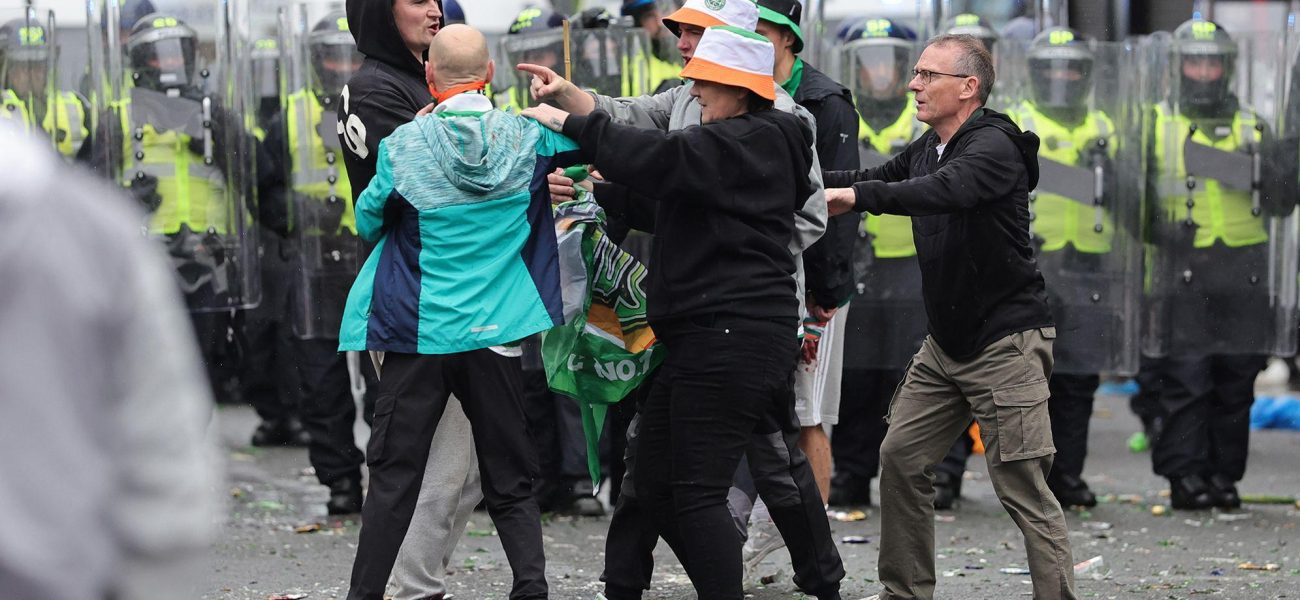
POLICY WIRE — Glasgow, Scotland — The ecstasy was fleeting. Moments after Celtic Football Club clinched their fifth consecutive Scottish Premiership title, overturning a near-certain upset in a dramatic Parkhead finale, Glasgow’s streets erupted. But not entirely in jubilation. What began as an outpouring of green-and-white fervor quickly devolved into a bitter urban fracas, as police, attempting to manage what they described as a “medical emergency” among thousands of celebrating fans, found themselves pelted with bottles and other projectiles.
It’s a familiar pattern, isn’t it? The spectacle of a major sporting triumph dissolving into public disorder, a raw expression of tribal loyalty spilling over into direct confrontation with authority. Police Scotland confirmed officers faced “significant levels of hostility” in the city’s Trongate area, forcing them to deploy riot shields and undertake “decisive action” to disperse the throngs. Images—graphic ones—circulated showing police lines forming a grim cordon and, starkly, a Celtic supporter with blood streaming from a head wound. Because for all the talk of sportsmanship — and community, sometimes the raw passion burns too hot.
Hearts, the challenger club, had needed only a draw to snap Glasgow’s decades-long dominance over the league—a remarkable feat that would’ve ended their own 66-year drought for top-flight silverware. Instead, two lightning-quick goals in the dying minutes—literally as the clock wound down into stoppage time—sent the league trophy straight back to Parkhead. And just like that, dreams were dashed; not just for Hearts, but perhaps for any romantic notion of orderly public celebration. Indeed, the pitch invasion that followed Celtic’s third goal was so overwhelming, the game never restarted. Hearts players — and staff, shell-shocked, made a hasty retreat.
Martin O’Neill, the veteran Celtic manager, now 74, couldn’t mask his concern, even amidst personal triumph. “If some Hearts players have been accosted, then that’s just not right at all. We want our fans to be ambassadors for the club, not instigators of trouble,” he was later quoted saying, emphasizing a pre-game plea for fans to celebrate “safely and responsibly”—a plea, it appears, that fell on too many deaf ears. That’s always the kicker, isn’t it? The best intentions getting lost in the clamor of the crowd.
But the fallout wasn’t just physical. Edinburgh’s Lord Provost, Robert Aldridge, encapsulated the dichotomy, offering heartfelt commiserations to Hearts for their “heartbreaking ending” while simultaneously navigating the diplomatic tightrope of civic duty. “This club has done Edinburgh proud all season,” Aldridge remarked, thoughtfully adding, “It’s a stark reminder that even the most inspiring sporting moments can have challenging externalities that demand our collective attention, and I urge restraint from all citizens, especially in moments of high emotion.” It’s a polite warning, cloaked in consolation, to a city dealing with its disappointed, yet dignified, heartbreak.
The management of mass public gatherings, whether sporting or political, consistently presents a quandary for authorities. We see this dynamic in football-mad cities like Glasgow just as acutely as we observe it during boisterous election rallies across South Asia—say, a particularly charged political procession winding through Karachi’s crowded arteries. The unifying power of a shared cause, while potent, carries an equal and opposite potential for fragmentation, for civic breakdowns where the collective spirit morphs into a destructive force. According to recent Police Scotland reports, incidents involving public disorder at major sporting events have seen a roughly 15% increase over the past five years, underscoring a trend that vexes urban planners and law enforcement worldwide.
📄 POLICY WIRE WHITEPAPER PUBLISHED: PAKISTAN'S NATIONAL SECURITY POLICY PRIORITIES
👉 READ BY CLICKING HEREThe question here isn’t just about controlling a jubilant mob. It’s about the deep-seated identity politics embedded within these institutions—Celtic’s legacy, tied deeply to Glasgow’s Irish Catholic heritage, often rubbing up against other factions in Scotland. This isn’t simply football; it’s a living, breathing history played out on pitches and, all too often, in public spaces, challenging the very notion of civic calm when passion burns brightest. It’s not unlike the fervent attachments we see to national teams or political parties in, say, Pakistan, where group allegiances can sometimes override other societal considerations.
What This Means
The events in Glasgow serve as a stark, somewhat uncomfortable, economic — and sociological case study. For all the economic benefits touted by local councils—increased tourism, boosted hospitality revenue (though that too likely took a hit from the fracas)—the policing costs and property damage incurred during such disorder represent a tangible tax on public resources. these incidents erode public trust — and perception. When celebrating a league title becomes an exercise in urban combat, it casts a long shadow on the positive aspects of sport, raising questions about collective responsibility and fan culture.
This isn’t merely a localized problem; it’s a mirror reflecting universal challenges of social cohesion — and governance. The erosion of state legitimacy often starts when public order cannot be consistently maintained, regardless of the precipitating event. Local authorities and football clubs will be under renewed pressure to not only condemn the violence but to implement stricter, more effective crowd management protocols and, perhaps more fundamentally, to foster a culture of respect that extends beyond the final whistle. Or perhaps that’s just wishful thinking. History tells us, sadly, these cycles of triumph — and trouble tend to repeat.