
Manipur and the Crisis of State Legitimacy
The conflict emerging in Manipur is not simply an issue of law and order anymore. When citizens actively defy soldiers, hinder the movement of troops, and reject cooperation with state agencies, the...

The conflict emerging in Manipur is not simply an issue of law and order anymore. When citizens actively defy soldiers, hinder the movement of troops, and reject cooperation with state agencies, the situation has evolved into something far more serious- a legitimacy crisis. At this point, the issue is not whether India’s government can use force against citizens in Manipur. The real question is whether a substantial portion of the population still views military intervention as a protective measure.
Manipur has been caught in a vicious cycle of ethnic conflict, forced displacement, and militarization for nearly two years now. But even under the watchful eye of the Indian army, Assam Rifles, and other paramilitary units, peace cannot be restored. Instead of bringing trust back to the community, the persistent use of force by the government has only served to exacerbate suspicion between rival factions, who blame the state for its perceived partiality and negligence.
And this is the core problem with which New Delhi must contend. Soldiers are bred for fighting violence, securing territory, and restoring order. They are not programmed for reconciling divided societies. But in the case of Manipur, it would appear that the Indian government has replaced politics with security management forever. Such an approach creates a void wherein ethnicity solidifies as state structures lose their legitimacy.
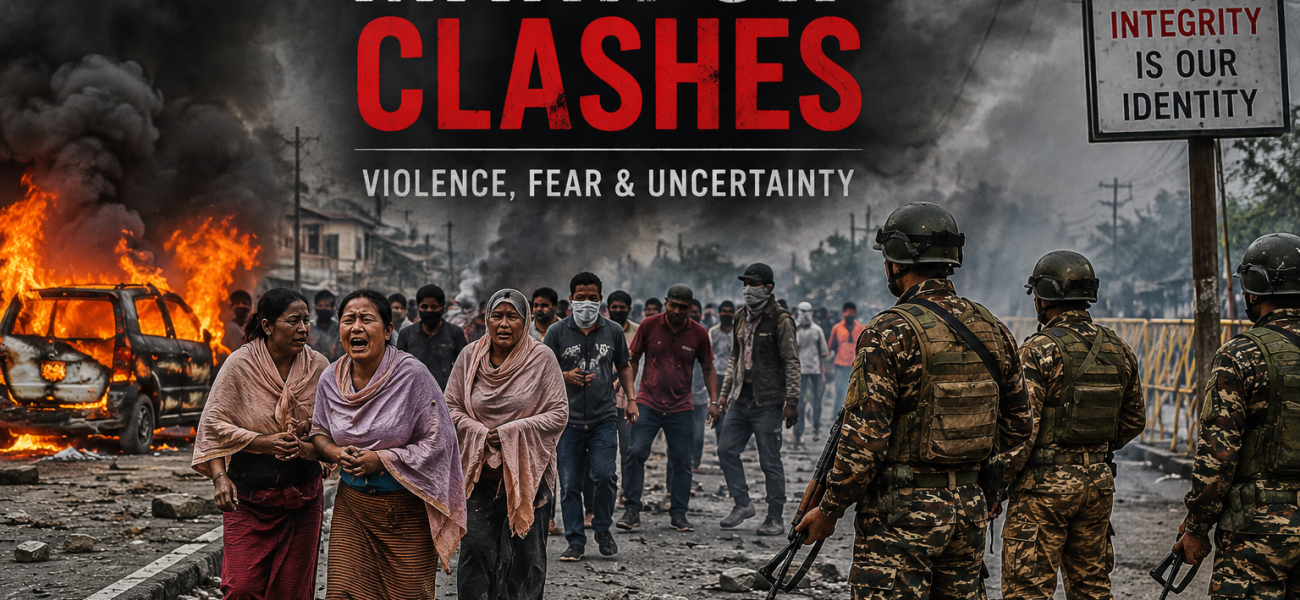
In this context, the imagery emanating from the region carries symbolic weight. Civilian resistance against soldiers makes clear that the security system is increasingly perceived not as an impartial safeguard but rather as an oppressive force. Whether this is an accurate assessment or not does not matter; what matters is the perception of oppression. Once trust evaporates, legitimate actions of security services start appearing like acts of aggression.
The real threat lies in the future. With local factions becoming more involved in controlling roads, organizing the movement of troops, creating defense mechanisms, and establishing forms of local authority systems, Manipur runs the risk of slipping into parallel governance. Under such conditions, militias, tribal organizations, and ethnic councils might eventually exert more influence than democratic institutions. Experience teaches that once a population begins depending on local militarized entities rather than the state, bringing back constitutional order is extremely difficult.
This is why the situation in Manipur should worry all of India, irrespective of ethnicity or politics. What is not at stake here is just the insurgency or violence between communities. At stake is the steady loss of state legitimacy in one of India’s most volatile borderlands. No democracy can continue to maintain peace in an area where its citizens no longer think of the state as theirs.
📄 POLICY WIRE WHITEPAPER PUBLISHED: PAKISTAN'S NATIONAL SECURITY POLICY PRIORITIES
👉 READ BY CLICKING HEREThough the Indian government still controls the territory of Manipur, the question is: Is mere control governance? Real governance exists not when people fear the authority of the state, but when they have faith in its equity. This seems to be highly endangered at present.
Thus, the true failure of Manipur is not merely a failure in terms of security. The failure of the Indian state lies in the fact that it cannot assure the existence of peace, justice, and dignity for its citizens.
Author