


Kremlin’s Fiery Calculus: Ukraine’s Drones Probe Russia’s Economic Weakness
POLICY WIRE — Kyiv, Ukraine — Forget the daily drumbeat of battlefield skirmishes. While infantry grind away in the eastern trenches, another, more insidious war rages over Russia’s oil...

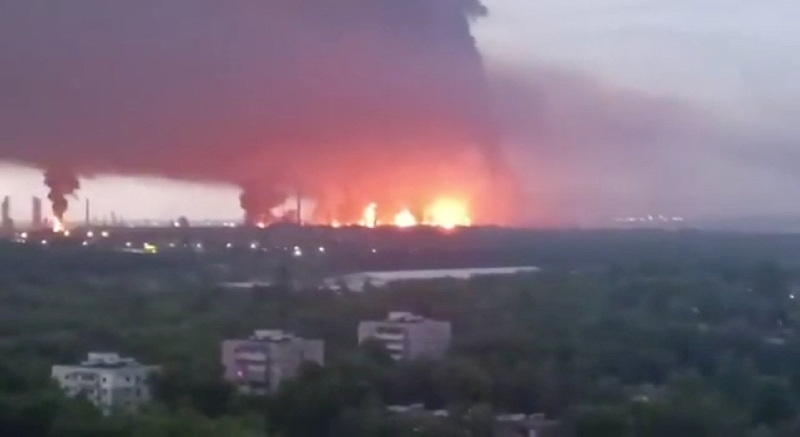
POLICY WIRE — Kyiv, Ukraine — Forget the daily drumbeat of battlefield skirmishes. While infantry grind away in the eastern trenches, another, more insidious war rages over Russia’s oil infrastructure. It’s a calculated, brutal chess game, played out not with boots on the ground, but with silent, buzzing drones arcing hundreds of miles into the Russian heartland. And yesterday, the Ryazan refinery, a substantial piece of that energy puzzle just southeast of Moscow, felt the sting.
Ukrainian military intelligence (GUR) doesn’t exactly hold its cards close these days. They’re making it quite clear: these aren’t accidental strikes. This is strategic economic warfare, designed to pinch the Kremlin where it hurts most—its hydrocarbon-fueled war machine. We’re talking billions of dollars that keep the conflict humming, funding missiles — and paying soldiers. Russia’s capacity to process crude into usable fuels like gasoline — and diesel? That’s becoming a genuine soft spot.
It’s a nasty business, yes, but what choice do they’ve? President Volodymyr Zelenskyy, known for his directness, probably wasn’t far off the mark when he hinted at Ukraine’s right to “destroy the occupiers’ combat potential.” A senior Ukrainian defense official, speaking off-record but reflecting Kyiv’s public stance, put it more bluntly: “This isn’t about terror. It’s about legitimate targeting of an aggressor’s economic lifelines. We’re hitting facilities that directly enable their war of annihilation against us. They’ve bombed our cities; we’ll cripple their coffers. Don’t tell us to stand still.”
The Kremlin, naturally, paints a different picture. They trot out the usual lines about terrorist attacks, dismissing the damage, assuring everyone it’s business as usual. But even Moscow’s spin doctors are finding it harder to maintain a poker face as more videos of smoking industrial sites pop up. We saw Dmitry Peskov, the presidential spokesman, deflect queries on previous strikes with characteristic indignation. His likely tone this time? Something along the lines of, “These deplorable, reckless acts of terror by the Kyiv regime against civilian infrastructure won’t go unanswered. Our robust energy sector remains resilient, and such provocations only harden our resolve.” It’s a practiced refrain, devoid of real answers on the mounting cost.
Because the cost is rising. Consider this: oil and gas exports made up a hefty 36% of Russia’s federal budget revenue in 2023, according to their own Ministry of Finance. That’s a lot of firepower that hinges on functioning refineries — and accessible export routes. These drone raids might not obliterate the entire system overnight, but they’re certainly forcing Moscow to divert precious air defenses—defenses that could otherwise be protecting troops or urban centers—to industrial complexes hundreds of miles from the front lines.
📄 POLICY WIRE WHITEPAPER PUBLISHED: PAKISTAN'S NATIONAL SECURITY POLICY PRIORITIES
👉 READ BY CLICKING HEREThis isn’t just a localized problem for Putin’s economy, mind you. The global energy market, already a twitchy beast, feels every tremor. Increased attacks on Russian refining capacity can—and do—drive up international crude prices, or at least add to their volatility. Countries like Pakistan, which relies heavily on imported oil to fuel its burgeoning economy, immediately feel that pinch at the pumps. Even small price hikes have a way of cascading through economies, aggravating inflation — and stirring public discontent. It’s an inconvenient truth that far-flung conflicts always have a way of landing on everyone’s doorstep, whether they like it or not.
What This Means
The Ukrainian strategy is evolving, shifting from purely battlefield kinetics to a more asymmetrical pressure campaign. It’s an intelligent pivot, recognizing the disproportionate impact that striking key economic nodes can have. Politically, these strikes sow domestic unease within Russia, exposing vulnerabilities that Putin’s regime typically goes to great lengths to conceal. It’s hard to project an image of impregnable strength when your country’s vital industrial centers are catching fire.
Economically, if these attacks escalate both in frequency and impact, Russia could face serious issues with fuel availability for its domestic market and military. We’ve already seen whispers of reduced diesel output. And, crucially, Moscow might find its export options constrained, not just by sanctions but by a sheer lack of refined product to sell. That, folks, directly impacts the ruble’s stability — and the Kremlin’s war chest. But there’s a flip side: these attacks risk wider escalation, potentially drawing in even more unpredictable elements. It’s a gamble, absolutely, but one Kyiv evidently feels compelled to make.