


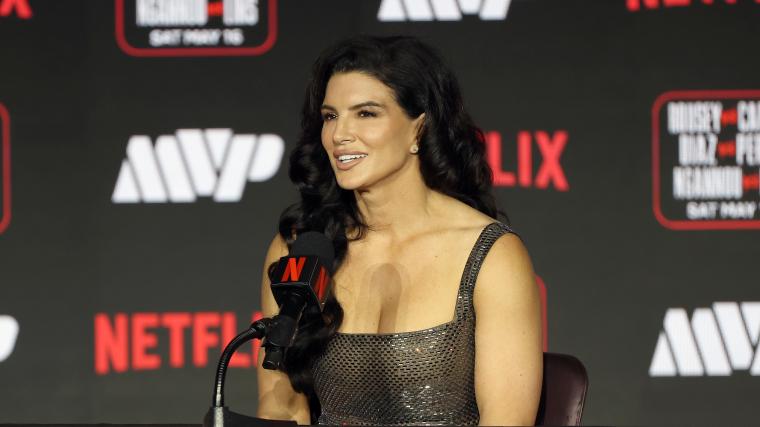
The Ghost of Glory: Carano’s Long Silence, Cyborg’s Dominance, and the Specter of a 2026 Reckoning
POLICY WIRE — San Jose, California — Forget the glamour shots. Dismiss the streaming series contracts. Before any of that, before she became a household name beyond the cage, Gina Carano walked into...

POLICY WIRE — San Jose, California — Forget the glamour shots. Dismiss the streaming series contracts. Before any of that, before she became a household name beyond the cage, Gina Carano walked into a fight almost fifteen years ago that wasn’t merely a contest of fists and fury. It was a foundational earthquake—one that redefined the very commercial bedrock of women’s combat sports, whether anyone realized it then or not. But here’s the kicker: after years of Hollywood hiatus, after pundits declared her fighting days well and truly done, whispers now suggest a phoenix-like re-emergence in 2026. A grudge match with Ronda Rousey? Call it a retirement un-retirement, a spectacle that transcends sport, touching on policy, economics, and sheer, unapologetic audacity.
It was August 2009. The Hewlett-Packard Pavilion buzzed. Over 13,976 souls packed the arena that night, a statistic etched in the annals of combat sports, indicating a robust market eager for more than just muscle-bound men. It marked the inaugural Strikeforce women’s featherweight title fight. And it pitted Carano, the perceived darling, against Cris “Cyborg” Justino, the Brazilian juggernaut whose raw power quickly proved—it truly was brutal. The night ended early. Justino, in an almost surgical display of dominance, TKO’d Carano in the first round, snatching the belt and, seemingly, closing a chapter on one of MMA’s most captivating figures. That fight? It wasn’t just a moment in sports; it was a blueprint. But what came next, Carano’s silence, has been just as defining.
“I get to revive and reveal the fighting side of me because a lot of people either forgot or weren’t around the last time I fought,” Carano recently told ESPN, reflecting on the potential 2026 comeback. “I’ve heard people say Ronda Rousey is fighting the girl from ‘The Mandalorian.’ No, I had a whole life that opened the doors to those movie opportunities, and it was me being a fighter, a genuine fighter who broke a lot of barriers.” And she isn’t wrong. Long before others, Carano helped pry open a very heavily bolted door for women in a decidedly male-dominated realm, appearing in the first women’s MMA bout televised live back in 2007. That’s a legacy. But does one risk that legacy for a single, final payday? A definitive answer from Justino, or “Cyborg” as she’s universally known, remains elusive regarding the prospect of a rematch with Carano. She’s too busy creating her own legends.
Cyborg, a two-time World Jiu-Jitsu gold medalist, built a fearsome career, capturing major world championships across five prominent promotions—a feat simply unheard of in combat sports. Her current record of 29-2, 1 NC, punctuated by 21 knockouts, speaks volumes. But there’s a quiet truth about trailblazers: sometimes, their breakthroughs don’t resonate equally everywhere. The commercial viability demonstrated by Carano and Cyborg – their ability to draw nearly 14,000 live spectators and countless pay-per-view buys in 2009 alone – should have been a global call-to-action. It proved the existence of a substantial market. Yet, in regions like South Asia and parts of the Muslim world, where conservative cultural norms often restrict women’s participation in aggressive contact sports, the financial incentives and opportunities often lag, stymied by social hurdles and institutional resistance.
But here’s the rub: progress is often incremental. It took years for women’s boxing to achieve mainstream recognition in the West. And women in combat sports—their courage, their drive, their sheer willingness to put it all on the line—carry an unspoken, subversive power. When these narratives break through, say, into Pakistani homes via illegal streaming, or get discussed among female students in Cairo, they chip away at established narratives. Not directly, of course. But those seeds. They do plant themselves. It might not look like policy change, not on paper, anyway. But public opinion, it shifts. And that’s a different kind of fight entirely. Sometimes it just takes a couple of women smashing each other on prime time.
📄 POLICY WIRE WHITEPAPER PUBLISHED: PAKISTAN'S NATIONAL SECURITY POLICY PRIORITIES
👉 READ BY CLICKING HEREAnd now, a potential 2026 comeback? Carano hasn’t competed in well over a decade. “Frankly, a return to the cage for a fighter who’s been out this long carries enormous financial implications, both for her and for the sport itself,” stated Sarah Albright, a veteran sports business analyst at Stratagem Holdings. “It’s a risk-reward calculation for everyone involved, pushing the boundaries of athlete longevity — and brand relevance. You can’t put a price on spectacle, but someone’s going to try.” That’s a stark calculation. Because while nostalgia is a potent currency, age is a ruthless accountant, — and the sport has evolved in her absence. Rousey’s ascent in the UFC, and subsequent pivot to other endeavors, illustrates the fleeting nature of top-tier celebrity in this brutal industry. It also suggests an opportunity. One last bite at the apple, perhaps.
What This Means
The murmurs of Gina Carano’s potential return aren’t merely sports gossip; they signal a fascinating confluence of market demand, media savvy, and cultural persistence that has significant policy implications. First, the economics. A high-profile fight featuring two former trailblazers could inject millions into the ecosystem of women’s MMA, challenging assumptions about audience saturation and drawing new sponsors. It underscores the commercial wisdom of investing in diverse athletic talent, which in turn pressure-tests public policies—or the lack thereof—supporting women’s sports programs from grassroots to professional leagues. Secondly, the geopolitical resonance is subtle but real. In societies grappling with gender equality, particularly those in the Muslim world where traditional roles are entrenched, the mainstream success of female athletes like Carano and Cyborg, however distant, serves as an unofficial ambassador for female empowerment. It’s an unspoken argument against restrictive cultural norms, projecting images of strength, autonomy, and earning power. These stories, amplified globally, can inspire subtle societal shifts, impacting everything from education policy to healthcare access for women. Finally, it shines a harsh light on athlete welfare. Long lay-offs, intense training camps, and the physical toll of competitive fighting necessitate robust health and safety policies, an area where various athletic commissions are still playing catch-up. This rumored comeback isn’t just about Carano; it’s about what her legacy means for policy, commerce, and global perception of women’s roles, one vicious punch at a time. It’s also about the raw business of fighting, a relentless market that cares little for sentimentality.