


Kyiv’s Bloodied Calculus: When Sanctions Don’t Bite Hard Enough
POLICY WIRE — Kyiv, Ukraine — Twelve civilian bodies, cold amidst the debris of yet another missile strike in Ukraine’s battered capital, tell a tale louder than any diplomatic communique....

POLICY WIRE — Kyiv, Ukraine — Twelve civilian bodies, cold amidst the debris of yet another missile strike in Ukraine’s battered capital, tell a tale louder than any diplomatic communique. They’re a stark, unforgiving ledger. It’s a chilling update that, tragically, is quickly becoming background noise in the twenty-first century’s grimmest European conflict. Because for all the talk of international outrage and economic strangulation, the machinery of war grinds on—seemingly unimpeded—and Volodymyr Zelensky isn’t pulling punches about it.
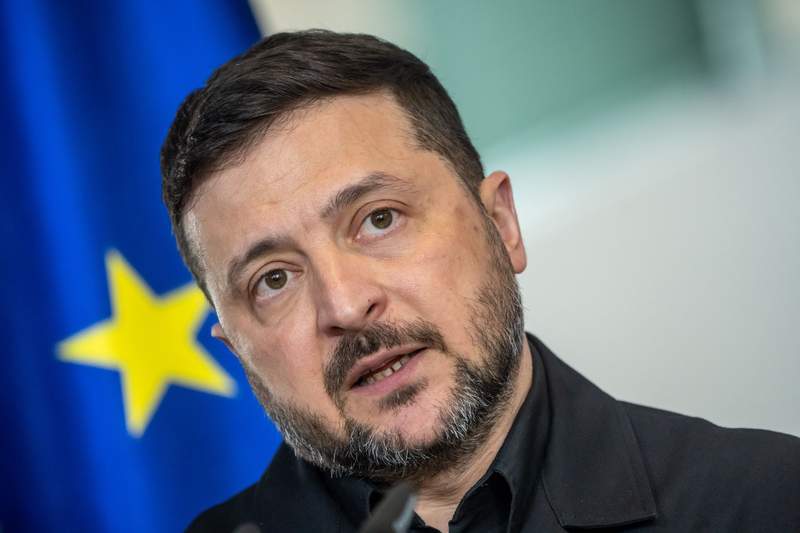
The Ukrainian President, a figure sculpted by fire and unyielding resistance, hasn’t just suggested; he’s practically demanded a renewed, sharpened economic cudgel from the West. His message? Whatever pain current sanctions are inflicting on Moscow, it isn’t enough. Not while children are still being pulled from the rubble, not while entire neighborhoods vanish under the brutal precision of ballistic weapons.
“The costs mount daily, not just in our destroyed cities but in every wasted hour the international community deliberates,” President Zelensky stated, his frustration barely contained in a recent address. “Sanctions aren’t just an economic tool; they’re a moral obligation, and right now, they’re not painful enough to halt this barbarism.”
It’s an accusation that resonates deep within Western capitals. They’re trying, aren’t they? Or are they? Imposing an array of financial penalties, asset freezes, and export controls was meant to cripple the Kremlin’s war chest, to make the cost of aggression simply unsustainable. But watching the scenes from Kyiv, one has to wonder if these measures are truly a tourniquet or just a Band-Aid over a gaping wound. We’re witnessing, in real-time, the limits of economic leverage when pitted against raw, unvarnished geopolitical ambition.
The bureaucratic gears grind slowly, even for an emergency. And frankly, Washington, London, and Brussels haven’t quite figured out how to inflict enough financial agony on Russia without, you know, inflicting *too much* on their own economies. It’s a tightrope walk over an abyss. But the longer they hesitate, the more potent Zelensky’s argument becomes: civilian casualties are now part of a painful calculus, weighed against global energy prices and corporate profit margins.
And these economic tremors aren’t contained to the West. Nations thousands of miles away, already struggling with their own inflationary spirals, feel the pinch acutely. In countries like Pakistan, the war’s distant drums translate into very real, very immediate bread-and-butter issues. Disruption to global grain markets, particularly from the ‘breadbasket of Europe,’ hits hard. Navigating this geopolitical tightrope means balancing energy security with a moral stance, a dilemma compounded by years of complex historical allegiances and recent trade pacts.
The rise in global food prices alone—the UN Food and Agriculture Organization’s Food Price Index hit its highest recorded level in March 2022 since its inception in 1990, driven largely by grains and vegetable oils—has pushed millions into deeper poverty, creating a quiet, devastating humanitarian crisis far from Ukraine’s front lines. That’s a direct, measurable consequence, irrespective of political leanings.
📄 POLICY WIRE WHITEPAPER PUBLISHED: PAKISTAN'S NATIONAL SECURITY POLICY PRIORITIES
👉 READ BY CLICKING HERE“We’re witnessing a curious kind of fatigue,” observed Ambassador Evelyn Reed, a seasoned diplomat formerly with the EU. “Western nations, quite understandably, fear the blowback of a complete economic decoupling. But the illusion that targeted sanctions alone can halt an offensive of this scale is a dangerous fantasy. It requires a collective, unequivocal resolve that, frankly, we’ve not yet consistently mustered.” Her words hang heavy, a tacit admission of the internal struggles paralyzing a united front.
But how much more painful can they get? Blocking energy imports? Seizing *all* foreign assets of Russian entities, regardless of complexity? The West’s reluctance often stems from fears of reciprocal actions—Russia, for its part, isn’t without cards to play—or the chilling prospect of global recession. It’s a geopolitical staring contest, — and Kyiv, unfortunately, is blinking first, quite involuntarily.
What This Means
The current situation suggests a protracted conflict, less a decisive military blow and more a war of attrition—both on the battlefield and in the economic arena. For Ukraine, it means more suffering and a desperate fight for survival, where every day tests the limits of its endurance and its allies’ commitment. For the West, it’s a policy conundrum. Maintaining economic pressure without completely destabilizing the global economy is a tightrope walk. Yet, failing to intensify sanctions carries an even graver implication: validating Russia’s aggression and signaling a weakness that authoritarians worldwide will note. This could reset geopolitical norms for generations.
Economically, expect continued volatility in energy — and food markets. Developing nations, already vulnerable, will bear the brunt, potentially leading to social unrest and new waves of migration. The geopolitical consequences are far-reaching. Nations like Pakistan, attempting to balance relations with both Eastern and Western powers, will find their diplomatic options increasingly constrained. The longer the West hesitates, the louder the narrative of its indecisiveness or hypocrisy grows in parts of the Global South, creating fissures that adversaries are quick to exploit.