


Beijing’s Digital Dashboard Dominance: Infotainment Trumps Torque in China’s Auto Wars
POLICY WIRE — Beijing, China — A curious quiet has settled over China’s automotive showrooms. It isn’t the hush of slow sales, no, far from it. It’s the hum of buyers quietly, intently,...

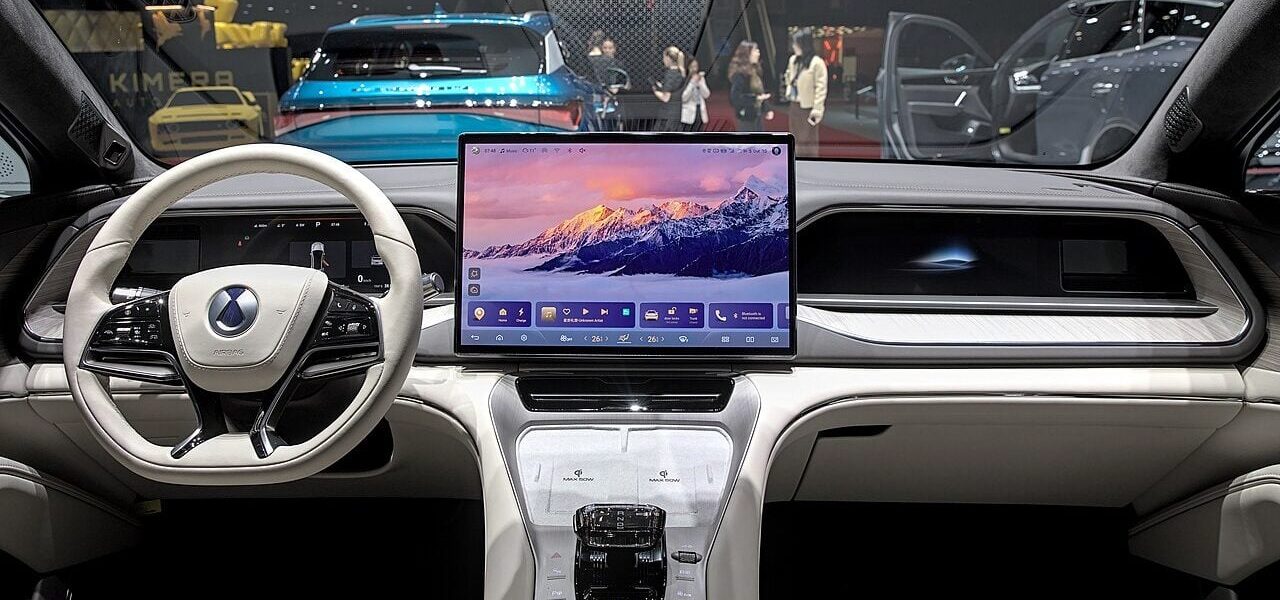
POLICY WIRE — Beijing, China — A curious quiet has settled over China’s automotive showrooms. It isn’t the hush of slow sales, no, far from it. It’s the hum of buyers quietly, intently, navigating sleek touchscreens and barking commands at AI assistants rather than kicking tires or debating horsepower figures. We’ve officially entered an era where the car, particularly in this vast, digitally voracious nation, has ceased to be merely a mode of transport. It’s now a rolling gadget, a connected living room, and a data-hoovering entertainment hub—all packed into four wheels.
It’s a peculiar twist, this market pivot. For decades, the engine’s growl or the sheet metal’s curve dictated desirability. But China, always keen to blaze its own trail—or at least repurpose existing paths with its characteristic vigor—has decided the ‘smart cockpit’ is where the action’s at. And foreign automakers, those venerable German and Japanese giants, they’re scrambling to keep up with the homegrown players who’ve mastered the digital zeitgeist. Their heritage of precision engineering often seems beside the point when the local competitor offers voice control for literally everything and a karaoke app pre-installed.
“We’ve seen a generational shift,” noted Lin Wei, a senior analyst with China Auto Insights, during a recent industry forum. “Younger buyers don’t care if a car has 300 or 400 horsepower. They care if it has the latest Baidu-powered assistant, a 5G connection that doesn’t drop, and a screen that’s bigger than their home TV. It’s about digital immersion now.” He’s not wrong. They’re not just buying a car; they’re acquiring a lifestyle appliance that just happens to move.
This isn’t a subtle preference either; it’s a tidal wave. According to the EY Mobility Consumer Index 2023, a staggering 91% of Chinese respondents planning to buy a car in the next two years are specifically looking for increased software features. Nine out of ten. That’s a statistic that should make every automotive CEO outside China sit up a bit straighter. Because this isn’t just about bells — and whistles; it’s about a complete redefinition of value.
The implications are substantial. For one, it means Chinese car manufacturers, often dismissed by Western critics for derivative designs or lesser build quality, suddenly hold an unexpected advantage. They’ve built their platforms with digital services—the WeChats and Xiaohongs of the world—baked right in, from the start. Western brands, meanwhile, are often trying to retrofit legacy systems, resulting in clunky interfaces and less-than-seamless user experiences. It’s like trying to teach an old dog new app tricks; sometimes it just doesn’t take.
But the ramifications extend beyond mere sales figures. Consider the data. All those in-car commands, all those personalized entertainment choices, all that navigation history—it’s a goldmine of information. For car companies, it’s about user behavior — and targeted advertising. For the state, it presents an unparalleled opportunity for surveillance, or, as Beijing prefers to term it, ‘social management.’ Who’s driving where, what they’re listening to, who they’re calling—it’s all logged, potentially. And because it’s a domestic product, consumers here seem less bothered by it, which is telling, don’t you think?
The push for this digital primacy comes straight from the top, implicitly — and explicitly. China’s vision for ‘smart cities’ and an ‘internet of everything’ doesn’t just stop at homes and factories; it extends to the very vehicles on its roads. It’s part of a grander strategy, making domestic tech ubiquitous, undeniable. That, my friends, is geopolitics disguised as gadgetry.
📄 POLICY WIRE WHITEPAPER PUBLISHED: PAKISTAN'S NATIONAL SECURITY POLICY PRIORITIES
👉 READ BY CLICKING HERE“Our focus isn’t just on manufacturing quantity anymore; it’s about delivering an intelligent mobility experience that truly reflects the aspirations of the Chinese people,” declared Foreign Ministry spokesperson Wang Wenbin recently. “This includes cutting-edge connectivity — and human-machine interaction.” An astute observation from Wang, really. He’s talking about consumer desire, yes, but he’s also talking about national tech leadership and economic self-sufficiency, a consistent theme in Beijing’s policy declarations.
And where China leads digitally, especially with state backing, the rest of the world often follows, sometimes cautiously. Look to the emerging markets, particularly across South Asia. Pakistan, for instance, a nation with its own rapidly expanding consumer base and a strong appetite for tech—it’s already a significant destination for Chinese automobile exports, including a growing fleet of electric vehicles. As these smart Chinese cars roll onto Pakistani roads, they bring not just new transportation options, but a new digital ecosystem. This isn’t merely about driving; it’s about introducing specific tech standards, data management practices, and perhaps even cultural interfaces into new regions, often outmaneuvering traditional Western manufacturers who simply don’t get the local digital flavor. The flow of technology isn’t always benign; it can carry shadows of a greater influence. Allegations concerning the misuse of data in other emerging economies underscore these concerns. You know, just a thought.
What This Means
This dramatic shift in Chinese auto consumption—from horsepower to touchscreen wizardry—isn’t just a quirky market trend; it’s a political and economic earthquake. For global automakers, it’s an existential challenge. If you can’t deliver the digital experience Chinese buyers crave, you don’t just lose sales in the world’s biggest market; you risk being technologically outflanked elsewhere. The rapid innovation cycle for in-car software is completely different from traditional engine development. This prioritizes software giants and data-savvy companies over mechanical engineers, shifting talent requirements and R&D budgets globally.
Economically, it cements China’s position as a software-defined automotive leader, fueling its domestic tech sector and strengthening its industrial self-reliance—a core strategic goal for Beijing. It positions Chinese manufacturers to dominate future mobility trends, including autonomous driving, which leans heavily on robust software and data infrastructure. Politically, the integration of advanced, government-aligned tech into a ubiquitous consumer product raises further questions about data sovereignty, surveillance capabilities, and the subtle extension of China’s digital influence through its export economy. For developing nations adopting these advanced, affordable Chinese vehicles, the convenience often comes with less understood, long-term implications regarding data security and technological dependence. It’s a brave new world on four wheels, isn’t it?